
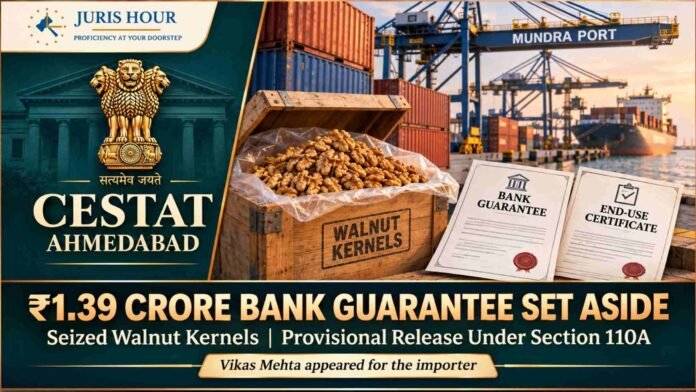
The Ahmedabad bench of the Customs, Excise and Service Tax Appellate Tribunal (CESTAT) has set aside a ₹1.39 crore bank guarantee condition imposed by Mundra Customs for the provisional release of seized walnut kernels and allowed the importer’s appeal subject to submission of an end-use certificate and directed that the guarantee be returned once the applicable conditions were met.
The bench of Somesh Arora (Judicial Member) relied on earlier rulings in which courts and the tribunal examined the material relied on by Customs at the provisional-release stage and removed bank guarantee requirements in the circumstances of those cases. The ruling addresses the terms of release under Section 110A of the Customs Act, 1962. The underlying customs dispute remains for adjudication.
Buy Now: Indirect Tax Judgments E-Compilation – October 2026
The consignment consisted of walnut kernels classifiable under Customs Tariff Heading 0802 32 00. The tribunal’s order records two grounds for the seizure. The transit certificate issued by Afghanistan Customs lacked an endorsement from Iran Customs, and there was a gap between the commercial invoice dated April 15, 2025, and the filing of the bill of entry on February 10, 2026.
The Additional Commissioner imposed security conditions that took into account differential duty of ₹1,16,06,018, along with amounts towards redemption fine and penalties. The Commissioner (Appeals) sent the matter back for reconsideration, after which the bank guarantee was reduced to ₹1,39,27,000. The importer challenged the revised condition, but the Commissioner (Appeals) upheld it on October 26, 2026, prompting the appeal to CESTAT.
The importer argued that Customs must exercise its discretion judiciously when fixing the terms of provisional release. It relied on Section 110A and Customs Circular No. 35/2017-Cus dated August 16, 2017, to argue that the security demanded should reflect the circumstances of the case.
The importer also cited Santa Monica Farm Product Private Limited, in which, according to its submissions, the Bombay High Court permitted provisional release of similar goods without a bank guarantee. It sought comparable relief. The authorised representative for Customs defended the security condition and relied on the order under appeal.
CESTAT relied on its November 4, 2026 decision in Quantum Petrochem India v. Commissioner of Customs, Kandla, which had followed the Gujarat High Court’s ruling in Noya Infrastructure LLP v. Union of India. Those cases concerned distillate oil and the evidence Customs relied on. In Quantum Petrochem, the tribunal removed the bank guarantee requirement and provided for release on a bond and production of end-use documentation.
In the walnut kernels appeal, CESTAT expressly required the importer to produce an end-use certificate and provided for the bank guarantee to be returned. The operative paragraph refers to the conditions reproduced from Quantum Petrochem, which also included furnishing a bond.
Membership Required to Access Case Details & Order Copy
To view the complete Case Details and Download Order Copy, you must have an active membership. Please subscribe to continue.
Read More: DRI | CESTAT Quashes Customs Duty Demand on Past Textile Imports Based on Tests of Later Shipments

