
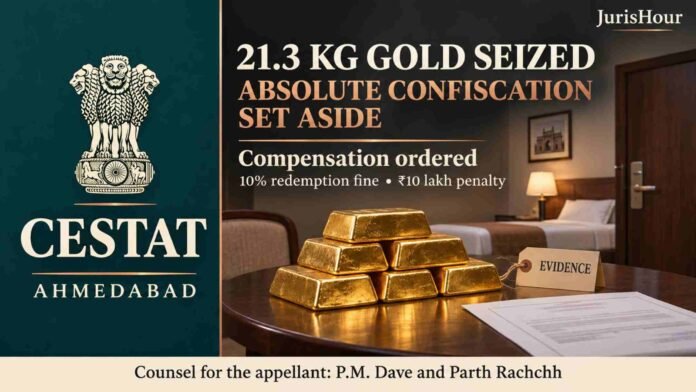
The Customs, Excise and Service Tax Appellate Tribunal (CESTAT), Ahmedabad, has set aside the absolute confiscation of 21.3 kg of gold seized from a hotel room in Chotila, Gujarat and upheld the gold’s liability to confiscation but held that, in the circumstances of this inland seizure, the adjudicating authority should have offered the appellant the option to redeem it.
The bench of Somesh Arora (Judicial Member) fixed the redemption fine at 10% of the gold’s value as worked out with reference to the seizure date, April 19, 2014 and reduced the personal penalty from ₹25 lakh to ₹10 lakh and directed that both amounts be deducted from the compensation payable in lieu of the gold.
Buy Now: Indirect Tax Judgments E-Compilation – October 2026
The bench allowed redemption under Section 125 of the Customs Act. Since Customs had reportedly disposed of the gold, the tribunal directed payment based on its average market price on the date of transfer to SPMCIL, after deducting the redemption fine and reduced penalty.
The Directorate of Revenue Intelligence recovered the gold from the appellant’s room at Hotel Regency in Chotila. The department alleged that the gold had been brought into India in breach of import restrictions and handed over to the appellant inland. In March 2017, the Principal Commissioner of Customs, Kandla, ordered absolute confiscation under Section 111 of the Customs Act, 1962, and imposed a ₹25 lakh penalty under Section 112. The tribunal also referred to a separate seizure of approximately 25 kg from a car, which fell outside this appeal.
The appellant argued that gold imports were restricted and that even irregularly imported gold could be offered for redemption. He disputed direct involvement in bringing it into India and sought monetary relief because the gold had already been disposed of. The department defended the adjudication order.
The bench relied on Commissioner of Customs, New Delhi v. Ashwini Kumar alias Amanullah to explain how Section 125 operates. An adjudicating authority must offer redemption for goods outside the prohibited category and has discretion to do so for prohibited goods. In exercising that discretion, the authority can consider the nature of the goods, the restriction and the potential harm from releasing them.
The tribunal noted that courts have frequently upheld absolute confiscation for gold seized at ports, while decisions involving inland seizures have generally taken a more liberal approach to redemption. It also referred to K.K. Saidalavi, where confiscation of gold recovered from a jeep was upheld with an option to redeem it. The Ahmedabad bench held that the recovery from a hotel room well away from the port warranted a redemption option on the facts of this case.
Customs did not furnish the date of disposal. The tribunal applied CBIC’s September 6, 2022 clarification, which distinguishes gold seized in a customs area from gold seized elsewhere. For an inland seizure, compensation for gold already disposed of is based on the average market price on the date it was transferred to the Security Printing and Minting Corporation of India Ltd. (SPMCIL). For a seizure in a customs area, the instruction uses the tariff value on the date of transfer.
The Joint Pricing Committee was asked to determine the average market price and final compensation within two months. The tribunal treated the market price as inclusive of the duty element and directed that the 10% redemption fine and ₹10 lakh penalty be deducted from the amount payable. The order therefore uses two dates for two calculations. The seizure date governs the redemption fine, while the transfer date governs the gross compensation.
In reducing the penalty, the tribunal noted that the department itself had not treated the appellant as the principal smuggler. It also took into account the time taken in adjudication, the rise in gold prices and the fact that the physical gold was unavailable. The appeal was partly allowed, and the request for 6% interest was not granted.
Membership Required to Access Case Details & Order Copy
To view the complete Case Details and Download Order Copy, you must have an active membership. Please subscribe to continue.
Read More: Widow’s Demat Account Frozen Without Notice: Bombay High Court Stays Coercive GST Recovery

