
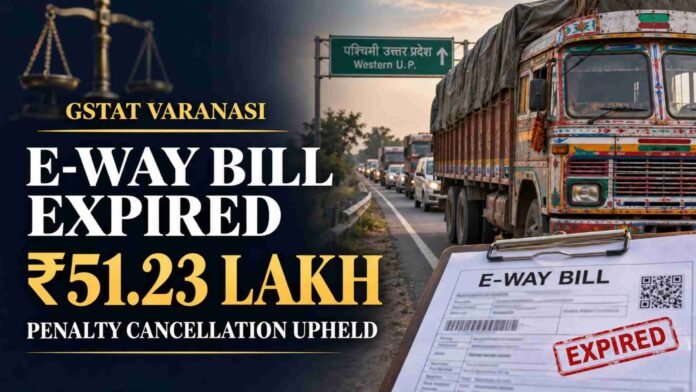
The Goods and Services Tax Appellate Tribunal (GSTAT), Varanasi Bench, upheld the cancellation of a ₹51,23,201 penalty imposed under Section 129(3) of the CGST and UPGST Acts after a truck was intercepted 13 hours and 25 minutes after its e-way bills expired. The Tribunal found the transit delay reasonably explained and said the record showed no attempt or intention to evade tax.
The Bench of Narendra Bahadur Yadav (Judicial Member) and Ananjai Kumar Rai (Technical Member) also set aside a separate ₹20,000 penalty imposed by the First Appellate Authority. The Bench held that the transporter should have been given an opportunity to show cause against the proposed levy under Section 107(11).
Buy Now: All 200+ GSTAT Judgements Till November 2026 | Comprehensive E-Magazine
The Bench accepted the transporter’s explanation for a delay linked to a vehicle breakdown amid election rallies. It also quashed a separate ₹20,000 penalty imposed without giving the transporter an opportunity to respond.
A State Tax mobile squad intercepted the truck in Uttar Pradesh’s Siddhartha Nagar district at 1:25 p.m. on April 15, 2024. The e-way bills, generated on April 8, were valid through April 14. The driver could not produce an extension during the inspection. The officers seized the vehicle and goods and issued a show-cause notice alleging a breach of Rule 138 of the GST Rules.
The transporter said the goods had originally moved with valid e-way bills and e-invoices. It attributed the delay to a vehicle breakdown amid road blockages in western Uttar Pradesh during campaigning for the Lok Sabha elections. It also said it had missed the deadline to extend the bills because the driver did not inform it in time.
The adjudicating authority rejected the explanation and imposed the ₹51,23,201 penalty. The First Appellate Authority cancelled that levy but imposed ₹20,000 under Section 122(1)(xiv) of the CGST and UPGST Acts, read with Section 20 of the IGST Act. The State appealed against the cancellation of the larger penalty, while the transporter challenged the ₹20,000 levy.
The State argued that the transporter had failed to extend the e-way bills within eight hours of expiry and that the breach of Rule 138 attracted a penalty under Section 129. It contended that the absence of intent to evade tax did not excuse the failure to extend the bills.
The Tribunal noted that election campaigning in western Uttar Pradesh at the relevant time was undisputed. It considered the explanation for the breakdown and resulting delay reasonable in the circumstances and found no evidence that the transporter or the trader had attempted to evade tax.
The Bench relied on the Supreme Court’s order in Assistant Commissioner (ST) v. Satyam Shivam Papers Pvt. Ltd., where the Court declined to interfere with a Telangana High Court ruling involving a delay beyond the taxpayer’s control. It also referred to the Allahabad High Court’s ruling in Falguni Steels v. State of Uttar Pradesh on penalties for procedural lapses. On the facts before it, GSTAT held that the expiry of the e-way bills alone did not justify inferring tax evasion or restoring the Section 129 penalty.
The Tribunal examined the ₹20,000 levy under the first proviso to Section 107(11), which requires a reasonable opportunity to show cause before an appellate authority enhances a penalty. The Bench found that the First Appellate Authority had imposed the separate levy without giving the transporter an opportunity to respond.
GSTAT allowed the transporter’s appeal, dismissed the State’s appeal and directed each party to bear its own costs.
Membership Required to Access Case Details & Order Copy
To view the complete Case Details and Download Order Copy, you must have an active membership. Please subscribe to continue.
Read More: Supreme Court Upholds Mesne Profits Based on Tenant’s Evidence of Local Rents

