
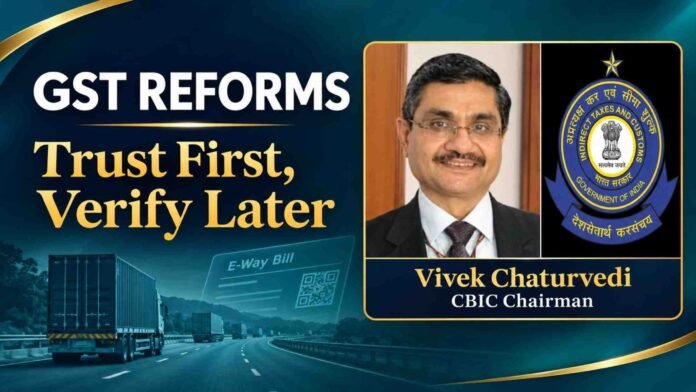
CBIC Chairman Vivek Chaturvedi said the October GST Council reforms aim to automate registration, simplify compliance and speed up refunds. PHDCCI separately sought wider input tax credit on infrastructure and relief from the 180-day supplier payment condition.
India’s GST administration is moving towards a “trust first, verify later” approach that would ease routine compliance and focus enforcement on specific risks, Central Board of Indirect Taxes and Customs (CBIC) Chairman Vivek Chaturvedi said on Wednesday.
Speaking at an event organised by the PHD Chamber of Commerce and Industry (PHDCCI), Chaturvedi said the recommendations made at the GST Council’s October 8 meeting marked a shift towards trust-based governance. He identified automated registration, simpler compliance procedures and faster refunds as priorities and said GST reform would remain an ongoing agenda.
Buy Now: Complete Tax & Supreme Court Judgments E-Magazine Combo – October 2026
GST transit checks to focus on specific intelligence
Chaturvedi said changes to e-way bill enforcement would reduce unnecessary stops for trucks carrying goods between states. Under the revised approach, vehicle interception is to be based on specific intelligence and authorised by a proper officer of at least Joint Commissioner rank. The officer must record in writing the reasons for believing the goods are being transported in violation of GST law.
The GST Council’s FAQ says officers in the jurisdiction where the supplier or recipient is located would generally exercise inspection, detention and seizure powers under the proposed framework. The CBIC’s interim instructions provide an exception when both the e-way bill and documents establishing the origin or destination are unavailable.
Chaturvedi said fewer stoppages could help India’s industrial hubs and manufacturing corridors move goods more efficiently. He cited textiles, steel and processed agricultural products as examples of consignments that could face fewer interruptions.
PHDCCI seeks wider input tax credit for factories and infrastructure
PHDCCI President Anil Gupta said the next phase of GST reform should make the tax more predictable, lower compliance costs and improve tax neutrality. The chamber’s recommendations covered MSMEs and sectors including agriculture, food processing, hospitality, aviation, infrastructure, energy and exports.
The chamber called for a review of Section 17(5) of the CGST Act, which lists categories of blocked input tax credit (ITC). It proposed allowing eligible credit on civil infrastructure and capital expenditure used to provide taxable business services, citing factories, warehouses, cold chains, hotels, airport terminals and runways. PHDCCI argued that blocked credits can leave businesses absorbing GST on investments used in taxable operations, increasing costs and tying up working capital.
Industry body proposes easing the 180-day payment condition
PHDCCI also proposed revising the supplier payment condition under Section 16(2) of the CGST Act. For supplies covered by the condition, a business that claims ITC must pay the supplier both the value of the supply and the GST charged within 180 days of the invoice date. A payment shortfall can trigger a credit adjustment and applicable interest under the prescribed rules.
The chamber proposed linking ITC reversal to whether the GST component of the invoice remains unpaid. Under its proposal, a business that paid the GST portion within 180 days could retain eligible credit even if part of the underlying invoice value remained outstanding. The payment change and the expansion of infrastructure credit were both recommendations put forward by PHDCCI.
Read More: Paytm, Pine Labs Shares Fall as UPI Merchant Fee Rollout Faces Further Delay

