
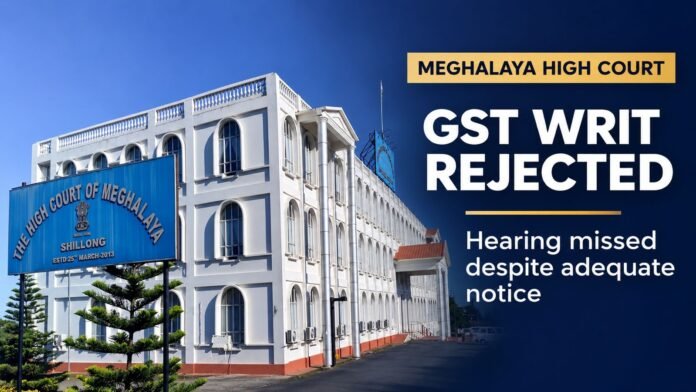
The Meghalaya High Court has declined to entertain a writ petition challenging a ₹19,90,088 GST demand after finding that the taxpayer had adequate notice of the proceedings, missed the scheduled hearing and let the statutory appeal period expire.
The bench of Justice H.S. Thangkhiew and Justice B. Bhattacharjee found substantial compliance with the prescribed procedure and rejected the grounds of lack of jurisdiction and denial of natural justice. The Bench expressly said that the four-week permission was granted in the circumstances of this case and would carry no precedential effect.
Buy Now: 210+ GST Judgments E-Magazine – October 2026
The appellant/assessee is a Shillong partnership firm trading in motor parts and related items, received a return scrutiny intimation in Form GST ASMT-10 on August 21, 2024. It filed a reply on September 21, 2024. The Superintendent of Taxes then issued Form GST DRC-01 on November 28, 2024, in proceedings concerning FY 2020–21.
The department fixed December 13, 2024 for the personal hearing and December 28, 2024 as the deadline for submitting a written reply. On February 27, 2025, the Superintendent passed an assessment order under Section 73 confirming the ₹19,90,088 demand, with the judgment also recording interest and penalty. The department issued a summary in Form GST DRC-07. Recovery notices followed on March 5 and March 31, 2026.
The firm argued that it received only the electronic summary in Form GST DRC-01 and an attachment containing figures. It said the attachment lacked the factual grounds necessary for a substantive show-cause notice under Section 73(1). Under Rule 142(1)(a), the electronic summary in DRC-01 accompanies the statutory notice.
The firm also argued that scheduling the hearing 15 days before the written reply deadline denied it a reasonable opportunity to present its case. It questioned whether the DRC-01 summary and assessment order had been authenticated as required under Rule 26(3). Relying on the exceptions to the alternative-remedy rule, it argued that the High Court could intervene under Article 226 because the alleged defects went to jurisdiction and natural justice.
The State maintained that a signed show-cause notice accompanied the DRC-01 summary. It said the attachment identified the taxpayer, the period, the head of demand and the amounts under IGST, CGST and SGST. The State also said those figures matched an item in the earlier scrutiny intimation, to which the firm had already responded.
The State submitted that the firm neither attended the hearing nor sought an adjournment or filed a reply in Form GST DRC-06 by the deadline. It also disputed the signature objection and argued that the firm had allowed the Section 107 appeal period to lapse before filing its writ petition on April 27, 2026.
The Bench took up maintainability first. On the record before it, the court found that the firm knew of the Section 73(1) notice and the hearing date. The firm had replied at the earlier scrutiny stage, but the court found that it filed no reply to the show-cause notice. The firm did not attend the hearing and did not file an appeal even after receiving the recovery notices.
The court concluded that the department had substantially complied with the procedure and had acted within its jurisdiction. Given the adequate notice and the firm’s failure to participate, the Bench found no breach of natural justice. It also cited the long, unexplained delay in approaching the High Court after the statutory appeal period had expired.
The Bench nevertheless gave the taxpayer four weeks from its November 17, 2026 judgment to appeal the assessment order and two subsequent recovery notices under Section 107 of the Meghalaya Goods and Services Tax (MGST) Act, 2017.
Membership Required to Access Case Details & Order Copy
To view the complete Case Details and Download Order Copy, you must have an active membership. Please subscribe to continue.
Read More: Delhi High Court Leaves Disputed GST Hearing Notices to Appellate Authority

