
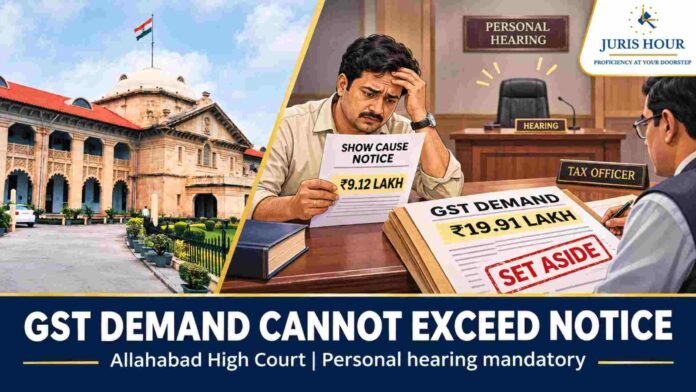
The Allahabad High Court has set aside GST adjudication orders and the corresponding appellate orders after finding that the taxpayer was denied a personal hearing and, in one of the proceedings, the GST demand confirmed exceeded the amount proposed in the show cause notice.
The bench of Justice Vikas Budhwar held that the absence of a specified date, time and venue for a personal hearing violated the principles of natural justice and found that enhancing the demand beyond the notice contravened Section 75(7) of the GST legislation.
Buy Now: All 200+ GSTAT Judgements Till November 2026 | Comprehensive E-Magazine
Although the company’s statutory appeals had been rejected as time-barred, the High Court intervened because of defects in the decision-making process.
The petitioner/assessee is a private limited company engaged in manufacturing and trading sweet supari sold under the brand name “Lovely”. It challenged orders passed under Section 74 of the U.P. GST Act, 2017, and the subsequent rejection of its appeals on limitation grounds.
In the leading petition, concerning April 2021 to March 2022, a show cause notice dated October 16, 2023, was issued in Form GST DRC-01 under Rules 100(2) and 142(1)(a).
According to the judgment, the notice proposed tax of ₹4,56,472 and an equal penalty of ₹4,56,472, taking the total proposed demand to ₹9,12,944. The deadline for submitting a reply was November 16, 2023.
However, the entries relating to the date, time and venue of the personal hearing were all marked “NA”.
A reminder issued on October 15, 2024, required a reply by October 21, 2024. This communication also showed “NA” against the personal-hearing particulars.
An ex parte adjudication order was subsequently passed on October 23, 2024, under Section 74.
The judgment records that the leading proceeding resulted in tax and penalty under both SGST and CGST, with the aggregate demand stated as ₹19,91,432.08. This was substantially higher than the ₹9,12,944 proposed in the show cause notice.
The company filed an appeal on November 24, 2025. The appellate authority rejected it on July 29, 2026, on the ground of delay under Section 107 of the U.P. GST Act.
The company then approached the High Court challenging both the adjudication order and the appellate order.
The connected petition concerned the tax period April 2022 to March 2023, corresponding to financial year 2022-23.
In that proceeding too, the show cause notice dated October 16, 2023, prescribed November 16, 2023, as the deadline for a reply but marked the date, time and venue of the personal hearing as “NA”.
The reminder dated October 15, 2024, fixed October 21, 2024, as the reply deadline without specifying any personal-hearing particulars. An adjudication order followed on October 23, 2024.
The appeal against that order was rejected as delayed on July 22, 2026.
The denial of a personal hearing was therefore common to both petitions. The separate objection that the final demand exceeded the notice arose in the leading petition.
The petitioner argued that prescribing a deadline for a written reply did not dispense with the requirement to communicate the date, time and venue of a personal hearing.
Since no hearing had been provided, it contended that the adjudication orders violated the principles of natural justice.
For the leading petition, the company additionally relied on Section 75(7) of the CGST Act, 2017. As discussed in the judgment, that provision prohibits confirmation of tax, interest and penalty beyond the amounts specified in the notice and bars confirmation of a demand on grounds other than those stated in the notice.
The company submitted that increasing the proposed demand of ₹9,12,944 to approximately ₹19.91 lakh breached this statutory restriction.
The State’s counsel maintained that the petitioner was liable to pay the amount lawfully due.
However, the judgment records that the Revenue could not dispute that no personal hearing had been afforded in either proceeding. It also could not dispute that, in the leading petition, the amount in the notice had been increased to the petitioner’s detriment in the final order.
Both sides agreed that the petitions could be decided on the documents already available, without filing affidavits.
The Court distinguished between ordinary challenges to a decision and cases involving irregularities in the process through which the decision was reached.
It observed that courts ordinarily do not interfere in such matters, but intervention becomes warranted when the decision-making process suffers from infirmity or irregularity.
Applying that approach, the Court found a violation of natural justice in both petitions because no date, time or venue had been fixed for a personal hearing.
In the leading petition, it further found that the liability imposed exceeded the show cause notice, which was prohibited by Section 75(7).
On these grounds, the Court held that the impugned orders could not be sustained.
The High Court set aside the October 23, 2024, orders issued in Form GST DRC-07 in both proceedings. It also quashed the appellate orders dated July 29, 2026, and July 22, 2026, which had rejected the respective appeals as delayed.
The Court expressly left it open to the authorities to issue fresh show cause notices and initiate proceedings against the petitioner in accordance with law.
Membership Required to Access Case Details & Order Copy
To view the complete Case Details and Download Order Copy, you must have an active membership. Please subscribe to continue.

