
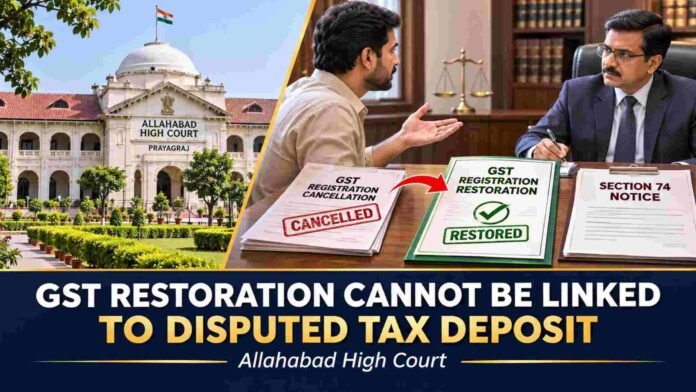
The Allahabad High Court, Lucknow Bench, has quashed the cancellation of a taxpayer’s GST registration and the subsequent rejection of its revocation application, holding that the authority was wrong to insist on deposit of a disputed amount when separate proceedings under Section 74 of the GST Act, 2017 had already been initiated.
The Division Bench of Justice Shekhar B. Saraf and Justice Amitabh Kumar Rai observed that liability had to be imposed through the proceedings initiated under Section 74. The authority’s insistence on payment of the disputed amount as a condition for revocation was therefore incorrect.
Buy Now: All 200+ GSTAT Judgements Till November 2026 | Comprehensive E-Magazine
The taxpayer approached the High Court under Article 226 of the Constitution, challenging two orders concerning its GST registration.
The first order, dated June 10, 2026, was issued in Form GST REG-19 and cancelled the registration with effect from May 20, 2026.
Following the cancellation, the taxpayer applied for revocation. However, the authority rejected that application through an order dated August 14, 2026, issued in Form GST REG-05.
The petitioner sought quashing of both orders and a direction to restore its GST registration, with consequential effect in accordance with law.
The High Court recorded that, after cancellation of the registration, a notice under Section 74 of the GST Act, 2017 had also been issued against the taxpayer. The revocation application was rejected on the ground that the petitioner should deposit the disputed amount to secure revocation.
The central question was whether the authority could insist on payment of the disputed amount for revocation when separate proceedings under Section 74 had already been initiated.
The Bench rejected the authority’s approach. It reasoned that liability had to be imposed upon the taxpayer under the separately initiated Section 74 proceedings.
On that basis, the Court found the insistence on deposit of the disputed amount to obtain revocation incorrect.
The decision distinguishes the registration dispute from the proceedings concerning the disputed liability. The Court did not determine the merits or quantum of the underlying tax demand.
The High Court quashed and set aside both the June 10, 2026 cancellation order and the August 14, 2026 order rejecting the revocation application.
The relief thus extended to the original cancellation itself, as well as the subsequent refusal to revoke it.
However, the Court did not quash the notice issued under Section 74. It expressly directed the taxpayer to comply with that notice in accordance with law.
Membership Required to Access Case Details & Order Copy
To view the complete Case Details and Download Order Copy, you must have an active membership. Please subscribe to continue.

