
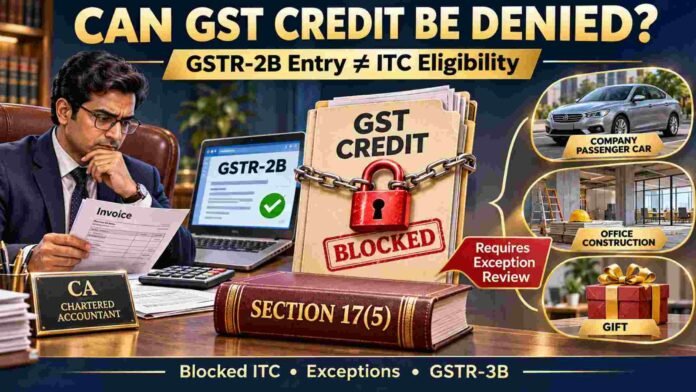
A genuine purchase, a valid tax invoice and use in business do not always entitle a taxpayer to input tax credit under GST. Section 17(5) of the Central Goods and Services Tax Act, 2017 excludes specified expenses from credit, subject to defined exceptions.
For businesses, the challenge is therefore more than matching purchase records with GSTR-2B. Each expense must also pass the statutory eligibility test. Where a restriction applies, the taxpayer must establish that the transaction falls within an exception before taking credit.
These provisions affect everyday spending, including company cars, employee insurance, catering, office construction, corporate social responsibility programmes and promotional goods.
Buy Now: All 200+ GSTAT Judgements Till November 2026 | Comprehensive E-Magazine
Why Business Use Does Not Settle Eligibility
Section 16 lays down the general framework for taking ITC. Section 17(5), however, overrides the general entitlement for the supplies it specifies. An expense can be commercially necessary and still attract a credit restriction.
This distinction also matters when calculating common credit under Rules 42 and 43. Those rules address attribution between eligible and ineligible uses; they do not remove a statutory block. Businesses should identify blocked amounts before putting expenditure into a common-credit calculation.
An accounting description such as “administrative expenses”, “staff welfare” or “project expenditure” cannot determine eligibility. The nature of the actual supply, its use and the relevant statutory clause require separate examination.
Company Cars: Seating Capacity And Actual Use Matter
The motor-vehicle restriction covers vehicles for transporting persons with an approved seating capacity of up to 13 persons, including the driver.
Credit may be available where such vehicles are used for specified taxable activities: further supply of the vehicles, passenger transportation or driving instruction. Purchasing a car for directors, executives or business meetings does not, by itself, satisfy these exceptions.
For example, a vehicle purchased for an ordinary company’s management travel may remain blocked even though every journey serves a business purpose. A driving school using the vehicle to provide taxable driving lessons is differently placed, subject to the remaining ITC conditions.
Vehicles outside the stated category, including goods vehicles and passenger vehicles with an approved capacity exceeding 13, require examination under the other eligibility provisions. Their exclusion from this particular block does not create an unconditional credit entitlement.
Registration certificates, approved seating particulars, deployment records and outward invoices are useful evidence when establishing the applicable treatment.
Insurance And Repairs Need An Asset-Level Review
The Act also restricts general insurance, servicing, repair and maintenance relating to the vehicles, vessels and aircraft covered by the relevant clauses.
Specified relief is available where the underlying asset serves a permitted purpose. The provision also contains exceptions for qualifying manufacturers and general insurers.
Businesses should link the insurance policy or repair invoice to the particular asset. A general statement that an entire fleet is used for business may not establish whether each item satisfies the statutory conditions.
Vessels and aircraft have their own listed exceptions, including specified further supplies, passenger transportation, navigation or flying instruction, and transportation of goods. Their treatment should be determined under those provisions rather than by applying the passenger-car seating test.
Employee Benefits: Identify The Precise Exception
Section 17(5)(b) covers several categories of expenditure, including food and beverages, outdoor catering, specified healthcare and personal-care services, life and health insurance, and leasing, renting or hiring of covered transport assets. It also addresses club and fitness-centre memberships and vacation travel benefits for employees.
The same-category outward-supply exception attached to sub-clause (i) can permit credit where the inward supply supports an outward taxable supply of the same category, or forms an element of a taxable composite or mixed supply. That exception should not be treated as a general exemption for every employee-related expense.
A separate proviso permits credit where an employer is legally required to provide the relevant goods or services to employees. CBIC Circular No. 172/04/2022-GST clarifies that this employer-obligation proviso applies across clause (b).
The employer must establish the actual legal requirement. An internal HR policy or a voluntary employment benefit does not automatically become an obligation under law.
For a canteen or insurance arrangement, the supporting file should identify the applicable legislation, the establishment and employees covered, relevant thresholds, and the nature of the mandated benefit. Optional additions beyond the legal requirement need separate consideration.
Construction: Distinguish The Contractor From The Property Owner
Construction-related credit requires careful examination of both the contractual arrangement and the resulting asset.
Section 17(5)(c) restricts works-contract services used for constructing immovable property, other than qualifying plant and machinery. An exception applies where the service is an input for further supply of works-contract service.
A main contractor receiving subcontracted works-contract services may therefore have an available exception. A business commissioning construction of its own office cannot claim that exception merely because it operates in a construction-related industry.
Section 17(5)(d) separately addresses goods or services used for constructing immovable property on the taxpayer’s own account. Business use of the finished property does not, by itself, overcome this restriction.
The contract, scope of work, ownership arrangement, asset classification and downstream supply must be read together.
The Retrospective Change To “Plant And Machinery”
The Finance Act, 2025 substituted “plant and machinery” for “plant or machinery” in Section 17(5)(d), with deemed effect from July 1, 2017. An accompanying clarification directs that the earlier expression be read in the same manner despite contrary judicial decisions.
This amendment makes it necessary to reassess positions that relied on the distinction between the two expressions.
The statutory definition covers qualifying apparatus, equipment and machinery fixed to earth through foundations or structural supports and used for outward supplies. It includes those foundations and supports, but excludes land, buildings and other civil structures, telecommunication towers, and pipelines outside factory premises.
Consequently, calling an entire building “plant” in an accounting record does not establish eligibility under this definition. Project expenditure should be separated into identifiable components, supported by contracts, technical records and invoice details.
Renovation And Repairs: Capitalisation Is Relevant
For clauses (c) and (d), the extended meaning of construction includes reconstruction, renovation, additions, alterations and repairs to the extent of capitalisation to the immovable property.
A capitalised renovation may therefore attract a restriction even where it concerns an existing office or factory building. Conversely, genuine revenue repairs require examination on their own facts.
The accounting entry must reflect the transaction’s substance. Booking capital expenditure as repairs does not create an entitlement that the law otherwise denies. Asset registers, capitalisation workings and itemised contractor bills help explain the treatment adopted.
CSR Spending, Gifts And Inventory Losses
Clause (fa), effective from October 1, 2023, blocks credit on goods or services used or intended for activities relating to CSR obligations under Section 135 of the Companies Act, 2013.
The relevant question is whether the expenditure relates to that statutory obligation. Voluntary community spending should be examined separately under the applicable provisions rather than automatically treated as eligible or blocked.
Section 17(5) also excludes personal consumption and goods lost, stolen, destroyed, written off, or disposed of as gifts or free samples.
Businesses should maintain event-specific records for inventory adjustments. Stock-loss reports, insurance documents, disposal approvals and promotional schemes help establish what occurred and the corresponding credit treatment.
A commercial promotion is not resolved simply by describing an item as “free”. Its contractual terms and supply structure must be examined before deciding whether the gift or free-sample restriction applies.
Other Restrictions Should Not Be Overlooked
The provision also covers supplies on which composition tax has been paid under Section 10 and supplies received by a non-resident taxable person, except goods imported by that person.
Specified demand-related tax payments are separately addressed in clause (i). Historical transactions require the wording applicable to the relevant period; older summaries of that clause should not be applied mechanically.
Where Blocked Credit Goes In GSTR-3B
CBIC Circular No. 170/02/2022-GST places Section 17(5) blocked credit in Table 4(B)(1) of GSTR-3B, which addresses permanent reversals.
Table 4(B)(2) serves a different purpose: reversals that may be reclaimed after the relevant conditions are met. Table 4(D)(1) reports specified reclaims, while Table 4(D)(2) covers specified ineligible amounts, including time-barred credit under Section 16(4) and certain place-of-supply restrictions.
A permanently blocked expense should not be treated as temporarily reversible merely to preserve a future reclaim. Nor does correct return disclosure cure substantive ineligibility.
Monthly workings should reconcile the purchase register, GSTR-2B, credit claimed, permanent reversals, temporary reversals and reclaims. Any correction of an earlier claim should remain traceable to the original transaction.
Documentation Must Explain Why Credit Is Available
A defensible ITC file should connect the invoice to the relevant asset, employee benefit, construction component or outward supply. Where an exception is claimed, the records should show precisely how its conditions are satisfied.
This requires coordination between accounts, tax, procurement, HR and project teams. Information needed to decide credit eligibility often sits outside the finance department.
Businesses should also distinguish an invoice that is legally ineligible from one for which an eligibility condition remains temporarily unmet. If credit was wrongly taken, the timing of correction and whether it was utilised require separate examination when assessing interest and other consequences.
For taxpayers, effective compliance begins with deciding whether the law permits the credit. Portal matching, accounting entries and return reporting must follow that legal assessment.
Read More: 90+ Supreme Court Judgments E-Magazine – October 2026

