
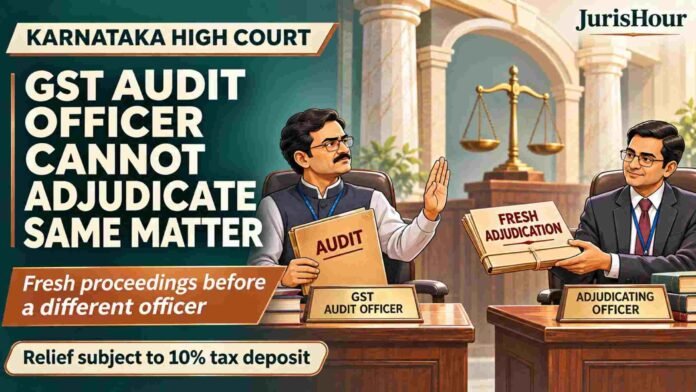
The Karnataka High Court has directed fresh consideration of a GST dispute involving a demand of ₹38.63 lakh after noting that the same officer had conducted the audit and passed the adjudication order. The Court directed reassignment to another proper officer, subject to the taxpayer depositing 10% of the tax amount demanded.
The bench of Justice T.M. Nadaf allowed the writ petition, following earlier coordinate-bench rulings, the Court held that the matter warranted reconsideration by an officer other than the one who had passed the impugned adjudication order.
Buy Now: Direct tax (Income Tax) Judgments E-Magazine October 2026
The petitioner/assessee, a proprietorship concern supplying tipper lorries and related automobiles to mining and quarry businesses, challenged GST proceedings concerning the financial year 2017–18.
The taxpayer’s case was selected for audit through an authorisation dated September 16, 2022. The Commercial Tax Officer (Audit-1), Hosapete, subsequently issued Form GST ADT-01 on September 19, 2022, seeking records.
The petitioner furnished documents on March 29, 2023, and actively participated in the audit. These documents included audited financial statements, inward supply registers, income-tax returns, GSTR-9, GSTR-9C and other relevant records.
An audit observation issued on June 6, 2023, alleged, among other things, that credit of ₹17,60,334 had been wrongly availed. The officer subsequently issued an audit report in Form GST ADT-02 on September 11, 2023, followed by a DRC-01A intimation dated September 15, 2023, under Section 73(5).
The petitioner submitted objections on September 26, 2023, and paid certain tax components, describing the payments as a bona fide gesture.
It alleged that the officer failed to properly consider its objections and proceeded to issue a show-cause notice in Form GST DRC-01 on September 30, 2023, demanding ₹36,08,684.
The notice required payment within 30 days and referred to the levy of penalty under Section 73 if the demand remained unpaid.
The taxpayer submitted a reply on October 18, 2023, reiterating its claim concerning TRAN-1 credit. The judgment also records its grievance that a reply submitted on December 30, 2023, was not considered before the adjudication order was passed the next day.
The order-in-original dated December 31, 2023, raised a total demand of ₹38,63,934, including interest and penalty.
The petitioner challenged the adjudication order through a manually filed appeal before the appellate authority.
It contended that, under a circular dated November 10, 2020, it was not required to make the statutory 10% pre-deposit. However, the appellate authority dismissed the appeal on December 8, 2025, for non-payment of the deposit.
The taxpayer then approached the High Court, challenging the adjudication and appellate orders along with the associated audit and demand proceedings.
Its prayers also included challenges to the Central and Karnataka notifications extending the time limit for proceedings. The Court’s decision, however, focused on fresh consideration by a different officer.
Appearing for the petitioner, advocate Y. Pranay Sharma argued that the authorities had not properly considered the taxpayer’s replies. He further submitted that the officer who conducted the audit could not also adjudicate the resulting dispute.
He relied on the High Court’s decision in W.P. No. 104956 of 2026, disposed of on October 9, 2026, which had followed another coordinate-bench ruling in W.P. No. 103328 of 2026, decided on April 23, 2026.
In the earlier ruling, the Court had disapproved of the same officer initiating the audit, completing the audit report, issuing notice, conducting adjudication and passing the final order.
That matter had been remanded for fresh consideration from the reply stage of the tax-ascertainment intimation under Section 73(5), with directions to assign it to another proper officer.
The petitioner sought similar relief.
The respondents defended the impugned order, submitting that the officer had considered the material placed on record.
They also argued that the taxpayer had not previously objected to the same authority issuing the audit notice, recording observations, preparing the audit report, issuing the show-cause notice and passing the adjudication order.
According to the respondents, this objection was raised for the first time in the writ petition.
The petitioner’s counsel responded that the objection involved a point of law and could therefore be urged before the High Court even if it had not been raised before the appellate authority.
The Court noted that, unlike the taxpayer in one of the cited cases who had proceeded against ex parte, the present petitioner claimed to have actively participated and submitted replies.
Nevertheless, the material issue remained that the audit officer and adjudicating officer were the same person.
Referring to the coordinate-bench ruling directing reassignment in comparable circumstances, Justice Nadaf concluded that the petitioner was entitled to the same relief.
The Court allowed the writ petition and remanded the matter for fresh consideration. It directed the Joint Commissioner of Commercial Taxes to assign the proceedings to another person or proper officer, excluding the officer who had passed the order-in-original.
The High Court left all the petitioner’s contentions open, subject to depositing 10% of the tax amount demanded before the officer to whom the proceedings would be assigned.
Membership Required to Access Case Details & Order Copy
To view the complete Case Details and Download Order Copy, you must have an active membership. Please subscribe to continue.

