
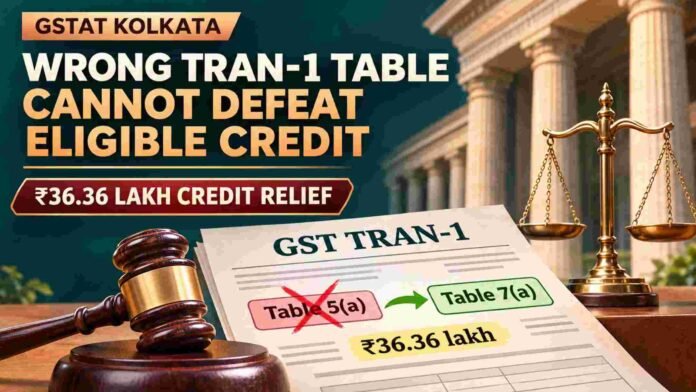
The Goods and Services Tax Appellate Tribunal (GSTAT), Kolkata Bench, has dismissed a department’s appeal challenging relief granted to a dealer concerning ₹36,35,704 in transitional credit entered in the wrong table of Form GST TRAN-1.
The bench of Satya Gopal Chattopadhyay (Judicial Member) and Anindya Mitra (Technical Member) has observed that an inadvertent error in selecting the relevant table cannot impair a taxpayer’s substantive entitlement where the taxpayer is otherwise eligible.
Buy Now: 210+ GST Judgments E-Magazine – October 2026
The bench rejected the department’s attempt to question compliance with Section 140(3) at the appellate stage when neither the show cause notice nor the adjudication order had made such non-compliance a ground for denying credit.
The dispute arose from a TRAN-1 declaration filed by Stores and Spares Co. on July 10, 2017. The taxpayer, registered as a dealer under the erstwhile Central Excise framework, transitioned CGST credit of ₹36,35,704 through Table 5(a).
The department maintained that Table 5(a) covered the carry-forward of CENVAT credit under provisions including Section 140(1). A dealer claiming transitional credit on eligible stock under Section 140(3), however, was required to use Table 7(a).
A show cause-cum-demand notice dated August 9, 2023 proposed recovery under Section 73(1), read with Rule 121 of the CGST Rules. The notice also recorded that the taxpayer had not responded to earlier departmental communications dated April 9 and July 1, 2021 seeking supporting documents.
In its reply, the taxpayer acknowledged that it had entered the credit in Table 5(a) instead of Table 7(a), attributing the mistake to inadvertence. It maintained that the underlying credit was eligible under Section 140(3).
The taxpayer stated that it possessed invoices evidencing payment of excise duty and that the relevant purchases fell within the prescribed twelve-month period preceding the introduction of GST.
It submitted sample invoices and an invoice-wise and quantity-wise register, while offering to produce the original invoices at the hearing. The tribunal noted that the adjudication order itself recorded the submission of sample invoices and production of hard copies of the related invoices.
By an order dated November 10, 2023, the adjudicating authority held the credit recoverable under Section 73(9).
The authority relied on the taxpayer’s admission that it had used the wrong table and its failure to revise TRAN-1 during the opportunity provided following the Supreme Court’s orders in Union of India v. Filco Trade Centre Pvt. Ltd. and CBIC Circular No. 180/12/2022-GST dated September 9, 2022.
It also took the view that judgments cited by the taxpayer, having preceded the circular, were no longer applicable in the changed circumstances.
The first appellate authority reversed the decision on December 31, 2024. It found that the notice and adjudication order did not dispute the legitimacy of the credit under Section 140(3), allege excess transitional credit, or allege availment under another tax head.
It consequently treated the wrong-table entry as a procedural mistake that could not defeat substantive rights.
Before GSTAT, the Revenue argued that the first appellate authority had allowed credit without independently verifying fulfilment of the statutory conditions under Section 140(3).
It contended that Section 107(11) required further inquiry and that the failure to scrutinise the taxpayer’s entitlement rendered the appellate order non-speaking and legally deficient.
The department also relied on the taxpayer’s failure to correct its declaration despite being informed of the error and having an opportunity to revise TRAN-1.
The tribunal examined decisions including Blue Bird Pure Pvt. Ltd. v. Union of India, R.R. Distributors Pvt. Ltd. v. Commissioner of Central Tax, GST, Delhi North, and Calcutta Radio Service Private Limited (Caltron) v. Union of India.
It noted that the High Courts had treated genuine mistakes in selecting the relevant TRAN-1 table as inadvertent errors or procedural lapses, while preserving the authorities’ ability to examine whether the underlying credit was admissible.
The tribunal explained that these decisions did more than permit correction of a form. They recognised the principle that procedural lapses or technical errors cannot impair substantive rights where the claimant is otherwise eligible.
It therefore expressed surprise at the adjudicating authority’s view that the September 2022 circular made earlier judgments inapplicable. The tribunal did not accept that reasoning as an answer to the legal principle those judgments established.
Addressing the Revenue’s challenge to eligibility, GSTAT found that both the show cause notice and the adjudication order were silent on any alleged failure to satisfy the conditions of Section 140(3). The denial rested solely on the use of the wrong TRAN-1 table.
The tribunal observed that the department knew about the table error at least from April 2021. Although Rule 121 empowered it to verify transitional credit, it had not undertaken an inquiry into compliance with Section 140(3).
The taxpayer had offered documents and registers supporting its claim, but the adjudicating authority had neither scrutinised them nor called for additional records. Instead, it confined its decision to the wrong-head entry.
The bench held that the officer could not subsequently adopt an inconsistent position on appeal by treating the omitted eligibility objection as a ground for disallowance.
The tribunal relied on the Supreme Court’s decision in Shankara Coop. Housing Society Ltd. v. M. Prabhakar, (2011) 5 SCC 607, concerning a statutory non-compliance ground that was available but had not been raised in earlier proceedings.
Applying the principle analogous to constructive res judicata, GSTAT rejected the Revenue’s attempt to rely on the omitted ground in this appeal.
The finding was tied to the manner in which the department had framed and adjudicated the demand. The tribunal’s reasoning does not generally dispense with the statutory conditions governing transitional credit.
The tribunal also rejected the argument that the first appellate authority was necessarily required to conduct an independent eligibility inquiry.
Section 107(11) permits the appellate authority to pass an appropriate order after making such further inquiry as may be necessary. GSTAT held that this wording confers discretion to conduct an inquiry when the facts demand it, rather than imposing a requirement in every appeal.
Finding no infirmity in the first appellate authority’s reasoning, the tribunal upheld the appellate order and dismissed the Revenue’s appeal. It made no order as to costs.
Membership Required to Access Case Details & Order Copy
To view the complete Case Details and Download Order Copy, you must have an active membership. Please subscribe to continue.
Read More: SEZ Supplies Reported As Exports: GSTAT Orders Fresh Examination Of ₹9.06 Lakh ITC Refund Claim

