
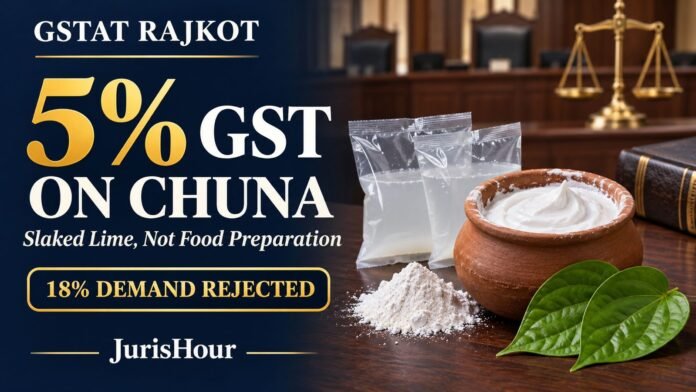
The Goods and Services Tax Appellate Tribunal (GSTAT), State Bench at Rajkot, has held that chuna supplied in slurry and paste forms remains classifiable as slaked lime attracting 5% GST, rejecting the Revenue’s attempt to tax the products at 18% as food preparations.
The Bench of Pramod Kumar Rai (Judicial Member) and Kishori Lal (Technical Member) has observed that physical blending with water, calcium carbonate and, in the slurry, a small quantity of glycerin did not alter the goods’ essential character as slaked lime.
Buy Now: 210+ GST Judgments E-Magazine – October 2026
The bench also ruled that an FSSAI licence and the description of the goods as a food additive did not establish classification as a food preparation under the Customs Tariff.
The dispute concerned chuna sold under the brands “Babu”, “Jay Sardar”, “Raja Baba” and “Deluxe” during financial years 2017-18 to 2023-24. The manufacturer classified both slurry and paste under tariff item 2522 20 00, covering slaked lime, and paid GST at 5%.
The company purchased slaked lime powder of approximately 90% purity. To manufacture the slurry, it mixed the powder with precipitated calcium carbonate and water, filtered the mixture and added a small quantity of glycerin before laboratory checking and packing.
The paste consisted of slaked lime, calcite powder and water, without glycerin. The products were used in small quantities on betel leaf, or paan, and with supari and tobacco.
Following a search on September 14, 2021, the department issued a show cause notice dated August 30, 2023, under Section 74(1) of the CGST Act. It proposed classification under tariff item 2106 90 99 as food preparations not elsewhere specified or included, attracting 18% GST.
The adjudicating authority confirmed the classification, differential tax, interest and an equal penalty. The Commissioner (Appeals) set that order aside on December 26, 2024, leading to the Revenue’s appeals before GSTAT.
The department argued that Note 1 to Chapter 25 excludes products obtained by mixing. Since the manufacturer deliberately combined slaked lime with other ingredients, it contended that the resulting goods could no longer qualify as slaked lime under that chapter.
The department also relied on the company’s FSSAI licence for food additives and the products’ use with paan, supari and tobacco to support classification under Chapter 21.
The manufacturer maintained that the process involved only physical blending, without any chemical reaction or new compound emerging. Water acted as a diluent, calcium carbonate as a filler and glycerin as a soothing agent. Slaked lime remained the active ingredient giving the goods their identity and function.
The Tribunal held that the exclusion in Note 1 had to be read together with its opening exception concerning cases where the context otherwise requires.
Relying on the Supreme Court’s decision in Commissioner of Customs & Central Excise v. 20 Microns Ltd., the Bench explained that the context could arise from the nature of the goods named in a heading, even without express wording permitting a particular process.
Heading 2522 expressly covers quicklime and slaked lime, which necessarily involve calcination and hydration. The Revenue itself accepted their inclusion despite the Chapter Note’s exclusion of calcined products.
The Bench reasoned that slaked lime is produced by bringing quicklime and water together. Treating every instance of mixing as sufficient for exclusion would remove slaked lime from the very heading that names it.
The relevant question was whether the finished goods retained the character of slaked lime or whether the additions produced a different article. On the admitted facts, no new compound or article with a distinct name, character or use emerged.
The Tribunal found that slaked lime supplied the function for which the goods were manufactured, purchased and used. There was no material showing that calcium carbonate or glycerin performed that active function.
The essential character therefore remained that of slaked lime, even though water and filler together exceeded it by weight.
The Bench also rejected the argument that failure to conform to industrial grades of hydrated lime under IS 1540 established a different classification. Such non-conformity did not show that the goods had ceased to be slaked lime under heading 2522.
It distinguished these products from purified calcium hydroxide, which falls under heading 2825 and is expressly excluded from heading 2522.
The Tribunal rejected the Revenue’s reliance on the FSSAI licence, explaining that a licence issued under a regulatory statute serving a different purpose does not determine classification under the Customs Tariff.
It noted that the statutory definition of a food additive refers to a substance not normally consumed as food by itself. For the products under consideration, their regulatory treatment as food additives did not establish that they were food preparations.
The Bench examined Chapter 21’s supplementary notes and the HSN Explanatory Notes. It found that the Revenue had not established the foodstuff component required to support its classification case.
The Tribunal further explained that an ingredient does not automatically take the classification of the preparation in which it is used. Lime’s use in paan or supari preparations did not make lime itself a food preparation under heading 2106.
The Bench emphasised that heading 2106 covers food preparations not elsewhere specified or included. Once the products were covered by the specific slaked lime entry, they could not be shifted to that residuary heading.
It also examined Rule 3(b) of the General Rules of Interpretation because the show cause notice had relied on that provision. The rule classifies mixtures according to the material or component giving them their essential character.
Applied to the products before it, the rule pointed to slaked lime under heading 2522.
Although the manufacturer produced expert reports and the department did not test its own sample, the Tribunal clarified that its conclusion did not rest on laboratory descriptions or quantitative findings. The reports were relevant to confirming physical blending without a chemical reaction; tariff classification remained a legal question determined from the statutory text and admitted facts.
The Tribunal upheld classification under tariff item 2522 20 00, attracting 5% GST under Serial No. 131 of Schedule I to Notification No. 1/2017-Central Tax (Rate), along with the corresponding State and Integrated Tax notifications.
It dismissed all seven Revenue appeals and upheld the Commissioner (Appeals)’ order. Consequently, the differential tax demand, interest and penalty did not survive.
Since classification was decided in the manufacturer’s favour, the Bench did not examine its alternative contention against invocation of the extended period under Section 74.
Membership Required to Access Case Details & Order Copy
To view the complete Case Details and Download Order Copy, you must have an active membership. Please subscribe to continue.
Read More: Invoices, E-Way Bills Alone Can’t Establish Genuine Supplies: MP High Court

