
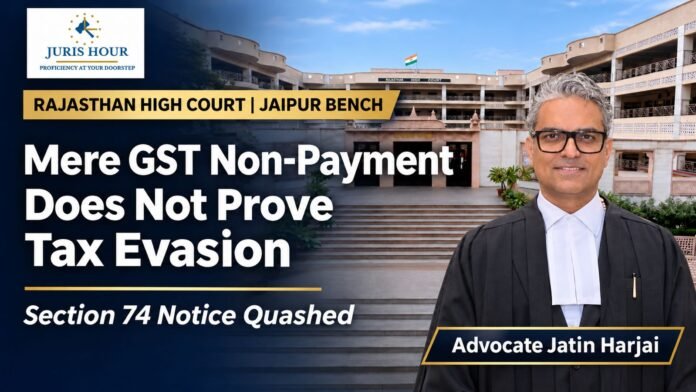
The Rajasthan High Court has held that mere failure to disclose or pay GST does not, by itself, establish an intention to evade tax so as to justify proceedings under Section 74 of the Central Goods and Services Tax Act, 2017.
The bench of Justice Arun Monga and Justice Ashutosh Kumar quashed a show cause notice issued to the Jaipur Development Authority (JDA), finding that it did not disclose the jurisdictional fact of intent to evade tax. The Court also quashed all proceedings taken under the notice.
The petitioner/assessee, JDA is a statutory authority constituted under the Jaipur Development Authority Act, 1982, responsible for planning, coordinating and supervising development in the Jaipur region. Its activities include developing residential and commercial colonies, constructing buildings and undertaking roads and external development works.
Buy Now: 210+ GST Judgments E-Magazine – October 2026
The authority was subjected to an audit under Section 65 of the CGST Act for the financial years 2019–20 to 2023–24. An audit memo dated August 30, 2025 raised 16 observations, to which JDA replied on September 16, 2025. A final audit report followed on September 29, 2025.
The audit led to six notices dated September 29, 2025 concerning separate issues, including return mismatches, sales of flats and tree guards, entry tickets for Smriti Van, interest on delayed returns and bookings of under-construction EWS flats.
The notice challenged in the writ petition was issued on September 30, 2025 under Section 74. The judgment describes it as concerning road-cutting charges, additional floor area ratio (FAR) charges and betterment levy, and receipts from Master Plan booklets and application forms.
The Court emphasised that the receipts had been found in JDA’s own books during audit, rather than uncovered through a search or outside information.
Jatin Harjai, the Counsel on behalf of JDA argued that the notice contained general allegations without identifying any specific fraudulent act, wilful misstatement or suppression intended to evade tax. The additional FAR charges and betterment levy arose from statutory regulatory functions referable to Article 243W of the Constitution, rather than consideration for a supply under Section 7 of the CGST Act.
Road-cutting charges, it submitted, recovered the cost of restoring public roads damaged by utility agencies. Collections for booklets and forms represented nominal printing recoveries incidental to statutory functions.
Mr. Harjai also relied on an advance ruling concerning the Rajasthan Housing Board to argue that its interpretation was reasonably arguable. Other objections concerned the clubbing of five financial years, the involvement of different officers after audit, the absence of a pre-notice intimation in FORM GST DRC-01A and the issuance of the notice summary by a different officer.
The department argued that the proceedings were at a preliminary stage and JDA should submit its reply before the adjudicating authority. It relied on the statutory adjudication and appeal mechanisms to oppose the writ petition.
On the merits, the Department contended that JDA had neither disclosed nor paid the disputed tax and that audit had brought the non-disclosure to light. It alleged wilful misstatement and suppression with intent to evade tax, describing JDA’s reliance on public functions as an attempt to avoid liability.
The Court recognised the general rule that writ courts ordinarily do not interfere with show cause notices. However, that rule is one of judicial restraint and does not prevent intervention where a notice is wholly without jurisdiction.
The Bench explained that Section 74 is a special power dependent on the existence of fraud, wilful misstatement or suppression coupled with intent to evade tax. Those requirements constitute jurisdictional facts.
A challenge to their absence on the face of the notice could therefore be examined without weighing evidence or deciding the underlying taxability dispute.
The Court also noted that a Section 74 notice carries serious consequences, including the longer limitation period and a penalty equal to the tax. Requiring a taxpayer to undergo adjudication would not cure a defect at the threshold of jurisdiction.
The Bench distinguished Section 73, which addresses cases outside fraud or evasion, from Section 74, which applies where the additional statutory conditions exist.
It explained that the words “to evade tax” govern fraud, wilful misstatement and suppression. Identifying one of those forms of conduct does not dispense with establishing its connection to evasion.
Explanation 2 to Section 74, which defines suppression, does not remove that further requirement. Non-declaration may fall within the definition, but Section 74 requires the conduct to be aimed at evading tax.
The Court rejected the inference that non-payment alone proved the necessary intention. Such an approach would leave Section 73 with no meaningful field of operation, because every short payment would become a case of evasion.
The Bench accordingly cautioned against treating Section 74 as the default route.
On the facts, the Court found that the dispute concerned the reach of the tax levy: whether receipts such as betterment levy and additional FAR charges constituted consideration for a supply.
The receipts were recorded in books examined by the Department. JDA’s position rested on constitutional and statutory provisions, and a similar advance ruling supported the existence of an arguable interpretation.
The Bench did not endorse that interpretation on merits. It held that openly advancing a reasonably arguable legal position did not establish evasion.
It also rejected the Department’s description of public functions as a “guise”, observing that JDA did perform statutory public functions. Whether a particular receipt was connected to those functions was a legal question.
The Court considered JDA’s public character and the absence of any identified personal benefit to the officers administering it.
It observed that the disputed tax, if payable, would move from JDA’s public funds to the public exchequer. In the circumstances, attributing an intention to evade required more than the allegation of non-payment contained in the notice.
However, the Bench expressly clarified that a public authority can face proceedings under Section 74. Deliberate falsification or conduct undertaken for a collateral purpose could present a different case.
The ruling therefore turns on the absence of the necessary jurisdictional foundation in this notice.
The Court rejected JDA’s separate contention that a notice could not allege both misstatement and suppression.
It explained that a false declaration may simultaneously misstate a fact and suppress the truth. The use of both expressions does not, by itself, invalidate a notice.
The decisive defect was the failure to disclose intent to evade tax.
Allowing the petition, the High Court quashed the September 30, 2025 notice and all proceedings taken under it. No costs were awarded.
The Court did not determine whether the disputed receipts attract GST, and its operative relief concerns the challenged notice.
Before concluding, the Bench suggested that the parties explore an administrative resolution through the Secretary of the relevant Union Ministry. It referred to the policy underlying a government mechanism for resolving disputes involving public sector enterprises, while acknowledging that the mechanism might not strictly govern this tax dispute.
The Court expressly described this suggestion as an observation, not a direction.
Membership Required to Access Case Details & Order Copy
To view the complete Case Details and Download Order Copy, you must have an active membership. Please subscribe to continue.

