
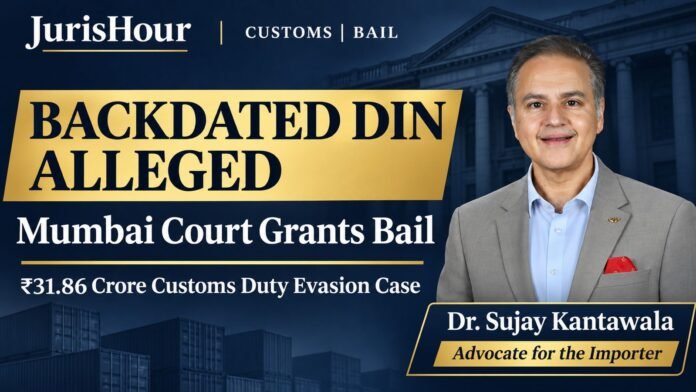
A Mumbai court has granted bail to an importer accused of evading approximately ₹31.86 crore in customs and anti-dumping duties, observing that the alleged undervaluation required verification of the valuation method and that a mere admission under Section 108 of the Customs Act was insufficient.
Additional Chief Judicial Magistrate Anuradha A. Pandule, presiding over the 19th Court at Esplanade, Mumbai, passed the order on November 7, 2026. The court noted that the Directorate of Revenue Intelligence (DRI) had secured the goods, mobile phones and electronic records and had already obtained an opportunity to question the accused in custody.
Buy Now: Indirect Tax Judgments E-Compilation – October 2026
The observations were made while deciding a regular bail application. The order does not finally determine the alleged duty evasion, the applicability of anti-dumping duty or the accused’s criminal liability.
The applicant, Sourabh Jain, is the proprietor of M/s Jimmy International, which imports products including DTF film, paint protection film, PET film, DTF ink, hot-melt glue powder, window film and heat transfer vinyl.
According to DRI, the business declared import values below the actual transaction values and allegedly remitted differential amounts through hawala or angadia channels. The agency alleged customs duty evasion of approximately ₹28.79 crore through undervaluation.
DRI further alleged that thermoplastic polyurethane (TPU) powder or hot-melt glue powder imported from China attracted anti-dumping duty under Notification No. 19/2024-Customs (ADD), dated October 22, 2024. Clearance without payment of the applicable levy allegedly resulted in additional duty evasion of approximately ₹3.07 crore.
The prosecution’s reply recorded that Jain was arrested on October 22, 2026, for alleged offences under Sections 132 and 135(1)(a) and (b) of the Customs Act, 1962.
The bail application described searches at the applicant’s residence and warehouse in Delhi on October 10 and 11, 2026. It stated that officers cloned computer data, backed up email accounts and detained warehouse stock. The applicant’s customs broker’s office was also searched.
The defence argued that the investigating agency already possessed the import documents and electronic evidence, substantially reducing any possibility of interference with those records.
Jain disputed the voluntariness of his statement, asserting that it had been recorded under pressure and subsequently retracted. The defence also alleged prolonged questioning during the search proceedings and challenged aspects of the arrest documentation.
DRI maintained that the applicable procedures had been followed and that the arrest memo contained the grounds of arrest and a Document Identification Number.
Appearing for the applicant, Dr. Sujay Kantawala argued that the goods were neither prohibited nor restricted and that the applicability of anti-dumping duty required adjudication. DIN number is tracked back dated i.e. on 22.10.2026. Why it is not on the same day of 21.10.2026 ? therefore the DIN number is generated back dated. It is further argued that, the applicant/accused is arrested on 22.10.2026. Since then, he is in judicial custody. The applicant/accused is only 27 years old and has a longstanding bright future ahead of him which will be seriously prejudiced in the event of continued incarceration. There is no flight risk. Godown is locked by the officers. There is no recovery or discovery pending. The applicant is permanently resident of Delhi. Now he is closing his importing business of Hot Melt Powder henceforth.
The defence disputed whether the imported goods were TPU powder covered by the notification. It submitted that the applicant had imported more than 286 consignments of glue powder over approximately three years and that the consignments had been cleared after examination and payment of duties.
Counsel further argued that the method used to calculate the alleged undervaluation required scrutiny. The defence relied on the seizure of mobile phones, access to email accounts and forensic examination of devices to contest DRI’s apprehension of evidence tampering.
The applicant also relied on his attendance pursuant to summons, permanent residence in Delhi and the absence of any further recovery requiring continued detention.
Opposing bail, Special Public Prosecutor S. R. Pathak submitted that the applicant knowingly prepared and submitted commercial invoices declaring values lower than those reflected in supplier invoices.
DRI argued that the applicant had admitted creating forged invoices and was a key participant with direct links to Chinese suppliers and domestic associates.
The agency maintained that digital evidence remained under examination and that the applicant needed to be confronted with retrieved material. Statements of several other persons were also yet to be recorded.
Referring to the pending anticipatory bail proceedings of another accused before a court in Ludhiana, the prosecution expressed concern that release could enable interference with evidence. It also stressed the seriousness of economic offences and the preliminary stage of the investigation.
The court noted that the parties disputed the description of the goods, including whether they were hot-melt glue powder or TPU hot-melt glue powder. That issue required examination.
It also recorded that the prosecution relied on statements under Section 108, while the defence challenged those statements as retracted and involuntary. The court left those disputes for consideration at trial and assessed the bail application on the preliminary material available.
Addressing the alleged undervaluation, the magistrate observed, “Mere admission of the accused in his statement under section 108 is not sufficient.”
Read in context, the observation concerned the need to verify the method adopted to arrive at the alleged undervaluation. The court treated valuation, declarations and alleged anti-dumping duty evasion as matters requiring adjudication.
The magistrate also noted that the goods had been cleared on the basis of import documents and that no material had been placed before the court, at that stage, showing a complete prohibition on importing the goods from China.
The court declined to make the applicant’s continued detention dependent on the outcome of another accused’s anticipatory bail application.
It noted that the prosecution had not produced an order rejecting that application. The proceedings placed before the magistrate showed that the matter was awaiting the officers’ reply.
Accepting the defence submission, the court reasoned that waiting for the reply or the eventual anticipatory bail order could result in incarceration for an uncertain period. It also considered the applicant’s young age while assessing the prejudice arising from prolonged detention.
The magistrate recorded that mobile phones had been seized, data had been cloned and email records were under the investigating agency’s control. The court also noted the seizure of goods and locking of the warehouse.
DRI had already received an opportunity to question the applicant in custody, and statements had been recorded.
Considering these circumstances, together with the applicant’s attendance before the agency and his known residential address, the court concluded that sufficient investigative opportunity had already been afforded to the prosecution.
The court allowed the application and directed Jain’s release on a personal recognisance bond of ₹2 lakh with one or two sureties in the same amount. It permitted cash bail of ₹2 lakh until November 17, 2026, if sureties were not immediately available.
Membership Required to Access Case Details & Order Copy
To view the complete Case Details and Download Order Copy, you must have an active membership. Please subscribe to continue.
Read More: Dept. Can’t Challenge Fine Alone While Leaving Related Penalty Findings Uncontested: GSTAT

