
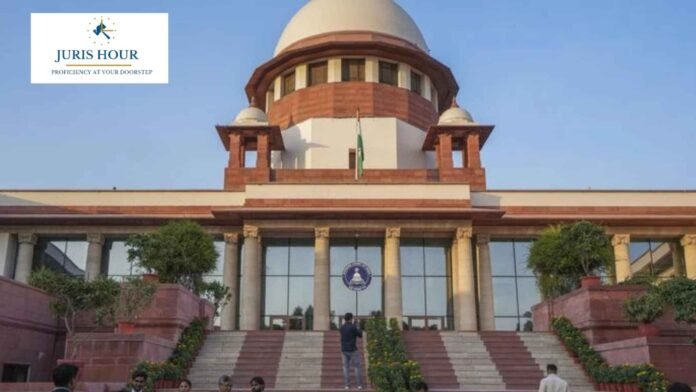
The Supreme Court has expunged adverse remarks made by the Rajasthan High Court against a district judicial officer over overlapping portions in two judgments, holding that the strictures were uncalled for and had been recorded without giving her an opportunity to explain the circumstances.
A Bench of Justice Sandeep Mehta and Justice Devendra Kumar Upadhyaya also set aside the High Court’s directions to send the officer for judgment-writing training and to make its order part of her annual confidential report (ACR).
Buy Now: 90+ Supreme Court Judgments E-Magazine – October 2026
The Court emphasised that High Courts must exercise their supervisory jurisdiction in a manner that guides, strengthens and nurtures the district judiciary. It cautioned that adverse personal remarks can damage an officer’s career and have a chilling effect on the district judiciary as a whole.
The proceedings arose from two trials connected with FIR No. 56/2019, registered at Malsisar police station in Rajasthan’s Jhunjhunu district for offences under Section 376-D of the Indian Penal Code and Sections 3 and 4 of the Protection of Children from Sexual Offences Act, 2012.
One proceeding concerned a child in conflict with law. Following a preliminary assessment under Section 15(1) of the Juvenile Justice (Care and Protection of Children) Act, 2015, the Juvenile Justice Board considered the child fit to be tried as an adult. It accordingly transferred the case to the Special POCSO Court under Section 18(3).
A separate trial was conducted against an adult co-accused. The Supreme Court noted that Section 23 of the Juvenile Justice Act bars joint proceedings against a child in conflict with law and an adult accused, requiring separate trials and distinct judgments.
The judicial officer delivered separate judgments on January 20, 2024, convicting both accused of the charges found proved and sentencing each to 20 years’ rigorous imprisonment.
However, some overlapping extracts of evidence and numerical details from one trial were inadvertently incorporated into the judgment in the other.
The convicted child in conflict with law challenged the conviction before the Rajasthan High Court and sought suspension of sentence.
The High Court rejected the suspension application on May 1, 2025, after discussing the merits. While doing so, the Single Judge criticised the trial judge’s preparation of the judgment.
The High Court inferred that she had used a “cut, copy and paste” method and that the judgment had probably been prepared by a stenographer or clerk and signed without proper reading or correction.
It also questioned her discharge of judicial duties and made observations about her fitness to remain in judicial service.
The High Court directed that its order be sent to the Judge in charge of the Rajasthan Judicial Academy for training the officer in judgment writing. It further directed the Registrar General to make the order part of her ACR for 2024 after obtaining her comments.
The officer approached the Supreme Court seeking expungement of the remarks. Her identity was masked in the judgment.
Before the Supreme Court, the officer explained that the facts of the two cases were closely interwoven and that the witnesses and substantive evidence were almost the same.
She also referred to the limited resources available to Special POCSO Courts and the statutory requirement for expeditious disposal of cases.
According to her explanation, the court’s sole stenographer had gone on leave. She therefore dictated part of the judgment directly to a lower division clerk on a computer, while the major remaining portion was dictated to the stenographer after his return.
She described the mistakes, including incorrect serial numbers of prosecution witnesses, as bona fide typographical errors that did not alter the substance or outcome of the judgment.
The Supreme Court held that the High Court’s disparaging remarks suffered from non-adherence to the principles of natural justice because the officer had not been given an opportunity to show cause or place her explanation on record before they were made.
Even if the High Court believed an error had occurred, the Bench said it should first have allowed the officer to explain the circumstances.
The course adopted was contrary to audi alteram partem, the principle requiring an affected person to be heard before adverse action is taken.
The Court also considered it avoidable to castigate a judicial officer for inadvertent typographical errors that did not affect the outcome of the case. It declined to accept the High Court’s view that the officer had acted in dereliction of duty.
Referring to Kaushal Singh v. State of Rajasthan, the Bench reiterated the distinction between criticism of an erroneous judicial order and adverse comments on the personal conduct or calibre of the officer who passed it.
The Court noted that concerns about a judicial officer’s conduct may appropriately be brought to the Chief Justice’s notice on the administrative side, where the officer would have an opportunity to explain the circumstances.
It also referred to In Re: ‘K’, A Judicial Officer and Sonu Agnihotri v. Chandra Shekhar & Ors. while discussing the principles governing strictures against judicial officers.
Relying further on Shuvendu Saha v. State of West Bengal and Anr., the Bench explained that, where warranted, observations about the merits or quality of a judgment or proceedings may be recorded in a remark slip.
That slip can then be placed before the administrative judge or the Chief Justice for appropriate administrative follow-up. Condemnation on the judicial side without observing natural justice, the Court held, is unsustainable.
The Bench stressed the responsibility of High Courts under Article 227 of the Constitution to exercise superintendence in a manner that supports the district judiciary.
It said the case called for greater magnanimity from the High Court in its role as guardian of judicial officers.
The judgment opened with reflections on human fallibility and forgiveness, drawing on literary and Indian philosophical traditions. These observations framed the Court’s assessment of the response to the officer’s errors.
The Court warned that adverse remarks may destroy a judicial officer’s career and have a chilling effect on the wider district judiciary.
The Supreme Court expunged and set aside the strictures and adverse remarks in paragraphs 9, 10 and 11 of the High Court’s order, together with the training and ACR directions in paragraphs 17 and 18.
Membership Required to Access Case Details & Order Copy
To view the complete Case Details and Download Order Copy, you must have an active membership. Please subscribe to continue.

