
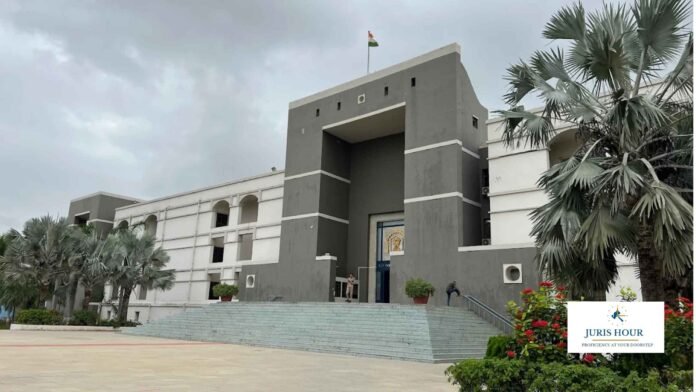
The Gujarat High Court has set aside a GST appellate order after finding that the proceedings sheet did not reflect any personal hearing on the three dates specified in notices issued together on the same day.
The Bench of Justice Sangeeta K. Vishen and Justice Utkarsh Thakorbhai Desai has observed that the order passed by the Deputy Commissioner of State Tax violated the principles of natural justice. The Court allowed the taxpayer’s petition on October 26, 2026, with the appeal to be decided afresh after providing an opportunity of hearing.
Buy Now: 210+ GST Judgments E-Magazine – October 2026
The proceedings also saw the Deputy Commissioner concerned appear personally before the Court and tender an apology. Although an earlier order had warned of exemplary costs if the explanation proved unsatisfactory, the final order imposed no costs.
The taxpayer challenged an appellate order dated May 26, 2026, passed under Section 107 of the Central Goods and Services Tax Act, 2017, read with the Gujarat GST Act and Section 20 of the Integrated GST Act.
The challenge centred on three notices, all dated April 16, 2026, which fixed personal hearings for April 18, April 21 and April 24, 2026.
Appearing for the taxpayer, advocate Hiren Trivedi submitted that the appeal form expressly recorded “YES” against the question asking whether the appellant wished to be heard in person. The taxpayer also stated that a 10% pre-deposit of the disputed tax, amounting to ₹85,55,279, had been made.
However, counsel submitted that neither the taxpayer nor the advocate had actually been heard on any of the three dates.
According to the taxpayer, the preamble to the appellate order stated that hearings had been held on all three dates and that the appellant’s advocate had been heard.
The taxpayer subsequently sought information under the Right to Information Act, 2005. The reply dated July 30, 2026, enclosed a copy of the Rojkam, or proceedings sheet.
Counsel submitted that this record did not show that either the taxpayer or the advocate had been heard. The entry for April 18 referred to consideration of evidence, while an entry dated April 22 recorded a WhatsApp request from the advocate seeking to provide further evidence.
The High Court noted that the taxpayer had not remained present on the specified hearing dates and that a request to produce further evidence had been communicated through WhatsApp. Crucially, the proceedings sheet supplied under the RTI Act did not reflect a hearing on any of the three dates.
The taxpayer relied on Section 107(9), submitting that the appellate authority may grant time and adjourn a hearing where sufficient cause is shown, with reasons recorded in writing. Counsel also referred to the proviso restricting adjournments to three.
It was argued that issuing three notices together, each specifying a separate hearing date, could not by itself constitute compliance with the principles of natural justice.
The taxpayer relied on the Gujarat High Court’s judgment in Regent Overseas Pvt. Ltd. v. Union of India, reported in 2017 (6) G.S.T.L. 15 (Guj.).
In an earlier order dated October 16, 2026, the Court directed the Chief Commissioner of State Tax to explain the functioning of the portal and how it permitted three hearing notices to be generated on the same date.
That order referred to the notices being generated at intervals of almost two minutes, intimating different hearing dates and times.
The Court warned that an unsatisfactory explanation could result in exemplary costs against the erring officer. It also directed the appellate authority to pass a fresh appellate order.
In response, the State submitted a report explaining the GSTN portal workflow through screenshots. The explanation covered selecting and acknowledging an appeal, generating a personal hearing notice, issuing additional notices and granting adjournments.
The State submitted that the portal permitted notices carrying three different hearing dates to be issued together. It denied any mischief or ill intention on the authorities’ part.
However, the Assistant Government Pleader fairly acknowledged that this course ought not to have been adopted and assured the Court that sufficient care would be taken in future.
Chetan Joshi, Deputy Commissioner (Appeal-1), Division-2, Ahmedabad, appeared personally before the Court.
Through the Assistant Government Pleader, regret and remorse were expressed over the notices. The explanation described their issuance as systematic scheduling through the portal and an administrative necessity.
It was maintained that the officer had acted bona fide, without any intention to manipulate the system or conduct the appellate proceedings mala fide. An apology was also tendered.
The High Court found that the proceedings sheet did not reflect that a hearing had taken place on any of the three dates.
On this basis, the Bench held that the appellate order violated the principles of natural justice and deserved to be quashed on that ground alone.
The Court recorded that the taxpayer had subsequently been heard on October 21, 2026, and that another hearing was scheduled for October 27, 2026. It also recorded the State’s statement that a fresh order would be passed after hearing the taxpayer or its representative.
The petition was accordingly allowed, and the appellate order dated May 26, 2026, was quashed. The Court did not decide the underlying tax dispute on merits and made no order as to costs.
Membership Required to Access Case Details & Order Copy
To view the complete Case Details and Download Order Copy, you must have an active membership. Please subscribe to continue.
Read More: GST Portal Glitch Can’t Defeat Transitional Credit: GSTAT

