
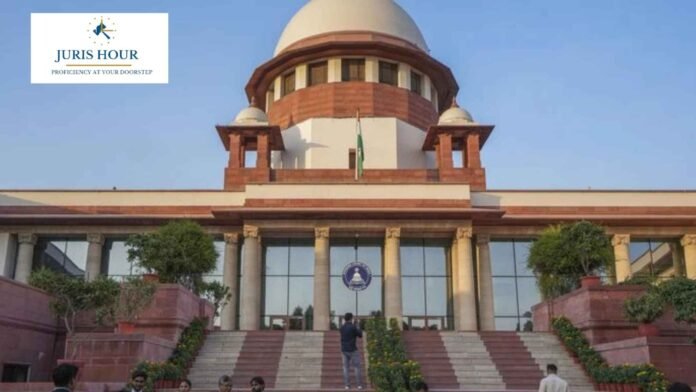
The Supreme Court has held that the moratorium under Section 14 of the Insolvency and Bankruptcy Code, 2016 (IBC) does not necessarily prevent a corporate debtor from pursuing arbitration proceedings to recover its own dues.
A Bench of Justice Ujjal Bhuyan and Justice Atul S. Chandurkar observed that a successful arbitral claim could strengthen the corporate debtor’s financial position and enhance its value, furthering the purpose of the insolvency process. A party which consented to a sole arbitrator and participated in the proceedings cannot belatedly insist on a three-member tribunal prescribed by the agreement.
Buy Now: 80+ Judgements Indirect Tax – September 2026 E-Magazine
The bench upheld the findings on waiver of objections to the sole arbitrator and the corporate debtor’s competence to pursue arbitration. However, it set aside the High Court’s conclusion that its power to appoint an arbitrator under Section 11 of the Arbitration and Conciliation Act, 1996 also enabled it to extend the arbitrator’s mandate under Section 29A.
Despite correcting that jurisdictional finding, the Supreme Court dismissed the appeals, lifted its earlier restriction on pronouncement of the award and directed the arbitrator to conclude the proceedings by passing an award within six weeks.
The petitioner is an electricity distribution licensee in Bihar, initiated a competitive bidding process to select a distribution franchisee. India Power Corporation Ltd. emerged as the successful bidder.
Under the arrangement, the successful bidder was required to establish a special purpose vehicle to implement the franchise. India Power Corporation (Bodhgaya) Ltd. was accordingly incorporated as its wholly owned subsidiary.
The three companies entered into a Distribution Franchisee Agreement on December 31, 2013. The subsidiary was responsible for performing the franchisee’s obligations, while India Power Corporation Ltd. joined as the confirming party.
Disputes subsequently arose over implementation of the agreement. Following an arbitration notice issued in November 2016, the matter reached the Patna High Court for appointment of an arbitrator.
Although the agreement provided for a tribunal comprising three arbitrators, the High Court appointed retired Justice Shashank Kumar Singh as the sole arbitrator on April 4, 2018, with the parties’ consent.
When he could not continue beyond the evidence-recording stage, the High Court appointed former Chief Justice of India Justice Dipak Misra as the substitute sole arbitrator on March 10, 2021, again with the parties’ consent.
When a further extension of the arbitral mandate was sought, the distribution company objected to the proceedings before a sole arbitrator. It relied on the contractual requirement for a three-member tribunal and separately sought the constitution of such a tribunal.
It also challenged the competence of the special purpose vehicle to pursue arbitration in view of insolvency proceedings initiated against it.
The Patna High Court rejected these objections on September 15, 2023, and extended the sole arbitrator’s mandate by four months. The distribution company challenged that decision before the Supreme Court.
The Supreme Court found that the distribution company had repeatedly consented to adjudication by a sole arbitrator and had actively participated in the proceedings.
Both High Court orders appointing the original and substitute arbitrators remained unchallenged. Consequently, those orders had attained finality and were binding on the parties.
The procedural order passed by the substitute arbitrator also recorded that the parties’ counsel and representatives had no objection to the tribunal’s composition or to the arbitrator acting alone.
Additionally, the distribution company had filed a counterclaim and a supplementary counterclaim and had consented to an extension of the arbitration period.
Applying Sections 4 and 16 of the Arbitration and Conciliation Act, the Supreme Court held that this conduct constituted waiver and acquiescence. The contractual requirement for three arbitrators could not be invoked at the belated stage when the respondents sought a further extension.
The Court explained that Section 4 treats a party as having waived its objection where it knowingly proceeds with arbitration despite non-compliance with a requirement under the arbitration agreement, without raising a timely objection.
It also referred to Section 16(2), under which a plea challenging the tribunal’s jurisdiction must ordinarily be raised no later than submission of the statement of defence. The provision nevertheless clarifies that participation in an arbitrator’s appointment does not, by itself, preclude a jurisdictional objection.
On the facts, the Court found a clear course of consent and participation supporting the High Court’s conclusion.
The special purpose vehicle had entered the corporate insolvency resolution process following an NCLT order dated November 8, 2019.
A resolution plan was subsequently approved by the NCLT on July 18, 2022, and the company’s name was changed to Vikriti Power Limited from August 28, 2023.
Rejecting the objection based on insolvency proceedings, the Supreme Court distinguished recovery proceedings againsta corporate debtor from claims pursued by it to recover money.
The Court explained that the Section 14 moratorium protects the corporate debtor against debt recovery action that could adversely affect the insolvency process. A claim pursued by the corporate debtor, however, could improve its financial health if successful.
The Bench stated that the moratorium would not impair an arbitral claim which, if successful, “would only bolster the financial health thereby enhancing the value of the corporate debtor.”
The Court also noted that the resolution professional had authorised the second respondent’s signatories to pursue the arbitration, and that the committee of creditors had approved the authorisation in compliance with Section 28(1)(h) of the IBC.
It therefore affirmed the High Court’s rejection of the challenge to the corporate debtor’s continuation of the arbitration.
On the separate question of extension of the arbitral mandate, the Supreme Court found the High Court’s reasoning legally unsustainable.
It held that jurisdiction under Section 29A lies with the “court” defined in Section 2(1)(e) of the Arbitration and Conciliation Act. In the domestic arbitration context, this means the principal civil court of original jurisdiction in a district, or a High Court exercising the relevant original civil jurisdiction.
A High Court does not acquire this jurisdiction merely because it appointed the arbitrator under Section 11.
Relying on earlier decisions, including Jagdeep Chowgule v. Sheela Chowgule and C. Velusamy v. K. Indhera, the Court reiterated that Section 11 jurisdiction is exhausted upon constitution of the arbitral tribunal. Appointment does not leave the High Court or Supreme Court with residual supervisory or controlling authority over the arbitration.
The Court also reiterated that a Section 11 appointment does not make the appointing court the court of first instance for the purposes of Section 42.
Discussing Section 29A, the Bench reiterated that an application for extension can be entertained even after expiry of the statutory period or the additional period agreed upon by the parties.
However, an extension is not automatic. The competent court must scrutinise the facts and circumstances and find sufficient cause.
The Court emphasised that the provision should facilitate completion of arbitration and should not receive a restrictive interpretation that unnecessarily forces parties to begin the reference or appointment process afresh.
During the pendency of the Supreme Court proceedings, the Principal District Judge-cum-Commercial Court, Patna, had independently extended the sole arbitrator’s mandate by six months through an order dated March 23, 2026, following a direction from the Supreme Court to consider the extension application.
The Supreme Court held that setting aside the High Court’s jurisdictional finding would not materially affect the outcome.
The Bench affirmed the High Court’s conclusions on waiver and the corporate debtor’s competence to pursue arbitration, while setting aside its finding on Section 29A jurisdiction.
Membership Required to Access Case Details & Order Copy
To view the complete Case Details and Download Order Copy, you must have an active membership. Please subscribe to continue.
Read More: No Detention For Non-Levy Of IGST On Job Work Movement Backed By Valid Documents: GSTAT

