
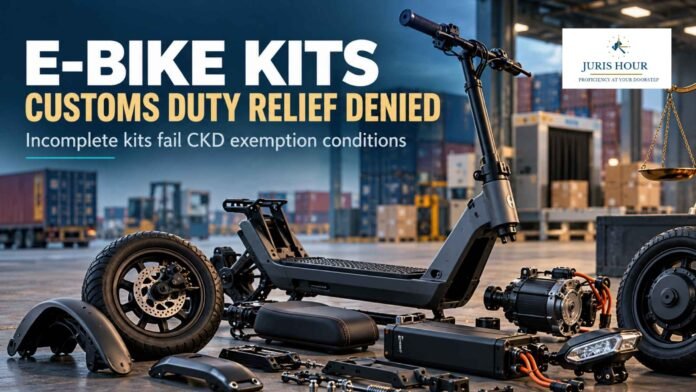
The Customs, Excise and Service Tax Appellate Tribunal (CESTAT), New Delhi, has held that imported electric two-wheeler kits may be classified as complete vehicles even when certain components are missing, while remaining ineligible for the customs duty concession available to knocked-down kits containing all necessary components.
The bench of Dr. Rachna Gupta (Officiating President) and Hemambika R. Priya (Technical Member) upheld an order confirming a customs duty demand of ₹54,82,066, along with applicable duties, and the related confiscation and penalty findings.
Buy Now: 80+ Judgements Indirect Tax – September 2026 E-Magazine
The company imported electric two-wheeler components in completely knocked-down (CKD) condition. It declared the goods under Customs Tariff Heading 87116020 and claimed concessional customs duty under Notification No. 50/2017-Customs dated June 30, 2017, as amended.
The customs authorities denied the concession on the ground that the imported kits did not contain all the components required under the relevant notification entry. The adjudicating authority confirmed the duty demand, held the goods liable to confiscation under Section 111(m) of the Customs Act, 1962, and imposed a penalty under Section 112.
The importer argued that the department’s approach was contradictory: it treated the incomplete kits as complete electric vehicles for classification but relied on the missing components to deny the CKD concession.
The tribunal upheld classification under Heading 87116020 by applying Rule 2(a) of the General Rules for Interpretation of the Customs Tariff.
Under that rule, an incomplete or unfinished article can be classified as the corresponding complete article if, as presented at import, it possesses the essential character of the finished product. The rule also extends to articles presented unassembled or disassembled.
Relying on its earlier decision in Y.C. Electric Vehicle and the HSN Explanatory Notes for Chapter 87, the tribunal concluded that the missing battery pack and charger did not prevent the imported goods from possessing the essential character of an electric two-wheeler.
It also noted that the importer itself had described the goods as an e-bike in CKD condition with pre-assembled essential parts and components, rather than merely as individual parts.
However, eligibility for the concession under Serial No. 531A(1) required compliance with the notification’s separate condition that the knocked-down kit contain all necessary components. Since the battery pack, charger and electric compressor had admittedly not been imported, the tribunal denied the benefit.
The bench also rejected the alternative claim under Serial No. 531A(2), following the earlier tribunal decision concerning an exemption benefit not claimed when the Bills of Entry were filed.
The company challenged the show-cause notice because it had been issued by an Assistant Commissioner despite the demand exceeding the prescribed monetary limits. It argued that a subsequent corrigendum making the notice answerable to the Principal Commissioner could not cure the defect.
The tribunal rejected the objection. It held that the “proper officer” concept is function-specific and accepted the Assistant Commissioner’s authority to issue the notice.
The corrigendum merely changed the authority before whom the notice was answerable, without changing its nature or prejudicing the importer. Accordingly, the tribunal held that it did not vitiate the adjudication proceedings.
The bench also rejected the allegation that the pre-notice consultation letter had not been received, noting that the adjudication order recorded the importer’s acknowledgment of its receipt.
The tribunal further held that the department could issue a notice under Section 28 to recover differential customs duty without first challenging the self-assessment of the imported goods.
It distinguished recovery proceedings under Section 28 from refund proceedings under Section 27, explaining that the requirement to modify an assessment before seeking a refund did not bar the department’s duty-recovery action.
The tribunal held that confiscation and redemption fine are distinct consequences. The absence of a redemption fine therefore did not, by itself, invalidate the confiscation finding or the related penalty.
Membership Required to Access Case Details & Order Copy
To view the complete Case Details and Download Order Copy, you must have an active membership. Please subscribe to continue.

