
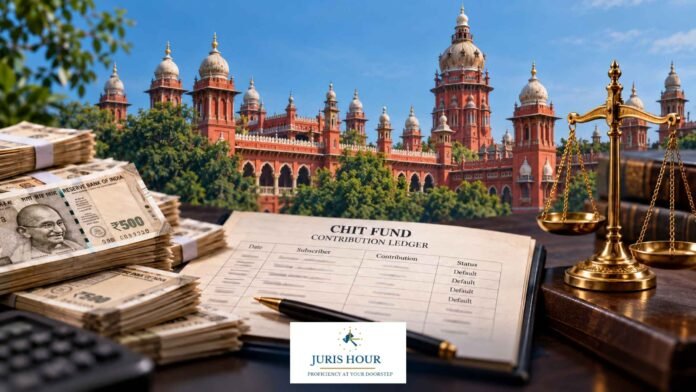
The Madras High Court has upheld income tax relief granted to a chit fund company on four disputed issues, including the deduction of amounts arising from defaults by chit subscribers, payments to closely associated companies, royalty expenditure and overdraft interest.
The bench of Justice Anita Sumanth and Justice K. Rajasekar reaffirmed that tax authorities must maintain consistency where the facts and legal position remain unchanged and similar claims have been accepted in other assessment years.
The departmental appeal under Section 260A of the Income Tax Act, 1961, involved four questions concerning bad debts, interest on security deposits and other payments to associated companies, royalty, and overdraft interest. These questions had been admitted by the High Court on December 17, 2014.
The first issue concerned the Tribunal’s deletion of an addition relating to bad debts. The substantial question of law reproduced in the judgment describes the disputed amount as ₹868 crore.
Both sides accepted that the issue had already been decided in favour of the assessee in an earlier judgment. The bench followed that ruling, which relied on the court’s decision dated April 3, 2012, in T.C.A. Nos.996 to 998 of 2005.
The earlier decision examined the obligations of a chit fund foreman under the Chit Funds Act, 1982. It recognised that, when subscribers default, the organiser may have to introduce its own funds to ensure that the chit cycle continues and its obligations are fulfilled.
Such payments arise directly from the conduct of the chit business. Where the organiser meets a subscriber’s liability from its own funds, the amount recoverable from the defaulting subscriber can give rise to a creditor–debtor relationship.
The court also referred to the Supreme Court’s ruling in T.R.F. Limited v. Commissioner of Income Tax, which held that, following the amendment effective from April 1, 1989, an assessee need not separately establish that a debt has actually become irrecoverable. For the write-off requirement under Section 36(1)(vii), it is sufficient that the bad debt is written off as irrecoverable in the accounts.
The precedent reproduced in the judgment further referred to CBDT instructions recognising that, where a chit organiser takes over the liability of members, unrecovered amounts due from those members should be examined as bad debts under the ordinary rules applicable to business assessments.
An additional basis for allowing the claim was its character as a business loss. The earlier ruling recorded that the amounts introduced to cover subscriber defaults were intimately connected with the business and could also qualify for deduction as a business loss under Section 28.
Following these decisions, the bench answered the bad debt question in favour of the company.
The second issue concerned the deletion of a ₹10.20 crore disallowance relating to interest on security deposits, commission and gifts paid to closely associated companies.
The court noted that the same issue, on identical facts and the same legal position, had been decided in favour of the assessee for Assessment Year 2002–03 by the Commissioner of Income Tax (Appeals). The Revenue’s appeal against that decision was dismissed by the Tribunal on October 19, 2007, and the order had attained finality.
Similar additions for Assessment Years 2004–05 and 2005–06 had also been deleted by the Commissioner of Income Tax (Appeals). The Department did not pursue those issues further.
The bench additionally noted that the Department had not raised the issue from Assessment Year 2006–07 onwards, although the company continued to follow the same method of operation.
The court held that consistency and uniformity in assessment were required. With no change in the facts or legal position, it found no reason to interfere with the Tribunal’s decision.
The ruling on this issue therefore rested on the established treatment of the same claim across assessment years and the absence of any material change warranting a different approach.
The third question concerned whether the Tribunal was justified in allowing royalty expenditure of ₹64.53 lakh.
The bench followed earlier decisions involving the assessee and other Shriram group companies, which distinguished a limited permission to use intellectual property from the acquisition of ownership or an enduring capital asset.
The precedent reproduced in the judgment examined royalty paid for the use of the parent company’s logo or trademark. The Revenue had argued that the trademark’s goodwill and market recognition formed part of the companies’ profit-making apparatus, making the payment capital expenditure eligible only for depreciation.
The assessee companies, however, maintained that they had obtained permission to use the logo without acquiring proprietary ownership or an exclusive, transferable interest.
The earlier ruling accepted that a licence to use intellectual property for a limited purpose did not, on those facts, amount to a transfer of ownership. Periodic renewal of the licence did not itself guarantee future renewal or establish the acquisition of an enduring asset.
The court also distinguished Honda Siel Cars India Ltd. v. CIT, where the technical collaboration arrangement involved technical information and assistance connected with setting up the business.
Applying the earlier rulings, the bench upheld the treatment of the royalty payment as revenue expenditure, allowing its deduction in full rather than restricting the relief to depreciation.
The final issue concerned the deduction of ₹22.73 lakh in overdraft interest. The assessing authority had questioned the claim on the ground that interest-bearing funds had been diverted towards interest-free advances.
The company’s position was that it possessed sufficient surplus funds to make those advances. Although the assessing officer recorded that supporting evidence had not been produced before him, the Commissioner of Income Tax (Appeals) made a categorical finding that surplus funds of ₹18.58 crore were available. The Tribunal reiterated that finding.
The High Court noted the availability of sufficient surplus funds and found no reason to disturb the Tribunal’s conclusion allowing the interest claim.
Membership Required to Access Case Details & Order Copy
To view the complete Case Details and Download Order Copy, you must have an active membership. Please subscribe to continue.
Read More: GST Demand Raised Beyond SCN Set Aside: Madras High Court

