
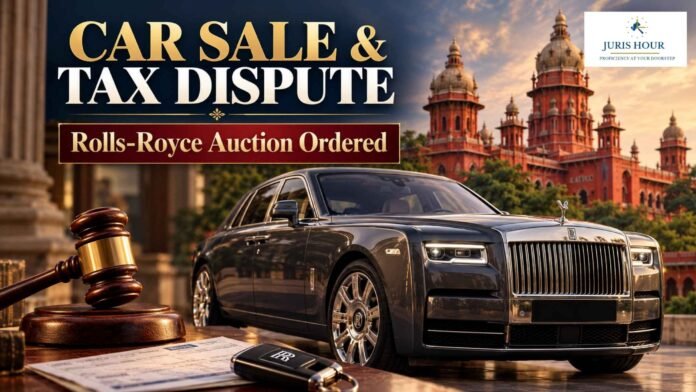
The Madras High Court has held, on a prima facie assessment, that handing over a car together with its original documents can complete a sale even when the registration has not been transferred to the buyer’s name and dismissed a challenge to income tax proceedings concerning a Rolls-Royce and directed the department to auction the vehicle, while preserving the owner’s right to pursue an appeal before the Income Tax Appellate Tribunal.
The bench of Justice C. Saravanan observed that retaining a spare key and failing to complete the formalities for transferring vehicle registration did not, by themselves, establish that no sale had taken place. However, the Court expressly directed the Tribunal to decide any appeal independently, without being influenced by its observations on the merits.
Buy Now: Direct tax (Income Tax) E-Magazine September 2026
According to the assessment order reproduced in the judgment, the petitioner purchased the Rolls-Royce on March 14, 2015, for ₹1.45 crore. The Income Tax Department concluded that he subsequently sold it on September 29, 2017, for ₹2.44 crore.
The petitioner disputed this account. He stated that an intermediary, Karthikeyan, had approached him with a proposal to sell the vehicle for ₹80 lakh to a prospective buyer said to be associated with the Lulu Group in Kochi.
His case was that the vehicle was also required for a wedding function and that he handed it over in the bona fide belief that payment would follow. The delivery included the original registration certificate, insurance documents, a delivery note and keys. He retained one duplicate key because payment was still awaited.
The petitioner maintained that the intermediary subsequently became untraceable. Although he allegedly received an assurance on October 16, 2017, that payment would be made the following day, he claimed that the transaction remained unpaid. He lodged a police complaint concerning theft of the vehicle on November 21, 2017.
The department’s position was different. A recovery notice dated April 21, 2022, alleged that ₹2.44 crore had been handed over to the petitioner’s son by a person sent by the father of Sukesh Chandrashekaran, the alleged purchaser. The judgment records that the alleged purchaser had pre-existing income tax liabilities of ₹217.63 crore.
The dispute developed against the background of income tax searches connected with Sukesh Chandrashekaran. The judgment records searches at Bengaluru on October 12, 2017, Coimbatore on October 17, 2017, and Kochi on November 9, 2017.
The Rolls-Royce was seized from Auto Tree Service Centre in Kochi. The petitioner was subsequently summoned by the investigation wing and appeared before the authorities in February 2018.
Separate proceedings were also initiated for production of the vehicle before a criminal court. A Judicial Magistrate at Coimbatore ordered its production on June 27, 2018. However, the High Court set aside that order on July 20, 2018, leaving the petitioner free to pursue his remedy before the income tax authorities.
The petitioner later sought release of the vehicle through a representation to the Director General of Income Tax (Investigation), Bengaluru.
Meanwhile, proceedings under Section 153C of the Income Tax Act culminated in the assessment order for Assessment Year 2018–19. The Commissioner of Income Tax (Appeals) dismissed his appeal, following which he approached the High Court.
The central issue before the Court was whether delivery of the vehicle and its documents constituted a sale despite the absence of an endorsement transferring registration to the buyer. The dispute also concerned whether the petitioner had received the alleged sale consideration.
The Court examined the distinction between a completed sale and an agreement to sell under Section 4 of the Sale of Goods Act, 1930.
It explained that a transaction is a sale when ownership in the goods passes from the seller to the buyer. Where ownership is intended to pass at a future time or after fulfilment of a condition, the transaction remains an agreement to sell until that time arrives or the condition is fulfilled.
Applying these principles, the Court considered the delivery of the Rolls-Royce together with its original documents sufficient, prima facie, to establish a completed sale.
It also referred to Section 32 of the Sale of Goods Act, which provides that, unless otherwise agreed, delivery of goods and payment of the price are concurrent conditions.
The Court found that the vehicle had not been delivered on approval or on a “sale or return” basis of the kind contemplated by Section 24 of that Act.
Spare Key and Unchanged Registration Did Not Negate the Sale
The petitioner relied on his continued possession of a duplicate key and the absence of a formal registration transfer to argue that ownership had not passed.
The Court rejected these circumstances as sufficient grounds to deny the sale. It observed that retaining a duplicate or spare key was, at best, a mere lien.
On registration formalities, the Court stated that the petitioner should have complied with the requirements governing transfer of ownership under the Motor Vehicles Act and the applicable rules. However, failure to complete those requirements did not support an inference that the vehicle had never been sold.
The Court further observed that, if the price remained unpaid, the petitioner should have pursued a civil suit as an unpaid seller under Section 45 of the Sale of Goods Act. It referred to the possibility of proceeding against the intermediary either as a principal or as an agent acting for an undisclosed principal.
The Court also took note of the interval between delivery of the vehicle and the police complaint.
The car was handed over on September 29, 2017, whereas the complaint was filed on November 21, 2017—after the searches and after seizure of the vehicle from the Kochi service centre.
This sequence formed part of the Court’s reasoning for declining to interfere with the assessment and appellate orders.
At the same time, the Court recognised that the matter involved several disputed questions of fact that could not be examined and resolved in the writ proceedings.
Since the vehicle had remained in the Income Tax Department’s custody since 2017, the Court directed the department to auction it and deposit the proceeds in an escrow account.
The money would be appropriated or released to the petitioner depending on the final outcome of the proposed appeal before the Income Tax Appellate Tribunal.
The petitioner was granted liberty to file that appeal within 30 days of receiving a copy of the judgment.
The Court specifically directed the Tribunal to decide the appeal without being influenced by the High Court’s observations on the merits.
Membership Required to Access Case Details & Order Copy
To view the complete Case Details and Download Order Copy, you must have an active membership. Please subscribe to continue.
Read More: Jewellery Sale Proceeds Not Exempt From Bankruptcy Estate; ₹19.17 Lakh Must Be Returned: NCLAT

