
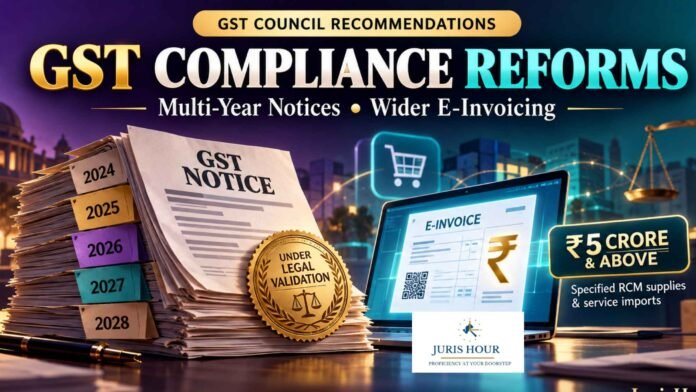
The GST Council has recommended a series of compliance reforms, including a statutory provision to validate notices covering multiple financial years, wider e-invoicing requirements for reverse-charge transactions and amendments to align return-related provisions with the time limit for claiming input tax credit.
The recommendations were made at the Council’s 57th meeting, held in New Delhi on October 8, 2026, under the chairpersonship of Union Finance Minister Nirmala Sitharaman. The package also seeks to clarify the tax liability of electronic commerce operators and align the GST Appellate Tribunal’s framework with tribunal reforms.
Buy Now: 195+ ITC Judgements Along With GSTAT Rulings – 2017 To 2026
Validation Of Notices Covering Multiple Financial Years
The Council has recommended introducing a validation clause in the Central Goods and Services Tax Act, 2017, to address notices that various courts have held invalid because they were issued for multiple financial years.
The proposal seeks to provide legislative backing to such notices. Its significance lies in the possibility of affecting proceedings where taxpayers have successfully challenged the inclusion of several financial years in a single notice.
However, the precise consequences for concluded cases, pending litigation and other grounds of challenge will depend on the wording and scope of the eventual amendment. The recommendation itself does not automatically revive notices set aside by courts.
Return Provisions To Be Aligned With ITC Time Limit
The Council has proposed amendments to Sections 16, 37 and 39 of the CGST Act to align provisions governing outward-supply statements and returns with the time limit for availing input tax credit under Section 16(4).
Section 37 concerns the furnishing of outward-supply details, while Section 39 governs returns. The proposed changes seek to bring these provisions into alignment with the statutory framework for claiming ITC.
The recommendation does not specify a revised deadline or announce a general extension for claiming credit. The exact changes will become clear when the legislative text is released.
Clearer Tax Liability For E-Commerce Operators
An amendment to Section 9(5) has also been recommended to clarify the liability of electronic commerce operators to pay GST on notified services, irrespective of their business models.
The proposal addresses the treatment of notified services supplied through e-commerce platforms where differences in operating arrangements may create uncertainty over tax responsibility.
Its stated scope concerns services notified under Section 9(5), rather than every supply made through an e-commerce platform.
E-Invoicing Proposed For Specified Reverse-Charge Transactions
The Council has recommended extending e-invoicing to domestic supplies received from unregistered persons where GST is payable under the reverse charge mechanism, as well as to imports of services.
The proposed requirement would cover taxpayers with aggregate annual turnover of ₹5 crore and above.
For affected businesses, this would bring the specified inward transactions within the proposed e-invoicing framework. Implementation details—including the applicable documents, reporting process, exclusions and commencement date—will need to be set out in the relevant legal and procedural changes.
The recommendation should not be read as imposing reverse-charge tax on every purchase from an unregistered supplier. It concerns domestic supplies on which tax is payable under reverse charge.
GST Appellate Tribunal Framework To Be Updated
The Council also approved amendments to the CGST Act and the GSTAT (Appointment and Conditions of Service of President and Members) Rules, 2023.
These changes seek to align provisions governing the GST Appellate Tribunal with the relevant provisions of the Tribunals Reforms Act, 2026, and the National Tribunals Commission and Qualification, Selection and Conditions of Service of Chairpersons and Members of Tribunals Rules, 2026.
The detailed amendments will determine how the alignment affects the appointment and service framework for the Tribunal’s President and Members.
Implementation To Follow Legal Amendments
The recommendations cover both taxpayer compliance and the administration of GST disputes. While return alignment and clarification of e-commerce liability seek greater certainty, the proposed validation of multi-year notices could have significant implications for litigation.
These measures remain subject to the necessary statutory amendments, rule changes and implementation arrangements. Businesses will need to assess their obligations once the final provisions and effective dates are announced.
Membership Required to Access Recommendation Details & Copy
To view the complete Recommendation Details and Download Copy, you must have an active membership. Please subscribe to continue.

