
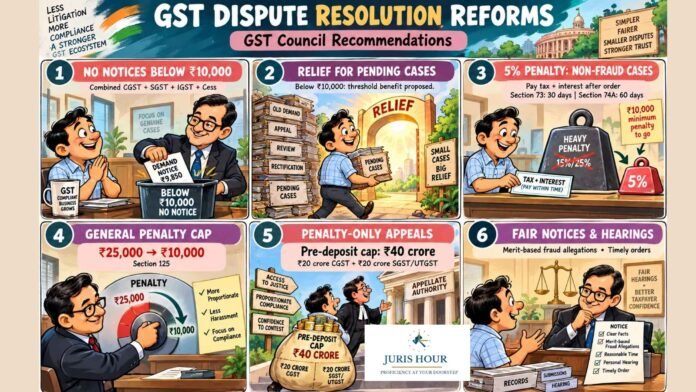
The GST Council has recommended a minimum tax threshold of ₹10,000 for issuing show cause notices, alongside relief for pending low-value disputes, reduced penalties in non-fraud cases and a cap on appeal pre-deposits in penalty-only matters.
The dispute resolution proposals seek to reduce compliance costs and litigation while improving the quality of demand notices, adjudication orders and appellate orders. The Council’s announcement of a ₹10,000 notice threshold was also reported following its 57th meeting.
Buy Now: GST E-Magazine Mega Combo (11 Publications)
No Show Cause Notices Where Tax Is Below ₹10,000
The Council recommended amendments to Sections 73, 74 and 74A of the Central Goods and Services Tax Act, 2017, to introduce a minimum threshold of ₹10,000 for issuing show cause notices.
The threshold would cover the combined amount of CGST, SGST, IGST and cess. Under the recommendation, no notice would be issued where the tax amount involved is less than ₹10,000.
The wording is significant: the proposed exemption applies to amounts strictly below ₹10,000, rather than ₹10,000 or below.
Pending Notices And Appeals To Receive Threshold Benefit
The Council also recommended a statutory provision extending the benefit to notices and appeals involving amounts below ₹10,000 that remain pending when the threshold provision comes into force.
Such matters would be decided as though the ₹10,000 threshold had already been applicable when the original notice was issued. This would bring existing low-value disputes within the proposed relief, instead of restricting the benefit to future notices.
The treatment of these pending proceedings would be governed by the statutory provision enacted to implement the recommendation.
Stricter Standards For Notices And Orders
The Council recommended a comprehensive circular prescribing guidelines for tax officers on issuing demand notices, adjudication orders and appeal orders.
The guidelines would address the quality and timely issuance of these documents, as well as the proper invocation of fraud, wilful misstatement or suppression of facts. These grounds would need to be invoked on the merits of each case.
The proposed circular would also reinforce adherence to the principles of natural justice, including the conduct of personal hearings. The measure seeks to ensure that taxpayers receive a fair opportunity to present their case during the decision-making process.
Reduced 5% Penalty For Prompt Payment In Non-Fraud Cases
Another recommendation would allow a reduced penalty of 5% in non-fraud cases where the taxpayer pays the tax and interest within the specified period after the adjudication order.
For proceedings under Section 73, payment would need to be made within 30 days of the adjudication order. For proceedings under Section 74A, the proposed period would be 60 days.
The Council further recommended removing the minimum penalty requirement of ₹10,000 in non-fraud cases. This would prevent the minimum monetary floor from determining the penalty in cases where a lower amount would otherwise apply.
Amount Paid As Penalty To Be Deemed A ‘Charge’
The Council recommended providing for the amount paid as penalty to be deemed a “charge” where the full tax amount is voluntarily paid, together with interest and penalty, within the specified time limit.
The proposal concerns the legal characterisation of the amount paid in qualifying cases. Its precise operation would depend on the wording of the amendments enacted.
Maximum General Penalty Proposed To Fall To ₹10,000
The Council recommended reducing the maximum general penalty under Section 125 of the CGST Act from ₹25,000 to ₹10,000.
The change would lower the statutory ceiling under that provision. It would not make ₹10,000 a mandatory penalty in every case.
₹40 Crore Pre-Deposit Cap For Penalty-Only Appeals
To ease access to appellate remedies, the Council recommended amendments to the provisos to Sections 107(6) and 112(8) of the CGST Act.
The proposed amendments would introduce an upper limit of ₹40 crore on the pre-deposit payable for appeals before the Appellate Authority or the Appellate Tribunal in cases where the disputed order involves only a penalty and no tax demand.
The combined ceiling would comprise ₹20 crore under CGST and ₹20 crore under SGST or UTGST. The cap is intended to reduce the financial burden of challenging substantial penalty-only orders.
Implementation Requires Legislative Changes
The measures remain recommendations requiring the relevant statutory amendments and issuance of the proposed circular. Taxpayers should therefore distinguish the Council’s proposals from provisions already in force.
Once implemented, the package would provide relief in low-value disputes, encourage timely payment in non-fraud cases and establish clearer standards for GST notices, hearings and orders.
Membership Required to Access Recommendation Details & Copy
To view the complete Recommendation Details and Download Copy, you must have an active membership. Please subscribe to continue.
Read More: Automated Refunds, 90% Provisional Sanction And 10-Day Acknowledgement: 57th GST Council Recommends

