
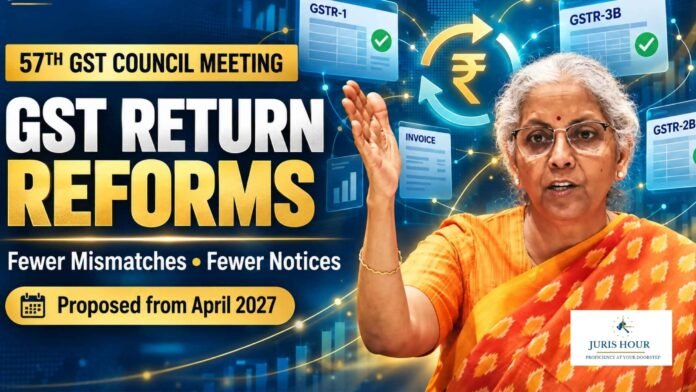
The GST Council, at its 57th meeting, recommended a revised mechanism for reporting and correcting tax liabilities and input tax credit (ITC) in GST returns, aimed at reducing mismatches, demand notices and system-generated intimations.
The proposed framework seeks to improve alignment between outward supply details furnished in GSTR-1, GSTR-1A and the Invoice Furnishing Facility (IFF), tax liabilities reported in GSTR-3B, and ITC reflected in GSTR-2B.
According to the recommendations, the alternate mechanism may be introduced from the return period of April 2027. The Council also recommended placing the proposed framework in the public domain for time-bound stakeholder consultation before finalising the changes.
Buy Now: GST E-Magazine Mega Combo (11 Publications)
Better Alignment Between GSTR-1 And GSTR-3B
The Council recommended enhancements to GSTR-1, GSTR-1A and IFF to enable better reconciliation of the details furnished in these forms with those reported in GSTR-3B.
It also proposed inserting sub-rule (1A) in Rule 61 of the Central Goods and Services Tax Rules, 2017. This provision would establish a mechanism for correct reporting and correction or rectification of tax liability in GSTR-3B, so that it aligns with the liability details furnished through GSTR-1, GSTR-1A and IFF.
The changes are intended to address differences between outward supply disclosures and the corresponding liability reported in the return, thereby reducing mismatch-related compliance proceedings.
Electronic Statement For Reverse Charge Tax And ITC
A proposed Rule 86D would provide for an “Electronic Statement of tax paid on Reverse charge basis and input tax credit claimed” on the GST portal.
The facility is intended to help taxpayers correctly report tax liability and ITC relating to supplies covered by the reverse charge mechanism (RCM).
By bringing reverse charge tax payments and the corresponding credit claims into a dedicated statement, the proposed framework seeks to improve the accuracy of reporting in returns.
Invoice Details To Be Included In DRC-03
The Council recommended amending Form GST DRC-03 to enable taxpayers to declare details of the underlying invoice against which payment has been made.
This would provide an invoice-level connection between the payment disclosed in DRC-03 and the transaction to which it relates, supporting reconciliation under the revised mechanism.
Rules Proposed For Invoice Management System
The Council recommended inserting sub-rule (6A) in Rule 60 to provide for the Invoice Management System (IMS).
Under the proposed provision, a recipient would be able to accept, reject or keep pending a document relating to an inward supply received on the portal, for the purpose of generating the ITC statement in GSTR-2B.
These actions would be subject to prescribed conditions, including the period for which a credit note may remain pending in IMS. The detailed conditions will therefore be significant for taxpayers managing inward supply documents and credit adjustments.
Dedicated Statement For ITC Reversal And Reclaim
The Council also proposed inserting Rule 86C to provide for an “Electronic Credit Reversal and Reclaim Statement” on the portal.
This facility would assist taxpayers in correctly reporting ITC reversed and subsequently reclaimed in GSTR-3B.
Alongside this statement, the Council recommended inserting sub-rule (1B) in Rule 61 to establish a mechanism for correct reporting and correction or rectification of ITC in the return. Its objective is to align ITC availed in GSTR-3B with the credit details made available in GSTR-2B.
Clarificatory Circular On ITC Reporting
A circular has also been recommended to explain the manner of furnishing correct information on ITC and its reversal in GSTR-3B.
The clarification would address reporting in the context of IMS, the Electronic Credit Reversal and Reclaim Statement, and the electronic statement covering reverse charge tax payments and corresponding ITC claims.
Together, these measures seek to make liability and credit reporting more consistent across GST forms and portal facilities.
April 2027 Rollout Proposed; Public Consultation To Follow
The Council recommended bringing the alternate return amendment mechanism into force from the April 2027 return period.
It expects the measures to considerably reduce liability and ITC mismatches, lowering the incidence of demand notices and automated intimations arising from such differences. The framework is also intended to improve the integrity of ITC across the supply chain.
The proposed revised mechanism will be placed in the public domain for time-bound consultation. The Union Finance Minister has been authorised to approve necessary changes or modifications based on stakeholder feedback.
The measures remain recommendations, with their final operation dependent on the relevant amendments, implementation provisions and portal changes.
Membership Required to Access Recommendation Details & Copy
To view the complete Recommendation Details and Download Copy, you must have an active membership. Please subscribe to continue.

