
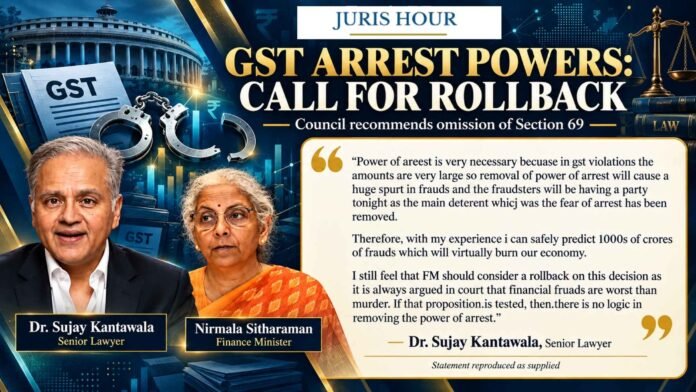
The GST Council has recommended omitting Section 69 of the CGST Act and raising the prosecution threshold from ₹1 crore to ₹5 crore.
Senior lawyer Dr. Sujay Kantawala has cautioned that removing the fear of arrest could weaken deterrence against large-scale tax fraud.
Buy Now: 195+ ITC Judgements Along With GSTAT Rulings – 2017 To 2026
The GST Council’s recommendation to completely withdraw arrest powers under the Goods and Services Tax framework has drawn strong criticism from senior lawyer Dr. Sujay Kantawala, who has warned that the proposed change could encourage large-scale fraud and cause substantial losses to the economy.
According to the recommendations provided, the Council has proposed omitting Section 69 of the Central Goods and Services Tax Act, 2017, to withdraw arrest powers under GST. It has also recommended increasing the monetary threshold for prosecution from ₹1 crore to ₹5 crore and revising several offences and punishment provisions under Section 132.
The Council has presented these measures as an effort to strengthen a progressive, trust-based tax regime while retaining effective deterrence against fraud and evasion. Kantawala, however, has questioned whether withdrawing arrest powers would undermine that objective, particularly in cases involving substantial amounts of alleged GST fraud.
“Fraudsters Will Be Having A Party Tonight”
Reacting to the proposed withdrawal, Kantawala said arrest powers remain necessary because GST violations can involve very large amounts. In his assessment, the fear of arrest serves as a major deterrent, and its removal could encourage fraudulent activity.
“The fraudsters will be having a party tonight,” he said, arguing that the recommendation would remove a significant consequence feared by those engaged in tax fraud.
Drawing on his professional experience, Kantawala predicted that the change could lead to frauds involving thousands of crores of rupees and seriously harm the economy. His remarks represent a warning about the possible consequences of the proposal, rather than an estimate of established revenue losses.
He urged Finance Minister Nirmala Sitharaman to reconsider the recommendation and consider a rollback.
Council Proposes Complete Withdrawal Of Arrest Powers
The recommendation expressly seeks the complete withdrawal of arrest powers under GST through the omission of Section 69 of the CGST Act, 2017.
The proposal forms part of a broader revision of the criminal enforcement framework. Alongside the withdrawal of arrest powers, the Council has recommended raising the monetary threshold for prosecution from ₹1 crore to ₹5 crore.
The Council’s stated objective is to develop a tax regime built on greater trust while continuing to deter fraud and evasion. Kantawala’s criticism raises a central question about the proposed approach: whether the remaining prosecution framework would provide sufficient deterrence once GST arrest powers are withdrawn.
Changes Recommended To Offences Under Section 132
The recommendations also propose changes to the scope of offences covered by Section 132(1) of the CGST Act.
These include the omission of clause (i) of Section 132(1), deletion of the words “evades tax” from clause (e), and deletion of the words “or in any other manner deals with” from clause (h).
The Council has further recommended amending clause (c) of Section 132(1) to cover only the offence of fraudulent availment of input tax credit without receipt of goods or services, or without an invoice or bill.
This proposed wording places emphasis on fraudulent availment of ITC in the specified circumstances. The recommendations supplied do not set out the complete replacement provisions, making the eventual legislative text important for determining the precise scope of the revised offences.
The Council has also proposed rationalising punishment for various offences under Section 132. However, the extract does not specify the revised punishment applicable to each offence.
Kantawala Questions The Deterrence Rationale
Kantawala’s principal objection is that withdrawing arrest powers could reduce the perceived consequences of committing serious GST fraud.
He argued that financial fraud can inflict grave economic damage and referred to arguments made in court describing financial frauds as worse than murder. On that reasoning, he questioned the logic of removing arrest powers.
That comparison is Kantawala’s argument in support of stronger enforcement; it should not be read as a judicial finding concerning the Council’s recommendations.
His criticism also highlights the distinction between easing the compliance burden on taxpayers and addressing deliberate fraud involving large sums. In his view, the scale of potential GST violations warrants retaining arrest as an enforcement tool.
Recommendations Require Legislative Implementation
The measures described are Council recommendations. A recommendation to omit Section 69 does not itself delete the provision from the CGST Act or establish that arrest powers have already ceased to operate.
The proposed statutory changes would require legislative implementation and commencement before their legal effect can be determined. The final amendments will also be important in assessing the revised prosecution threshold, the treatment of particular offences and the punishment framework.
The debate therefore centres on whether the proposed reforms can deliver the Council’s stated aim of a trust-based tax regime while preserving effective deterrence against serious fraud. Kantawala has called for reconsideration, warning that the withdrawal of arrest powers could carry significant economic consequences.
Membership Required to Access Recommendation Details & Copy
To view the complete Recommendation Details and Download Copy, you must have an active membership. Please subscribe to continue.

