
Ask Jurishour AI

Generic selectors
Exact matches only
Search in title
Search in content
Post Type Selectors
tdb_templates
saswp_reviews
saswp-collections
saswp_rvs_location
tdc-review-email
web-story-font
web-story
googlesitekit_email
tds_locker
tds_email
saswp
mailpoet_page
mailpoet_email
tdcpt_tunes
tdc-review
pronamic_payment
pronamic_gateway
pronamic_pay_subscr
wpcode
HomeColumnsExpired FMCG Goods and Medicines May Get Relief from GST Credit Reversal:...

Expired FMCG Goods and Medicines May Get Relief from GST Credit Reversal: 57th GST Council Meet

Published on

🚀 Stay Connected With JurisHour

WhatsApp X Telegram

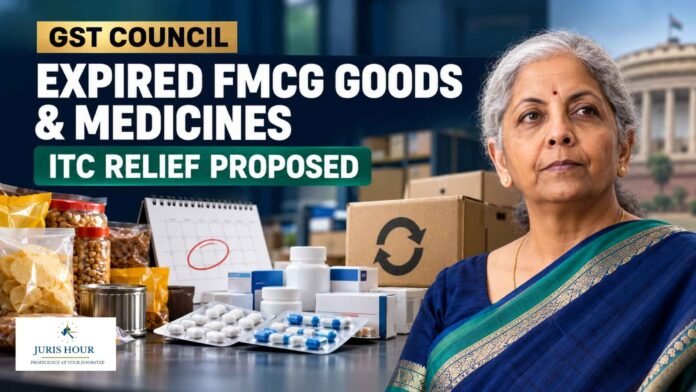
FMCG and pharmaceutical businesses could receive input tax credit relief on specified expired goods requiring destruction under proposals reportedly being considered for the 57th GST Council’s October 8 meeting. The measure would address a recurring issue in businesses where products have a limited shelf life.

The reported reform concerns the treatment of tax credit when genuine business inventory becomes unsaleable. It is not an announcement allowing expired medicines or food products to be sold, and would operate independently of product safety and disposal requirements.

Buy Now: 195+ ITC Judgements Along With GSTAT Rulings – 2017 To 2026

Section 17(5)(h) of the CGST Act blocks credit in respect of goods lost, stolen, destroyed, written off or disposed of as gifts or free samples. However, expiry, return to a supplier and eventual destruction are different events, and the applicable credit treatment cannot be reduced to a single rule for every transaction.

CBIC Circular No. 72/46/2018-GST explains alternative routes for returning time-expired medicines. Where a registered dealer treats the return as a fresh taxable supply, the manufacturer may take eligible credit on that return supply; if the returned medicines are then destroyed, the circular requires reversal of that return-supply credit. A return through a credit note involves a different adjustment mechanism.

In commercial terms, allowing credit to survive qualifying destruction could reduce the additional tax cost attached to unavoidable stock expiry. The potential benefit would depend on which credit is protected, who in the distribution chain claims it, and whether the original supply has already been adjusted.

Batch records, return invoices, credit notes and disposal evidence would be logical safeguards for such a reform, although the final documentation requirements have not been confirmed. The Council’s eventual recommendations will also need to distinguish expired stock from theft, unexplained shortages and other write-offs.

Until the relevant law or implementing instrument changes, businesses cannot treat a reported proposal as permission to stop reversals currently required.

Read More: 57th GST Council May Widen ITC for Telecom Towers and Pipelines Outside Factories

Mariya Paliwala
Mariya Paliwalahttps://www.jurishour.in/
Mariya is the Senior Editor at Juris Hour. She has 7+ years of experience on covering tax litigation stories from the Supreme Court, High Courts and various tribunals including CESTAT, ITAT, NCLAT, NCLT, etc. Mariya graduated from MLSU Law College, Udaipur (Raj.) with B.A.LL.B. and also holds an LL.M. She started her career as a freelance tax reporter in the leading online legal news companies.

Latest articles

57th GST Council May Widen ITC for Telecom Towers and Pipelines Outside Factories

The GST Council is expected to consider wider input tax credit eligibility for telecom...

Hearing Is Mandatory, Not a Formality: ITAT Quashes Ex Parte Tax Appeal Orders Over Unproven Service of Notices

The Delhi Bench of the Income Tax Appellate Tribunal (ITAT) has set aside two...

No Concealment Penalty For Debatable Transfer Pricing Adjustments In ₹44.06 Crore Dispute: ITAT

The Delhi Bench of the Income Tax Appellate Tribunal (ITAT) has upheld the deletion...

Rs. 58.99 Lakh CENVAT Credit Can’t Be Denied on Shared Corporate Support Services: CESTAT

The Customs, Excise and Service Tax Appellate Tribunal (CESTAT), Mumbai, has allowed assessee’s appeal...

More like this

57th GST Council May Widen ITC for Telecom Towers and Pipelines Outside Factories

The GST Council is expected to consider wider input tax credit eligibility for telecom...

Hearing Is Mandatory, Not a Formality: ITAT Quashes Ex Parte Tax Appeal Orders Over Unproven Service of Notices

The Delhi Bench of the Income Tax Appellate Tribunal (ITAT) has set aside two...

No Concealment Penalty For Debatable Transfer Pricing Adjustments In ₹44.06 Crore Dispute: ITAT

The Delhi Bench of the Income Tax Appellate Tribunal (ITAT) has upheld the deletion...