
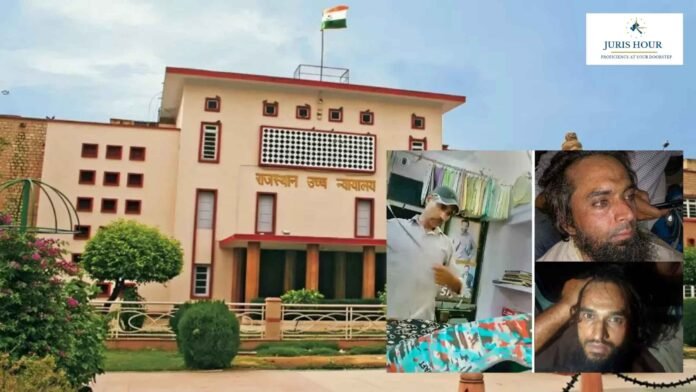
The Rajasthan High Court has dismissed the bail appeals of five accused in the 2022 murder of Udaipur tailor Kanhaiya Lal, holding that prolonged incarceration did not justify their release at this stage when the prosecution material prima facie supported the conspiracy allegations and the trial was progressing expeditiously.
The Bench of Chief Justice Sanjay K. Agrawal and Justice Sameer Jain upheld the Special NIA Court’s orders rejecting bail to Wasim Ali, Muslim Khan, Mohsin Khan, Mohammad Mohsin and Asif Hussain.
Buy Now: 90+ Supreme Court Judgments – September 2026
The central issue was whether the accused could be granted regular bail despite the restrictions under Section 43D(5) of the Unlawful Activities (Prevention) Act, 1967, particularly on the ground of extended pre-trial detention.
The Bench acknowledged that constitutional courts can intervene where prolonged incarceration and an unreasonably delayed trial infringe Article 21. However, it found that the circumstances necessary for such intervention were not established in the present case.
The proceedings arose from the killing of Kanhaiya Lal inside his tailoring shop in Udaipur on June 28, 2022. According to the prosecution, two principal accused entered the shop with sharp weapons, attacked him, recorded the killing and subsequently circulated videos online to spread terror and communal hostility.
The judgment records that two shop assistants were also grievously injured during the incident.
Following directions from the Union Ministry of Home Affairs, the National Investigation Agency took over the investigation and re-registered the case on June 29, 2022. The FIR invoked Sections 452, 302, 153A, 153B, 295A and 34 of the Indian Penal Code, along with Sections 16, 18 and 20 of the UAPA.
The five accused pursuing the present appeals were arrested in July and August 2022. Charges were framed in January and February 2024.
Their bail applications were rejected by the Special Judge dealing with NIA cases in Jaipur through orders dated October 9 and November 12, 2024. They challenged those decisions under Section 21(4) of the NIA Act, 2008.
Counsel for the accused argued that there was no cogent evidence placing them near Kanhaiya Lal’s shop during the period leading up to the murder. They also disputed the existence of messages, voice notes or other communications attributable to them that promoted religious hostility.
The defence submitted that their names did not appear in the original FIR and that the prosecution had relied on assumptions and call detail records arising from ordinary communication between neighbours.
The accused also challenged disclosure statements recorded in English, claiming that they did not understand the language. They argued that this affected the validity of the resulting recoveries under the Indian Evidence Act.
Another ground was parity with co-accused Farhad Mohammed and Mohammed Javed, who had already obtained bail. Counsel further cited the absence of criminal antecedents and submitted that the accused were the sole breadwinners of their families.
On trial delay, the defence pointed to their custody since 2022 and the prosecution’s original proposal to examine approximately 180 witnesses. Relying on Union of India v. K.A. Najeeb and Syed Iftikhar Andrabi v. NIA, counsel argued that the UAPA’s statutory bail restrictions could not override the constitutional guarantee of a speedy trial.
Opposing bail, the NIA submitted that the accused had played active and specific roles in a planned conspiracy culminating in the murder.
The agency argued that the recording and circulation of the killing were intended to terrorise the public and disrupt communal peace. It relied on witness statements, call records, video recordings and alleged weapon recoveries to support its case.
The NIA invoked National Investigation Agency v. Zahoor Ahmad Shah Watali, submitting that a court considering bail under the UAPA must assess whether the allegations are prima facie true without conducting a detailed trial of the evidence.
Addressing the delay argument, the agency stated that the prosecution witness list had been reduced from 180 to 89 and that approximately 30 material witnesses had already been examined. It further submitted that the trial was being conducted on a day-to-day basis.
The NIA disputed the parity claim, contending that the roles and circumstances of the accused who had obtained bail differed from those of the five appellants.
The High Court explained that Section 43D(5) restricts the grant of bail where the case diary or prosecution report provides reasonable grounds for believing that the accusation against the accused is prima facie true.
Referring to Gulfisha Fatima v. State (Government of NCT of Delhi), the Bench emphasised that this provision does not require automatic rejection of bail. Courts must examine whether the prosecution material, taken at face value, discloses the essential ingredients of the alleged offences.
The inquiry must also focus on the role attributed to the individual accused and whether that role has a meaningful connection with the alleged unlawful or terrorist activity.
However, the bail stage does not permit a detailed assessment of evidentiary reliability, competing defences or questions reserved for trial. The court must avoid conducting a mini-trial while deciding whether the statutory threshold is met.
Applying that approach, the Bench found that the charge-sheet prima facie supported the allegations concerning the appellants’ participation in the conspiracy. It also noted that charges had already been framed, meaning the prosecution material had passed a preliminary judicial assessment.
The Bench expressly recognised the constitutional protection against indefinite pre-trial detention.
Discussing K.A. Najeeb and Syed Iftikhar Andrabi, it acknowledged that statutory restrictions cannot make the guarantee of personal liberty illusory. Constitutional intervention may be warranted where a trial is unlikely to conclude within a reasonable period and the accused has already undergone substantial incarceration.
The court nevertheless distinguished the present proceedings from cases involving a trial that had not commenced or remained effectively stalled.
It relied on the examination of approximately 30 primary witnesses, the reduced witness list and the day-to-day progress of the trial. These circumstances, it held, did not establish that completion within a reasonable time was unlikely.
The Bench therefore declined to apply the constitutional exception invoked by the accused on the facts before it.
The court also declined to resolve the defence objections concerning the language of disclosure statements and the admissibility of electronic evidence at the bail stage.
It held that those issues required examination by the trial court during the evidentiary proceedings. Assessing them conclusively while deciding bail would exceed the limited inquiry permitted under Section 43D(5).
The Bench considered the alleged murder together with the recording and dissemination of the incident, observing that the prosecution case concerned an organised act intended to create terror and communal disharmony.
Dismissing all five appeals, the High Court sustained the Special NIA Court’s bail rejection orders.
Its conclusion rested on the prima facie prosecution material, the specific roles attributed to the accused in the alleged conspiracy, the gravity of the allegations and the continuing progress of the trial.
The Bench clarified that its observations were confined to deciding the bail appeals and did not amount to a final determination of guilt. It directed the trial court to adjudicate the case independently, uninfluenced by those observations.
Membership Required to Access Case Details & Order Copy
To view the complete Case Details and Download Order Copy, you must have an active membership. Please subscribe to continue.
Read More: Rs. 1.10 Crore GST Refund Must Be Paid in Cash After Business Closure: Allahabad HC

