
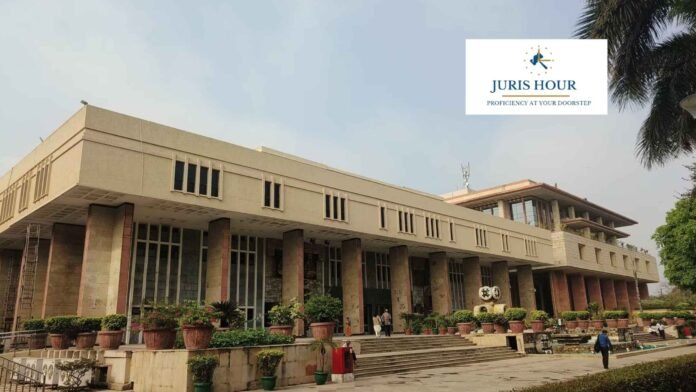
The Delhi High Court has held that later dates appearing on Forms GST DRC-01 and DRC-07 cannot, by themselves, render substantive show cause notices or adjudication orders time-barred under Section 74 of the Central Goods and Services Tax Act, 2017.
The bench of Justice Anil Kshetarpal and Justice Bharat Parashar distinguished the substantive notices and orders from their electronic summaries and ruled that the dates of the summary forms cannot automatically replace the dates of the underlying statutory proceedings for determining limitation.
Buy Now: 160+ GST E-Magazine September 2026
The appellant/assessee is a GST-registered proprietorship concern, faced proceedings arising from investigations into alleged availment and passing on of inadmissible input tax credit through entities suspected of being non-existent or issuing invoices without actual supplies of goods.
The first proceeding originated from an alert received from the Directorate General of Goods and Services Tax Intelligence, Gurugram Zonal Unit, concerning M/s Redmancy World. The investigation subsequently extended to other firms and recipients.
The department alleged that the assessee had availed inadmissible ITC of ₹23,06,264, comprising CGST and SGST of ₹11,53,132 each, on invoices allegedly issued by non-existent entities without actual receipt of goods.
The substantive show cause notice was dated July 11, 2024, while the corresponding Form GST DRC-01 bore the later date of August 23, 2024. An Order-in-Original dated January 27, 2025, confirmed the demand with applicable interest and an equivalent penalty.
The second proceeding arose from an analytical report dated May 26, 2022, received from the Directorate General of Analytics and Risk Management. It concerned 14 allegedly non-existent firms that were accused of passing inadmissible ITC to several beneficiary entities. The assessee was included as Noticee No. 203.
In that proceeding, the substantive show cause notice dated July 9, 2024, proposed a demand of ₹2,68,320, comprising CGST and SGST of ₹1,34,160 each, besides interest and penalty.
The corresponding DRC-01 was dated August 28, 2024. The adjudication order was dated January 29, 2025, while its summary in Form GST DRC-07 was dated February 21, 2025.
The taxpayer argued that August 4, 2024, was the last date for issuing the show cause notices under Section 74(2), having regard to the extended annual return due date for financial year 2017-18.
Since both DRC-01 forms were dated after that asserted deadline, it contended that the proceedings were barred by limitation. It further argued that where the substantive notice and its electronic summary were served together, the date appearing on DRC-01 should be treated as the effective date of issuance.
In the second petition, the taxpayer also relied on the February 21, 2025, date of DRC-07 to contend that the adjudication was beyond the asserted February 4, 2025, deadline under Section 74(10).
Separately, it challenged the invocation of Section 74, arguing that the notices and orders did not disclose sufficient material establishing fraud, wilful misstatement or suppression of facts with intent to evade tax. It maintained that there was no material showing its knowledge of, or collusion with, the allegedly non-existent suppliers.
The department opposed the petitions, submitting that the substantive notices and adjudication orders were within the prescribed period. It argued that the later electronic summaries could not make those proceedings time-barred and that the taxpayer’s remaining objections could be examined in statutory appeals.
The Court explained that Section 74(2) requires the proper officer to issue the notice under Section 74(1) at least six months before the deadline prescribed for issuance of the adjudication order under Section 74(10).
In the present case, the substantive notices were dated July 11 and July 9, 2024. Both preceded August 4, 2024, the cut-off date asserted by the taxpayer.
The Bench held that the later dates on the corresponding DRC-01 forms could not, by themselves, invalidate the notices on limitation grounds. DRC-01 is an electronic summary consequential to the substantive show cause notice; it does not substitute that notice.
The Court found this distinction consistent with Rule 142 of the CGST Rules, which provides for electronic service of a summary of the notice in DRC-01 and uploading of a summary of the adjudication order in DRC-07.
It therefore rejected the contention that limitation under Section 74(2) must necessarily be calculated by reference to the date appearing on DRC-01.
The Bench applied the same distinction to the adjudication orders.
It relied on the Delhi High Court’s decisions in Rishi Enterprises through its Proprietor Rajeev Kumar Goel v. Additional Commissioner Central Tax Delhi North & Anr. and Suresh Kumar v. Commissioner, CGST Delhi North, which addressed subsequent uploading of DRC-07 after substantive orders had been issued.
The Court explained that limitation under Section 74(10) attaches to the substantive adjudication order contemplated by Section 74(9). DRC-07 is the electronic summary of that order.
Consequently, a DRC-07 uploaded or dated after the prescribed period does not, by that fact alone, make the underlying adjudication order time-barred.
Here, the substantive orders were dated January 27 and January 29, 2025. Both preceded February 4, 2025, the expiry date asserted by the taxpayer. The challenge resting solely on the later summary-form dates therefore failed.
The Court also addressed the taxpayer’s contention that it received the substantive notice together with, or became aware of it through, the later DRC-01.
It held that this circumstance did not alter the date borne by the substantive notice. However, the Bench recognised that a factual dispute over the precise mode and date of service would require examination of departmental records and the relevant service material.
The Court declined to undertake that exercise in these writ proceedings. Its ruling thus addressed the effect of the later summary dates, while acknowledging that disputed service facts require a separate examination of the record.
The Bench declined to decide whether the department had sufficient evidence to invoke Section 74 or deny the disputed ITC.
Questions concerning the suppliers’ existence, actual supply of goods, the taxpayer’s knowledge, alleged collusion and the evidentiary basis of the adjudication findings required scrutiny of records and appreciation of evidence.
The Court held that the appellate authority under Section 107 could examine both factual and legal issues, including the applicability of Section 74, the department’s material, computation of liability and validity of penalties.
Although an alternative remedy does not absolutely bar a writ petition, the Court observed that High Courts ordinarily exercise restraint where an effective statutory appeal is available and the dispute involves factual assessment.
Referring to Assistant Commissioner of State Tax and Others v. Commercial Steel Limited, the Bench noted the recognised exceptions involving fundamental rights, natural justice, proceedings wholly without jurisdiction and challenges to legislative validity.
In this case, no denial of an opportunity of hearing had been demonstrated. The taxpayer had participated in adjudication, and its limitation argument did not establish a patent jurisdictional defect. Examining the remaining merits in writ jurisdiction would effectively convert the proceedings into an appeal.
The Court disposed of both petitions and pending applications, leaving all legally available contentions open before the appellate authority.
It expressly clarified that it had not decided the merits of the taxpayer’s objections concerning Section 74, fraud, knowledge or collusion, ITC admissibility, departmental evidence, liability computation or penalty.
The Bench further directed that if the taxpayer sought exclusion of the time spent pursuing the writ proceedings when computing the appeal limitation period, the appellate authority should consider that request in accordance with law. The judgment did not automatically grant an extension or exclusion of time.
Membership Required to Access Case Details & Order Copy
To view the complete Case Details and Download Order Copy, you must have an active membership. Please subscribe to continue.

