
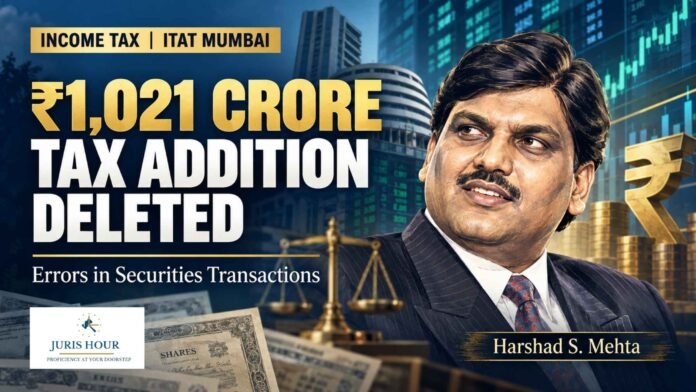
The Income Tax Appellate Tribunal (ITAT), Mumbai, has deleted a ₹1,021.33 crore addition relating to an alleged money market oversold position in the assessment of late stockbroker Harshad S. Mehta for assessment year 1993–94, finding calculation errors, omitted purchases and transactions incorrectly treated as sales.
The bench of Sandeep Gosain (Judicial Member) and Bijayananda Pruseth (Accountant Member) also deleted several other substantial additions, including ₹524.54 crore relating to payments to the State Bank of India and ₹159.72 crore concerning a negative opening balance in government securities. It repeatedly noted the Revenue’s failure to provide supporting documents or rebut the explanations backed by the assessee’s records.
Buy Now: Direct tax (Income Tax) E-Magazine September 2026
The dispute arose from the assessment of income from trading and brokerage activities in the capital and money markets. Harshad S. Mehta was the sole proprietor of a brokerage firm registered with the Bombay Stock Exchange.
No income tax return was filed for assessment year 1993–94. The original assessment, completed under Section 144 of the Income Tax Act on March 29, 1996, determined total income at ₹1,396.02 crore.
The first appellate proceedings were dismissed because the prescribed tax payment had not been made. The assessee attributed the inability to pay to the attachment of assets and bank accounts following his notification under the special court legislation on June 8, 1992.
Following successive appellate orders and remands, a fresh assessment was completed on December 29, 2016, determining total income at ₹2,106.04 crore. The Commissioner of Income Tax (Appeals) granted partial relief through an order dated December 19, 2023, leading both sides to approach the Tribunal.
The largest disputed addition concerned the alleged sale of money market securities beyond the quantity available with the assessee.
The Assessing Officer had compiled opening stock, purchases, sales and closing stock from information gathered from banks, financial institutions, brokers and other records. On this basis, the officer determined negative closing stock in eight securities and added ₹1,021.33 crore.
The Tribunal first found that the computation contained arithmetic errors of approximately ₹67.84 crore. After correcting those errors, the amount worked out to approximately ₹953.49 crore.
It then examined the individual transactions and identified several independent reasons why the additions could not survive.
A ₹441.49 crore component relating to the negative opening balance of 11.5% Central Loan 2010 was deleted by following the Tribunal’s decision for the immediately preceding assessment year. That decision had held that an unsupported negative opening balance could not justify an addition and that an amount brought forward from an earlier year could not be treated as unexplained investment of the current year merely on that basis.
Another component of ₹337.22 crore concerned securities transactions with the National Housing Bank. The Tribunal accepted that physical delivery had not taken place. Recovery proceedings and subsequent court-directed payments supported the position that the transactions did not establish the alleged oversold stock.
The bench also found that purchases had been omitted while calculating the alleged shortfall in certain securities. In the HUDCO bond transactions, the records showed purchases and sales of equal face value, leaving no oversold position.
In another transaction, the assessee had acted as a broker between institutional counterparties. The Tribunal held that the brokerage could be taxable in his hands, but the entire transaction consideration of ₹23.29 crore could not be treated as his income.
A further ₹3.26 crore receipt was found to represent a loan in a running account with another brokerage firm, rather than a sale of securities. The Tribunal consequently allowed the ground challenging the money market oversold position addition.
The Tribunal separately deleted an addition of ₹159.72 crore concerning 11.5% Central Loan 2007.
This addition had originated from an enhancement made during an earlier appellate round. It was based on a negative opening balance of securities having a face value of ₹170 crore.
Following the earlier decision in the assessee’s own case, the Tribunal held that the addition could not be sustained. The Revenue had not brought material to distinguish that decision on facts or law.
The assessee also challenged an addition of ₹524,53,68,500 relating to payments made to the State Bank of India.
The tax authorities had treated a substantial portion of those payments as unexplained. The assessee submitted transaction-wise details showing that the payments came from regular bank accounts and were funded through recorded transactions, including securities sale proceeds and transfers.
The Tribunal observed that the Revenue had not rebutted this explanation with tangible evidence. It also noted that documents relied upon by the Department had not been supplied despite specific requests and directions issued during the proceedings.
The bench found that the underlying evidence supporting the addition remained absent despite multiple proceedings extending over three decades. It therefore directed its deletion.
An addition of ₹20.77 crore relating to money market differences was also deleted.
After examining bank correspondence and other documents, the Tribunal found that the authorities had misunderstood payments made by the assessee as receipts earned by him.
The bench held that payments from regular and disclosed sources did not warrant the disputed income addition.
The Tribunal deleted the ₹143.67 crore addition relating to interest on money market securities by following earlier decisions accepting the assessee’s cash method of accounting.
The principle applied was that rejection or non-maintenance of books did not, by itself, justify ignoring the method consistently followed for recognising interest income. Under the accepted cash system, interest was to be considered on actual receipt.
The Tribunal similarly allowed the challenge to ₹7.40 crore of interest attributed to transactions with family members.
On dividend and interest income, the bench identified an additional computation error. Although the Assessing Officer had worked out income of ₹1.32 crore, ₹2.26 crore had been added to total income.
The Tribunal directed deletion of the excess ₹93.56 lakh and restricted the remaining addition to income actually received. The assessee had submitted that actual receipts were ₹9.05 lakh.
The Tribunal deleted ₹58.16 crore added as share market trading profit and ₹138.68 crore relating to an alleged share market oversold position.
Its examination revealed deficiencies in the supporting evidence and transaction treatment, including brokerage transactions being attributed to the assessee as his own sales, omitted purchases and disputed assumptions concerning delivery.
The bench concluded that the basis adopted by the authorities did not support the additions.
The assessee did not succeed on every issue.
The Tribunal upheld additions of ₹6.16 crore and ₹224 relating to unexplained bank credits. It held that the nature and source of those credits had not been satisfactorily explained despite reasonable opportunities across three rounds of litigation.
For the ₹4.45 crore addition concerning loans and advances, the Tribunal directed deletion of approximately ₹3.95 crore representing opening balances from earlier years. The remaining ₹49.69 lakh was remanded for verification of whether the advances came from regular sources disclosed in the books.
The ₹2.81 crore addition concerning transactions with Mazda Industries was directed to be deleted, with a limited remand to verify whether ₹1.93 crore of profit acknowledged in the assessee’s submissions had been offered to tax.
The Department challenged the deletion of ₹13.91 crore attributed to a presumed interest benefit from using bank funds without paying interest.
The amount formed part of an auditors’ estimate calculated by applying a 16% interest rate to funds allegedly utilised by the assessee.
Following its earlier decision, the Tribunal held that the estimate did not establish income actually received or accrued. The Revenue produced no fresh material to distinguish that ruling, and its appeal was dismissed.
The Tribunal directed the Assessing Officer to grant the benefit of telescoping after giving effect to the order, allowing relevant assessed income to be considered against unexplained investments or expenditure.
It also directed verification of statutory deductions under Chapter VI-A and the grant of tax credits in accordance with the Supreme Court’s directions.
Membership Required to Access Case Details & Order Copy
To view the complete Case Details and Download Order Copy, you must have an active membership. Please subscribe to continue.
Read More: Company Can’t Deny Rs. 2.28 Crore Deposit Repayment Because Lender Is Not a Shareholder: NCLT

