
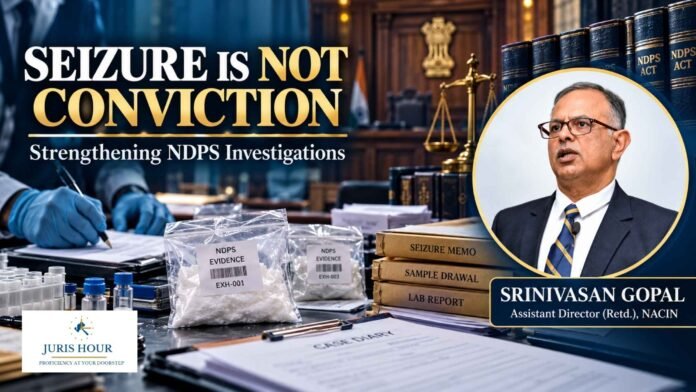
The Article “SEIZURE IS NOT CONVICTION” is authored by SRINIVASAN GOPAL, ASSISTANT DIRECTOR(RETD) NATIONAL ACADEMY OF CUSTOMS INDIRECT TAXES AND NARCOTICS PALASAMUDRAM.
Learning from NDPS Judgments, Strengthening Investigation and Building Institutional Capacity: Musings on Enforcement, Learning, Prosecution and Prevention.
INTRODUCTION
During the course of my analysis of recent judgements of the Ld. Trial Courts and the bail orders passed by different Courts under the NDPS Act, I paused and reflected on them. A number of cases were lost not because seizures were not effected, but on account of non-compliance with various mandatory provisions of the NDPS Act. But one case that stood out was decided on 28 September 2026 by the Ld. Judge, Special Court, SAS Nagar, Punjab in the case of State v. Sachin Kumar and Others [CNR No.PBSA010058472020]. The Ld. Judge, while acquitting all three accused, observed and held as under:
“16 The combined reading of all these statements of witnesses, which are material to the case when read together clearly reflects that the manner and method of investigation as depicted in the memo was in fact not followed and in fact the defence put up by accused has legs to stand against the prosecution story creating a doubt in the prosecution case. The material contradiction about the preparation of document, the facts present at the spot of recovery and even their ignorance and contradiction about the contraband goes to the root of case. In that case non compliance of Section 50 NDPS Act, non joining of independent witness and the inquiry being conducted by DSP Gursher Singh who was member of investigating team clearly reflects that there was doubt in the entire prosecution story shattering the very base of prosecution as well as recovery from Raghbir Singh is concerned, he has also come up with case that he was picked from his house and even his motor cycle was taken away. PW-10 ASI Sukhpal Singh while facing the cross-examination had stated that he had not accompanied ASI Satish Kumar and apprehended Raghbir Singh accused. He stated that private work was done by one operator Karanvir Singh. He also stated that firstly, accused Raghbir Singh was brought to CIA and then he was taken to PS Phase 1. This also fortified the stand of the accused that the false recovery has been shown.
Buy Now: 90+ Supreme Court Judgments – September 2026
17 Thus, collectively these facts reveals that accused have rebutted the presumption drawn against them and doubt in prosecution story takes this court to the conclusion that investigating agency could not prove on record entire evidence which is required to prove the guilt of the accused beyond reasonable shadow of doubt, therefore, accused are hereby acquitted of the charges framed against them in this case. Statements of accused have been recorded. In view of the statements of accused, the bail/surety bonds furnished by the accused shall remain in force for a period of six months under section 437(A) Cr.P.C and after the expiry of the said period of six month, the bail/surety bonds furnished by the accused shall be discharged automatically.”
A list of 14 cases – Court-wise and issue-wise – is appended to this article. Readers may go through the Annexure and reflect on the cases discussed.
The purpose of the Annexure appended to this article is to learn. Why learn? Because the NDPS Act is extremely dynamic and we have to adapt and change with the times. As the modus operandi keeps changing, we cannot simply rely on traditional methods deployed a few decades ago, in what was essentially a non-internet era and a largely unconnected world.
The decisions, in the form of judgments or orders, right from the Ld. Trial Court upwards, show us what actually happens when a case reaches the Ld. Trial Court. How does the Ld. Trial Court look at a particular case, and what are the things that it looks for? The Ld. Trial Courts are bound by the decisions of the jurisdictional High Court and by the law declared by the Hon’ble Supreme Court, the latter being binding on all Courts within the territory of India by virtue of Article 141 of the Constitution of India.
The compilation clearly shows us where a case may become vulnerable because of gaps in procedure, documentation, investigation, custody, sampling, presentation or proof. These judgments should, therefore, become learning material for the empowered officers who are going to investigate the next case. The approach is to learn, unlearn and relearn, and to take the case forward without committing the same mistakes again and again.
It is stressed at this juncture that the purpose of the article is not to criticise any of the empowered departments/officers/ Ld. Public Prosecutors/Ld. Defence Counsel, or for that matter, any Court.
My approach is simple: learn from the mistakes, admit the mistakes when they occur, understand why they occurred, and ensure that the same mistake is not repeated. There can be no real progress if we are unwilling to acknowledge our own shortcomings.
PART A — ENFORCEMENT: FROM SEIZURE TO A CASE THAT CAN STAND ON ITS OWN
1. Seizure is not conviction
One phrase I repeatedly use in my sessions is: “SEIZURE DOES NOT AMOUNT TO CONVICTION.”
Seizures of substances of abuse are extremely important, and there can hardly be any second opinion or dispute about their importance.
When I refer to substances of abuse, my primary focus is on the narcotic drugs and psychotropic substances that in today’s world are known as ‘hard drugs’. They include heroin, cocaine, MDMA, LSD, amphetamine, methamphetamine crystals, and similar drugs which have found their way into the illicit drug supply chain.
Seizures of substances of abuse, as is well known, drastically reduce the quantity available in the illicit supply chain. That is a real and immediate enforcement outcome. Once the substance of abuse has been seized and dealt with according to the NDPS Act, it is no longer available for circulation, and this is one of the most important immediate outcomes of a case booked under the NDPS Act.
It may be noted that seizure is only the beginning of the journey. The prosecution must still establish its case through lawful procedure, reliable evidence and proper proof.
Therefore, we should never sit on the seizure alone. We must ask what happened after the seizure: How was the seizure documented? How was the material weighed? How was it sampled? How was the seal handled? Who were the witnesses? How was the personal search of the suspect conducted? Was a proper notice under Section 50 issued? Were the contents of the notice under Section 50 explained to the person in a language known to him? Where was the seized case property kept? Was it kept in a notified godown as mandated under the Sampling Rules, 2022? When was it sent to the FSL? Is the chain of custody clear? Are the witnesses and documents consistent? Has the accused been properly linked to the offence? Has the case been properly prepared for Court?
The lesson is simple: STOP THE SUBSTANCE OF ABUSE FROM ENTERING THE ILLICIT SUPPLY CHAIN, but also PROVE THE CASE.
2. Documentation is evidence architecture
My teaching slogan has always been:
“THE MORE YOU SWEAT IN DOCUMENTATION, THE LESS YOU WILL BLEED IN THE COURTS.”
Documentation is not routine clerical work. Documentation preserves the ability to prove what actually happened in a Court of Law. Every properly recorded step helps avoid possible disputes and lends credence to the entire operation.
The judgments in the tabulation repeatedly bring this home. Generally, we see that issues have arisen around chain of custody, Section 42 compliance, Section 55 safe custody, delay in sending samples to the FSL, Section 52A procedure, seal handling, public witnesses, Section 50 compliance, weight determination, malkhana records and other contemporaneous documentation. These issues recur, and despite the NDPS Act having been in force since 1985, we see the same mistakes being repeated. The empowered officers should have one thing at the back of their minds. That is: the higher the punishment, the stricter the scrutiny of the evidence. So, it is essential that proper documentation is done to make the investigation transparent, traceable and capable of being explained many years later in Court.
3. A case booked is like a newborn child
I use a simple analogy. A case that is booked should be treated like a newborn child. The child cannot be left after birth and expected to stand on its own. The child needs care, attention, protection, guidance and nourishment until the child can stand independently.
The same should apply to a case. Booking the case is not the end of the officer’s responsibility. It is the birth of the case.
The need for such continuing attention does not cease with the completion of the investigation or the filing of the complaint. A passing reference may be made to the recent decision of the Bombay High Court in Satly Thomas v. Union of India [CNR No.: HCBM010329002025], where serious concerns arose regarding the production of the accused and the progress of the trial. The decision serves as a useful reminder that a case requires institutional attention even after it enters the trial stage. Booking a case is, therefore, not the end of responsibility; it is the beginning of a process that must be followed through until the case attains finality at the highest level.
The case must then be properly investigated, documented, supervised, taken through the FSL/CRCL/CFSL process, followed during remand and trial, and prepared for presentation before the Court. The case should receive the same sustained attention until it can stand on its own on the strength of the evidence.
4. Learn from mistakes — and first admit them
I emphasise this point repeatedly. We should learn from our mistakes. But to learn from a mistake, we must first admit that a mistake has been committed.
An acquittal should not automatically be treated as a failure of an officer or a department. Nor should an adverse judgment be treated as something to be hidden. It should be studied carefully. What was done correctly? What could have been done better? Was the problem individual, procedural, supervisory or systemic? What can be changed so that the next case is stronger?
A judgment of acquittal can, therefore, become a stepping stone towards future success if the empowered departments/organisations/agencies convert the experience into institutional learning. The judicial result must be respected while the institutional lesson must be captured.
5. The entire chain of events matters
An NDPS case is not the work of one person. It is a team effort. It starts with the collection of intelligence and the receipt of information. Then there is a chain of events: detection, information, search, seizure, arrest, documentation, sampling before the Ld. Magistrate, sealing, safe custody, FSL examination, investigation, remand, charge-sheet, evidence, examination-in-chief, cross-examination and passing of final verdict of the Ld. Trial Court.
Every person in this chain has a role. The officer who receives the information matters the most. It is the starting point. His role cannot be diminished. It is this officer’s work that sets the case in motion. The officer who detects the offence matters. The officer and every member of the search team involved in conducting the search matter. The person responsible for the case property matters. The investigating officer matters. The officer handling the records matters. The prosecutor matters. The person who prepares the case for court matters. The strength of the case is, therefore, the strength of the entire chain. This is where cooperation among empowered officers becomes essential.
“The success of one officer should become the knowledge of the department; the mistake of one officer should become the lesson of the department.”
6. The prosecutor must be properly briefed
A properly investigated case must also be properly presented before the Ld. Trial Court. Briefing the Public Prosecutor or counsel is, therefore, an important step, not a formality.
The prosecutor should know the factual sequence, the role of each accused, the documents, the witnesses, the seizure and sampling process, the chain of custody, the defence likely to be taken, the previous orders in the case and the points that may arise during cross-examination and arguments.
The investigating officer should also understand what the law requires the prosecution to establish. This should be a two-way process. The investigator brings the facts and the experience gained during the investigation. The prosecutor brings the legal and courtroom perspective.
Dedicated monthly or quarterly meetings between investigators and prosecutors can go a long way towards achieving this. Problems can be identified before they become failures in Court.
7. A case should have impact beyond the seizure
A case booked in a particular area should, as far as possible, have impact value in that area. When a modus operandi is detected, the learning should not remain with the officer who detected it.
The officer can share, within the authorised departmental system, the modus operandi, the structure that was dismantled, the manner in which the accused were identified and arrested, the contraband seized, the sampling methodology, the documentation adopted, the difficulties faced during the investigation and what happened during examination-in-chief, cross-examination and re-examination.
A common, secure portal for authorised officers can carry such case-learning material without disclosing the identities of accused persons or other sensitive particulars. The emphasis should be on facts, modus operandi, procedure, judicial learning and operational lessons.
The spread of knowledge is undoubtedly useful. What one officer learns in one case should become available, in an appropriate and secure form, to other empowered officers.
8. Recognise good work
Officers who have handled difficult cases with care should be recognised. Recognition should not be based only on the quantity seized or the number of cases booked. A proper assessment can consider investigation, team management, logistics, documentation, preparation of remand papers, coordination, prosecution support, response to writ proceedings and the officer’s contribution to institutional learning.
Recognition of good work encourages professional pride and creates a healthy culture of responsibility. It also encourages others to emulate the person felicitated and to aim to rise to that level.
9. Continuous learning is essential
An empowered officer must also remain an eager learner. The law is extremely dynamic. A person cannot rely only on what was learnt years ago.
What happens in North-East India may not happen in Western India. Trafficking patterns, modus operandi, local conditions and investigative challenges can be different. But an officer should know what is happening elsewhere and learn from it.
We are moving towards increasingly integrated national systems. Professional knowledge should move in the same direction. An officer should remain rooted in local realities while being aware of developments across the country and, where relevant, globally.
One should never take one’s position for granted or sit on past laurels. Experience should create confidence, not complacency. Past success should be a foundation for moving forward, not a chair on which to sit and enjoy past achievements. In a participative environment, each person in the chain is expected to contribute their best to its success.
10. The learning cycle
INVESTIGATION → COURT → JUDGMENT → LESSON → TRAINING → SUPERVISION → BETTER INVESTIGATION
That should be the cycle. The judgment should not be the end of the learning process. It should be the beginning of the next improvement. A self-correcting approach is the best way to improve.
PART B — PREVENTION: CATCH THEM YOUNG
Enforcement is only one side of the national response to drugs. Prevention is the other.
If drug networks seek to attract young people with promises of easy money1, the response must begin before the network reaches them. Young people need awareness, knowledge, confidence and the ability to recognise the risks and pressures around them.
Schools, colleges, universities, village chaupals and other places of gatherings, have, therefore, an important role. Awareness should not be a one-day programme. It should be continuous, practical and suited to the age of the students. Parents, teachers, counsellors, police, enforcement agencies, health professionals and civil society all have a role.
The objective should be simple: catch them young with awareness and knowledge, before the drug network catches them.
Prevention is also an investment in India’s human capital. Protecting a young person from addiction does not merely save one individual from harm; it protects a family, preserves a future member of the workforce and retains a potential contributor to the nation.
This requires a whole-of-society approach. Enforcement must stop supply. Treatment must help those who are already affected. Prevention must reduce the number of young people who enter the cycle in the first place.
CONCLUSION
The judgments in the Annexure made me reflect on a simple question: What can we do better?
The answer is to learn. We should learn from mistakes, admit mistakes, document carefully, supervise continuously, brief the prosecutor properly, follow the case, study the emerging trends, study the judgments, update ourselves, share the learning and improve the next investigation. While these enforcement actions address the supply side, we should also join forces to address demand reduction more effectively.
A seizure removes substances of abuse from the supply chain. A well-built case carries the evidence to Court. A judgment—whether of conviction or acquittal—should then teach us something for the future.
If every case is treated with the care given to a newborn child, if every officer remains a learner, if every link in the chain accepts responsibility, and if knowledge is shared across departments, regions and the country, there can be a dramatic improvement in the quality of prosecutions.
And prevention must run alongside enforcement. We must protect our youth and our human capital. We must involve society as a whole.
My basic philosophy remains simple:
“SEIZURE IS NOT CONVICTION.”
“THE MORE YOU SWEAT IN DOCUMENTATION, THE LESS YOU WILL BLEED IN THE COURTS.”
“A CASE BOOKED IS A CASE TO BE NURTURED UNTIL IT CAN STAND ON ITS OWN.”“CATCH THEM YOUNG — BEFORE THE DRUG NETWORK CATCHES THEM.”
Relevant Case Laws
| No. | CASE | COURT / CITATION | ISSUE | COURT’S CONSIDERATION / RESULT | ARTICLE LESSON |
| 1 | State v. Kamal Kumar | Special Judge (NDPS), Patiala House SC 123/2017; FIR 201/2013 | Sections 20(b)(ii)(B), 52A; Magistrate sampling; 26-day FSL delay; public witnesses | The source tabulation records acquittal after the Court considered Section 52A compliance, FSL delay and witness issues. | Sampling, certification and laboratory dispatch should be treated as one continuous evidentiary process. |
| 2 | State v. Nagina Begum | Special Judge (NDPS), Patiala House SC 182/2021; FIR 299/2020 | Sections 21(b), 50, 52A, 55, 57; public witnesses; FSL delay; malkhana | The source records acquittal after interconnected search, sampling, custody, reporting and FSL issues were considered. | A defect in one link can become important when the surrounding custody and documentation are also questioned. |
| 3 | State v. Chibuzor Peter Ofonedu | Special Judge (NDPS)-01, Dwarka CNR DLSW01-014396-2019 | Sections 50, 100(8); FSL form; seal custody; malkhana; visual/vehicle evidence; weight | The source records NDPS acquittal after the Court considered public-witness issues, Section 50 documentation, FSL-form evidence, seal handling, FSL delay and supporting evidence. | The seizure must remain demonstrable from the spot through custody and laboratory examination. |
| 4 | State v. Ikuezu Udochw Kwu @ Fabrice Dallo | Special Judge (NDPS)-01, Dwarka CNR DLSW01-015525-2018 | Secret information; Sections 50, 52A, 55; gross/net weight; sample weight; malkhana; seals | The source records acquittal after inconsistencies concerning search, weights, samples, seals, custody and witness examination were considered. | Consistency in contemporaneous records, measurements, seals and custody is essential. |
| 5 | State v. Okeke Ikenna & Anr. (A2 Eweely Ethel) | Special Judge (NDPS)-01, Dwarka CNR DLSW01-010190-2016 | Section 29; no recovery from co-accused; CDR/mobile connectivity; public witnesses; Section 67 | The source records acquittal under Section 29 after the prosecution case against A2 was found insufficiently connected by the material considered. | Investigate and prove the accused-specific nexus; association alone should not be allowed to substitute for evidence. |
| 6 | State v. Ajay Kumar, Rashid @ Sajid & Ors. | Special Judge NDPS, Saket SC 8274/2016; FIR 118/2011 | Sections 21(c), 29; public witnesses; logbook discrepancies; conspiracy; chain | The source records NDPS acquittal after search/seizure discrepancies and failure to establish conspiracy were considered. | Contemporaneous records, search evidence and subsequent testimony must remain mutually consistent. |
| 7 | Bheru Lal v. Union of India | Rajasthan High Court CNR RJHC010105192024; NC [2026:RJ-JD:47203] | Sections 8/29 & 67; co-accused statement; absence of independent recovery/CDR/overt nexus | The source records that the Court considered the Section 67 material and the absence of independent nexus material; the revision was allowed and the charge under Section 8/29 was set aside. | A conspiracy allegation requires a factual nexus capable of surviving scrutiny beyond a co-accused statement. |
| 8 | Kunhimonu @ Hussain Sharief & Anr. v. State of Karnataka | Karnataka High Court Crl. A. No. 7/2026 | Sections 20(b)(ii)(C), 55, 57; malkhana; link evidence; 18-day FSL delay | The source records that conviction was overturned and acquittal followed after the Court considered the broken chain, Section 55 custody and unexplained FSL delay. | Safe custody and prompt, traceable dispatch to FSL are part of the proof of identity and integrity. |
| 9 | Seniammal v. State | Madras High Court CNR HCMA011983012026; Crl.O.P. 24478/2026 | Article 22(1); Section 47 BNSS; Sections 37, 42, 52A NDPS; grounds of arrest; relative intimation | The source records bail being granted after the Court considered communication of grounds of arrest and related procedural issues. | Communication to a relative and communication of grounds of arrest to the arrestee are distinct matters. |
| 10 | Amit Singh & Anr. v. State of U.P. & NCB | Allahabad High Court Habeas Corpus W.P. 582/2026; NC 2026:AHC:202889-DB | Sections 52A, 36A(4), NDPS Rules 2022; disposal/destruction; sampling; quantitative analysis; limitation | The source records the arrest being held illegal and release ordered after the Court considered the Section 52A/disposal and related statutory issues. | Inventory, sampling, judicial involvement and disposal must be approached as statutory steps, not as post-seizure formalities. |
| 11 | Manoj Pradhan v. State NCT of Delhi | Delhi High Court CNR DLHC010352412026; Bail Appln. 3114/2026 | Sections 20, 27A, 29, 37 NDPS; Section 483 BNSS; no physical recovery; banking transactions | The source records regular bail where the alleged financial transactions were considered in the absence of physical recovery from the applicant. | When invoking Section 27A, the investigation should establish the evidentiary connection between financial activity and the alleged illicit traffic. |
| 12 | Arfaz Mehboob Tak v. Union of India | High Court of J&K and Ladakh at Jammu Bail App. 144/2025 | Sections 67, 27A, 37 NDPS; digital payments; co-accused statement | The source records bail being granted after the Court considered the evidentiary value of the Section 67 material and the isolated monetary transactions relied upon for Section 27A. | Financial evidence should be investigated for its actual connection with the alleged drug operation rather than treated as self-proving. |
| 13 | Dickson Alex / Anthony Chijioke Nweke / Arijit Mukherjee v. Union of India | Bombay High Court CNR HCBM010132002026; C.R. 127/2023 DRI Mumbai | Sections 8(c), 21(c), 23(c), 27A, 29, 30, 67, 37; direct recovery versus indirect nexus | The source records bail for A2/A3 and denial for A1, distinguishing direct physical recovery from the evidentiary material relied upon against the other applicants. | At bail stage, distinguish carefully between direct recovery and the quality of evidence connecting a peripheral accused to the seized consignment. |
| 14 | Imtiyaz Ahmed Khan v. NCB | High Court of J&K and Ladakh at Jammu Bail App. 373/2025; NC 2026:JKLHC-JMU:1543 | Sections 8, 20, 29, 60, 37; Sections 35/54; Section 483 BNSS | The source records the High Court affirming rejection of bail in a commercial-quantity case and considering the statutory Section 37 framework and presumptions. | The investigation and case papers must be prepared with the statutory Section 37 threshold in mind where commercial quantity and presumptions are involved. |
Read More: JURISHOUR | TAX LAW DAILY BULLETIN : 2 OCTOBER, 2026

