
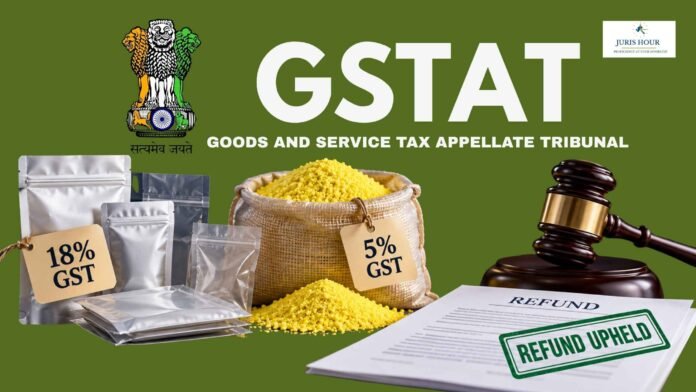
The Goods and Services Tax Appellate Tribunal (GSTAT), Kolkata Bench, has upheld a refund of ₹63,19,046 on accumulated input tax credit arising from packaging materials taxed at 18%, even though the sulphur purchased in bulk and sold in smaller packets attracted the same GST rate of 5%.
The bench comprising Judicial Member S.G. Chattopadhyay and Technical Member Bijoy Kumar Kar observed that the higher tax rate on packaging inputs brought the taxpayer’s claim within the scope of Section 54(3)(ii) of the Central Goods and Services Tax Act, 2017.
BUY NOW: E-Magazine: 1000+ Landmark GST Judgments (2017–2026)
The bench directed the department to refund the sanctioned amount, as upheld by the first appellate authority, within three months. Santosh
The dispute concerned the appellant/assessee operating from Jalpaiguri in West Bengal. The order records that the taxpayer supplied sulphur under HSN 2503 and fertilisers under HSN 3103 and 3105.
For the supplies in dispute, the taxpayer purchased loose sulphur in bulk at 5% GST and sold it in customised packets containing smaller quantities. The packaging materials, classified under HSN 3923, attracted GST at 18%, while the outward supply of sulphur remained taxable at 5%.
The taxpayer claimed that this difference between the tax rate on packaging inputs and the rate on the finished outward supply resulted in the accumulation of unutilised input tax credit.
On May 25, 2024, it filed a refund application in Form GST RFD-01 seeking ₹64,78,000 for the period May 1–31, 2022, on account of an inverted duty structure. The refund sanctioning authority partially allowed the application and sanctioned ₹63,19,046 through an order dated July 15, 2024.
The department challenged the sanction before the first appellate authority, arguing that Section 54(3)(ii) did not permit an inverted duty refund where the inward and outward supplies were the same goods attracting the same rate of GST.
According to the department, the taxpayer merely purchased loose sulphur and sold the same product in packets. Since sulphur attracted 5% GST at both stages, the department maintained that there was no qualifying inversion.
The department relied on CBIC Circular No. 135/05/2020-GST dated March 31, 2020, particularly paragraph 3.2, and the subsequent Circular No. 173/05/2022-GST dated July 6, 2022.
The first appellate authority rejected the departmental appeal on June 25, 2025. It held that the 18% GST on packaging materials, compared with the 5% rate on outward supplies, supported the refund under Section 54(3)(ii), read with Rule 89(5) of the CGST Rules.
The department then approached GSTAT under Section 112(1), raising substantially the same objections.
The taxpayer stated that it was engaged in manufacturing and selling agrochemicals and packaged bulk sulphur into smaller units according to customer requirements.
It argued that packaging was integral to the outward supply and that the packaging materials qualified as “inputs” under Section 2(59) of the CGST Act. That provision covers goods, other than capital goods, used or intended to be used in the course or furtherance of business.
The taxpayer maintained that the statutory test concerned whether credit had accumulated because the tax rate on inputs was higher than the rate on output supplies. The fact that sulphur itself attracted 5% GST at both the purchase and sale stages did not eliminate the effect of packaging inputs taxed at 18%.
It also submitted that a CBIC circular could not override the substantive refund entitlement provided by the Act.
That case concerned tea purchased in bulk and sold in containers, packets, pouches and sachets. The Tribunal had recognised that packaging materials, cartons and plastic containers were indispensable to marketing packaged tea and qualified as inputs under Section 2(59).
The Tribunal had also rejected the department’s reliance on paragraph 3.2 of the March 2020 circular. It explained that the clarification addressed the accumulation of credit arising from a reduction in the tax rate on the same goods over time.
The bench observed that packaging materials attracted 18% GST while the output supply attracted 5%. This resulted in accumulated credit attributable to inputs taxed at a higher rate than the outward supply.
The Tribunal relied on the Calcutta High Court’s decision in Shivaco Associates and Another v. Joint Commissioner of State Tax, Directorate of Commercial Taxes and Others, and the Delhi High Court’s decision in Indian Oil Corporation Limited v. Commissioner of Central Goods and Services Tax and Others.
As discussed in the order, these decisions establish that administrative circulars cannot overreach the CGST Act or deny an entitlement available under its provisions.
The Tribunal referred to the Delhi High Court’s reasoning that Section 168(1) empowers CBIC to issue instructions for uniform implementation of the Act. That power does not authorise the Board to add to the statute or curtail its operation.
The bench also considered the Karnataka High Court’s decision in Indian Oil Corporation Limited v. Assistant Commissioner of Central Tax, South Division 1, Bengaluru. The judgment, reproduced in the Tribunal’s order, explained that Section 54(3)(ii) does not contain an exception excluding refund merely because the principal input and output goods are the same. The Karnataka High Court had further discussed the substitution of paragraph 3.2 through the July 2022 circular and the treatment of multiple inputs attracting different tax rates under Rule 89(5).
The Tribunal concluded that the taxpayer’s case fell within Section 54(3)(ii) and that the first appellate authority had correctly upheld the refund arising from the inverted duty structure.
It dismissed the department’s appeal and directed payment of the sanctioned refund within three months. No costs were awarded.
Membership Required to Access Case Details & Order Copy
To view the complete Case Details and Download Order Copy, you must have an active membership. Please subscribe to continue.
Read More: Expired E-Way Bill Alone Can’t Justify GST Penalty Without Evidence Of Tax Evasion: GSTAT

