
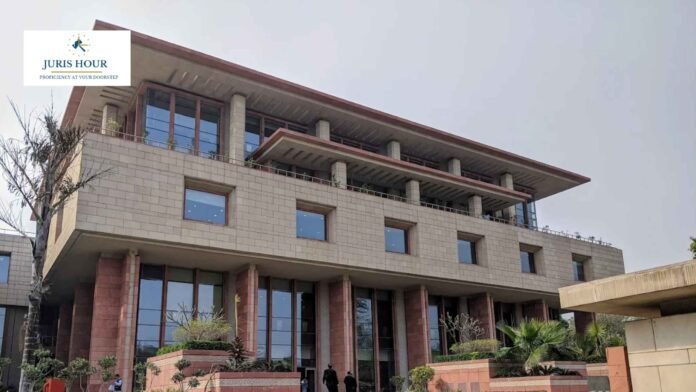
The Delhi High Court has upheld a GST anti-profiteering order requiring a housing developer to pass on ₹2.31 crore to homebuyers, along with 18% interest and held that credit which the developer says it could have claimed before GST cannot be treated as credit it actually received.
A Division Bench of Justice Anil Kshetrapal and Justice Shail Jain upheld a finding that the developer retained an additional input tax credit (ITC) benefit of ₹2,07,08,131 instead of passing it on to flat buyers. After adding ₹24,84,976 in GST collected on that amount, the sum payable to homebuyers came to ₹2,31,93,107, with interest at 18%.
Buy Now: E-Magazine: 1000+ Landmark GST Judgments (2017–2026)
The proceedings arose from a homebuyer’s complaint that the benefit of ITC available after the introduction of GST had not been passed on through a corresponding reduction in prices. An initial investigation resulted in an anti-profiteering determination of ₹1,85,70,263, which the erstwhile National Anti-Profiteering Authority accepted in June 2022.
The petitioner challenged that determination. In its January 2024 judgment in Reckitt Benckiser India Pvt. Ltd. v. Union of India, the Delhi High Court found fault with the method generally used for real estate projects: comparing ITC as a share of turnover before and after GST. Construction expenses and payments received from buyers do not arise uniformly over a project’s life, the Court had explained. It directed the authorities to calculate the total GST-related saving for each project and divide it by the project area to determine the benefit per square foot.
The petitioner’s case was consequently sent back for a fresh determination. The Directorate General of Anti-Profiteering (DGAP) submitted a revised report in April 2025, which GSTAT upheld on March 23, 2026. The developer then approached the High Court again.
For the revised calculation, the DGAP examined the project’s purchase value of goods and services and the credit actually availed. It recorded no pre-GST credit actually claimed and post-GST ITC of ₹2,07,76,653. Using the post-GST purchase value, it calculated a project-level saving of ₹2,07,65,434.
The DGAP divided that saving by the total project area of 2,70,048 square feet, arriving at a benefit of about ₹76.895 per square foot. Applying that figure to the sold area of 2,69,304 square feet produced the principal profiteering amount of ₹2,07,08,131. GST at 12% brought the total to ₹2,31,93,107.
The assessee argued that this was effectively the rejected ITC-to-turnover method with “purchase value” substituted for “turnover.” The High Court disagreed. It said the earlier judgment had rejected an assumed link between ITC and turnover, not every comparison of the pre-GST and post-GST periods. The revised exercise assessed purchases and credit actually availed, then distributed the calculated project saving by area. The developer had not shown that this method violated the earlier directions.
A central part of assessee’s case was that it had been legally eligible for about ₹2,38,25,609 in CENVAT credit on input services before GST but had failed to claim it because of an error. On that basis, it argued that post-GST credit on services should not be treated as a new benefit. It said that, at most, credit of ₹14,52,570 on inward goods could be considered.
The Court drew a distinction between eligibility for credit and actual use of credit. The developer’s pre-GST ST-3 returns recorded nil CENVAT credit availed. Its affidavit also acknowledged that the credit had not been claimed. By contrast, it had actually availed post-GST ITC.
Treating the unclaimed CENVAT amount as a pre-GST benefit would compare an actual post-GST benefit with a hypothetical earlier one, the Court held. It therefore found no basis to exclude the post-GST ITC relating to input services merely because similar credit might have been available under the previous regime.
The developer argued that a higher tax incidence on services after GST had inflated the credit figure. It had also submitted an alternative calculation of ₹1,39,93,358 on a “without prejudice” basis. The High Court clarified that such an alternative calculation should not automatically be treated as an unconditional admission of liability. However, GSTAT’s order rested on its examination of the DGAP’s calculation, rather than on that submission alone.
The assessee also pointed to expenditure it had borne for a sub-station and related electrical infrastructure. The Court did not decide whether that expense could be recovered from homebuyers, saying the issue would depend on the parties’ agreements and could be pursued through an available legal remedy. It held that the anti-profiteering calculation did not call for every project expense to be broadly offset against the ITC benefit.
The Court also upheld the inclusion of GST collected on the additional amount retained by the developer and found no separate defect in GSTAT’s direction to pay 18% interest.
The Bench concluded that GSTAT had considered the developer’s principal objections and that the revised calculation complied with the governing directions for real estate projects. It found no jurisdictional error or clear illegality warranting interference in writ proceedings.
The writ petition and pending applications were dismissed on September 28, 2026. The GSTAT direction to pay ₹2,31,93,107 to the homebuyers, together with 18% interest, therefore stands.
Membership Required to Access Case Details & Order Copy
To view the complete Case Details and Download Order Copy, you must have an active membership. Please subscribe to continue.

