
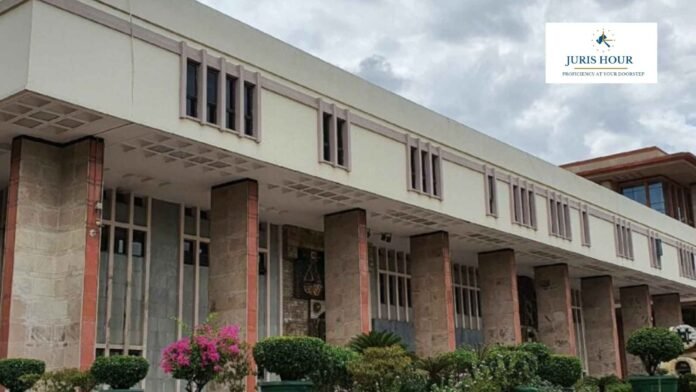
The Delhi High Court has directed the assessee to pursue its statutory appeal against a GST order covering several issues, including whether certain services qualify as exports and whether the department had sufficient grounds to invoke Section 74 of the Central Goods and Services Tax Act, 2017.
The Bench of Justice Anil Kshetrapal and Justice Shail Jain declined to decide the individual tax demands in writ proceedings. The court said the disputes require examination of agreements, returns, invoices, foreign inward remittance certificates and other records, making the appellate authority the appropriate forum.
Buy Now: E-Magazine: 1000+ Landmark GST Judgments (2017–2026)
The appellant/assessee challenged an Order-in-Original, a demand summary in FORM GST DRC-07 dated January 29, 2025, and a rectification order in FORM GST DRC-08 dated February 3, 2025. The court noted that the rectification corrected the penalty shown in DRC-07 but did not alter the substantive findings of the Order-in-Original.
Although an appeal under Section 107 of the CGST Act was available, the assessee relied on two Supreme Court judgments delivered after the Order-in-Original. It argued that those decisions had a material bearing on its case.
The first judgment concerned assessee’s money transfer and related services from July 2003 to September 2007, under the former service tax regime. In Commissioner of Service Tax III, Mumbai v. Vodafone India Ltd., the Supreme Court dismissed the Revenue’s appeal against a CESTAT finding that Transcorp’s activities fell within the Export of Service Rules, 2005 and were not liable to service tax.
The High Court stressed that the present dispute concerns a later period governed by GST law. Whether the earlier ruling affects Transcorp’s current transactions with Western Union must be assessed against the present contractual arrangement and the applicable provisions of the Integrated Goods and Services Tax Act, 2017, including Sections 2(6), 2(13) and 13.
The export of services demand also covers two other streams: Cash-to-Master and VISA Worldwide. The court made no finding on the GST treatment of any of the three streams.
The assessee also relied on the Supreme Court’s August 2026 decision in G.R. Infra Projects Limited Ratlam v. State of Madhya Pradesh. As recounted by the High Court, that decision held that the facts needed to invoke Section 74 must appear in the show cause notice itself. Merely using terms such as “fraud”, “wilful misstatement” or “suppression of facts” without explaining their factual basis is insufficient; the department cannot supply that basis later through a counter-affidavit.
The assessee argued that much of the demand arose from information already disclosed in its statutory returns and records, and that the department had identified no positive act showing an intent to evade tax.
The High Court noted, however, that the show cause notice dated August 1, 2024 contains a separate section setting out the department’s grounds for invoking Section 74. It alleges that material facts were omitted from statutory returns, that an audit detected the discrepancies, and that the omissions were intentional. The assessee disputes both those allegations and their legal sufficiency.
The court expressly left open whether the notice satisfies Section 74. It also left open Transcorp’s consequential arguments on limitation and the possible application of Section 75(2).
The Order-in-Original addresses six issues: input tax credit availment; reconciliation of GSTR-1 and GSTR-3B; credit linked to suppliers who allegedly failed to file GSTR-3B; reversal of common credit; supplies claimed as exports of services; and corporate guarantees.
Given the factual examination required across those issues, the High Court directed the appellate authority to consider the parties’ arguments independently and in accordance with law.
Transcorp may file its Section 107 appeal within four weeks of September 14, 2026. If filed within that period, the appeal must be heard on its merits and cannot be rejected as time-barred. The court also barred coercive steps under the challenged Order-in-Original for the same four-week period. Thereafter, the parties will be governed by the appellate authority’s orders.
Membership Required to Access Case Details & Order Copy
To view the complete Case Details and Download Order Copy, you must have an active membership. Please subscribe to continue.
Read More: GST Refund Rejection Quashed After Revised Notice Returned Undelivered: Gujarat High Court

