
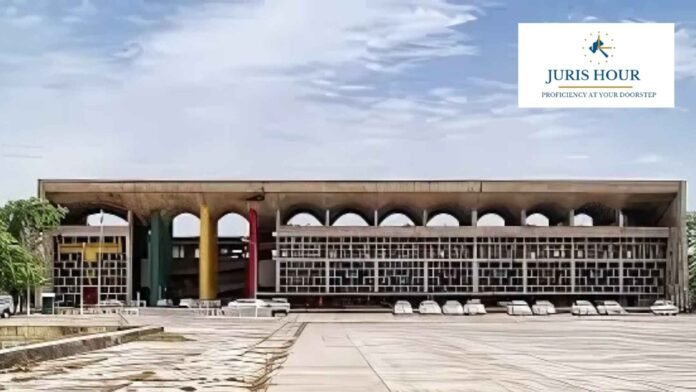
The Punjab and Haryana High Court has set aside an order refusing to condone the delay in an HMT employee’s refund claim and directed the tax authority to reconsider it. It did not decide whether the employee is entitled to the exemption or refund.
The bench of Justice Deepak Sibal and Justice Sunish Bindlish has held that an income tax authority considering a delayed refund claim under Section 119(2)(b) of the Income Tax Act must examine whether the claim is correct and genuine and whether refusing to consider it would cause genuine hardship. It cannot reject the application through an unreasoned finding or rely on objections unrelated to those tests.
Buy Now: Think Before You Pay Cash: 50+ Landmark Rulings on Section 40A(3) Of The Income Tax Act, 1961
The case was heard with 20 connected petitions filed by former employees challenging the Principal Commissioner of Income Tax, Panchkula’s refusal to condone delay in filing revised returns for assessment year 2017–18.
HMT’s tractor division had faced financial difficulties, and its employees had not received salaries since July 2014. After the Union Cabinet decided in October 2016 to close the division, HMT offered employees a Voluntary Retirement Scheme or Voluntary Separation Scheme. Employees who did not opt for it faced retrenchment under the applicable law.
The assessee, then a Senior Office Assistant, opted for the scheme. According to the Form 16 issued by HMT, he received ₹29,14,500. The employer treated ₹5 lakh as exempt under Section 10(10C) of the Income Tax Act and computed the remaining ₹24,14,500 as taxable. Singh filed his return on that basis on August 3, 2017, and it was processed and accepted.
A similarly situated employee subsequently claimed exemption under Section 10(10B), which concerns retrenchment compensation, instead of Section 10(10C). The Commissioner of Income Tax (Appeals) allowed that employee’s appeal in January 2020. The High Court also noted that an Income Tax Appellate Tribunal order dated September 20, 2023, allowed appeals by other similarly situated employees, and that the appellate decisions had attained finality.
After learning of the earlier appellate decision, Singh applied to the Principal Commissioner on August 10, 2020, for condonation of delay so that he could file a revised return claiming exemption under Section 10(10B). He said the revised claim would entitle him to a refund of ₹7,19,819.
The Principal Commissioner rejected the application on January 19, 2022. Among the reasons given were that the department had not accepted the favourable appellate ruling on its merits, though it had not appealed because of the low tax effect, and that Singh had not established genuine hardship.
The High Court explained that CBDT Circular No. 9/2015, issued under Section 119(2)(b), permits the competent authority to consider delayed refund claims within its prescribed conditions. For such an application, the authority must examine whether the refund claimed is correct and genuine and whether the case involves genuine hardship. The circular also prescribes a six-year limit from the end of the relevant assessment year for making a condonation application.
The Bench found no independent finding in the Principal Commissioner’s order on whether Singh’s proposed Section 10(10B) claim was correct or genuine. The fact that the department disagreed with an appellate order but did not challenge it because of the monetary limit did not, by itself, answer that question.
The court also found the hardship finding inadequate. The Principal Commissioner had stated, without supporting reasons, that no case of hardship was made out. The order did not address Singh’s loss of employment following the division’s closure, the significance of the claimed refund to him, or the decisions concerning similarly situated employees.
Another reason in the rejection order was that no appellate order had been passed in Singh’s own case. The High Court called that observation irrelevant: Singh had relied on decisions in other employees’ cases, not claimed to have obtained an appellate order himself.
Before the High Court, the department also argued that Singh had failed to explain the delay in seeking to revise his return. The Bench declined to uphold the rejection on that basis because the Principal Commissioner’s order had not relied on it.
The court further distinguished an application under Section 119(2)(b) from an application to condone delay under Section 5 of the Limitation Act. Under the CBDT circular, the controlling questions were the correctness and genuineness of the claim and the existence of genuine hardship, subject to the circular’s time limit. Delay remained relevant to the circumstances, but a detailed explanation of it was not a separate precondition of the kind urged by the department.
In any event, the Bench found that Singh had offered an explanation. He had filed his original return using the exemption reflected in HMT’s Form 16 and sought to make the Section 10(10B) claim after learning of decisions in favour of similarly situated employees. Whether that explanation should ultimately be accepted was a matter for the authority to decide; the department’s assertion that he had given no reason was contrary to the record.
The High Court quashed the Principal Commissioner’s January 19, 2022 order and sent Singh’s application back for fresh consideration. The Principal Commissioner must give him an opportunity of hearing, consider the material on record, and pass a reasoned order within three months of receiving a copy of the judgment.
The Bench expressly left the merits open. Its ruling does not grant Singh the Section 10(10B) exemption or the ₹7,19,819 refund; the competent authority must decide the claim in accordance with law.
Membership Required to Access Case Details & Order Copy
To view the complete Case Details and Download Order Copy, you must have an active membership. Please subscribe to continue.

