
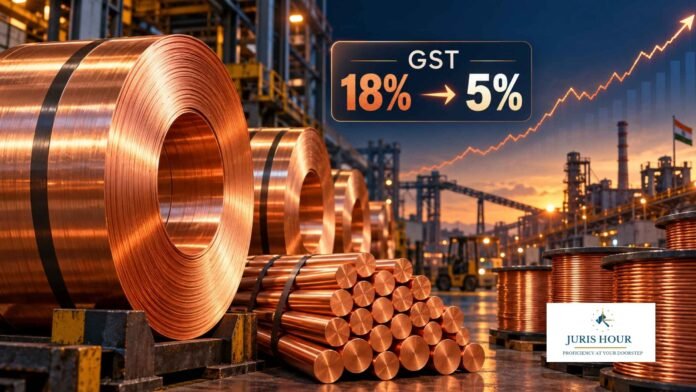
India’s copper producers have asked the government to reduce Goods and Services Tax (GST) on a range of copper products from 18% to 5%, arguing that record metal prices have increased the cash businesses must commit before they can sell their output.
The Indian Primary Copper Producers Association is discussing the proposal with the government, its president Rohit Pathak said on Wednesday. According to Pathak, the rate cut could release as much as $3.6 billion in working capitalacross the copper supply chain. That figure is the association’s estimate of the proposal’s potential effect, not a government assessment.
Buy Now: E-Magazine: 1000+ Landmark GST Judgments (2017–2026)
Why copper prices have sharpened the demand
Copper climbed above $14,700 a tonne on the London Metal Exchange earlier this month, pushing up the value of feedstock, finished metal and inventory held by Indian businesses. The LME’s official copper price is a benchmark used in physical copper contracts.
For a producer buying material to process, a higher copper price means more money is needed for each purchase. GST charged on a higher transaction value increases the amount paid upfront as well. Downstream manufacturers face a similar cash requirement when they buy copper for products such as wires and cables.
The industry’s concern is therefore about cash flow during the production and sales cycle. A business may be able to claim eligible input tax credit, but it still needs funds to make purchases and carry stock until that credit can be used. The association says reducing the GST rate would ease that immediate funding pressure.
Producers point to long processing cycles
Pathak said the pressure extends to primary producers, including Hindalco Industries, whose copper business operates on a concentrate cycle of roughly three months. During that period, capital remains committed to material being bought and processed.
He argued that money currently tied up in tax payments could instead support expansion at a time when the domestic copper industry is pursuing multibillion dollar investments. The requested rate change would depend on a government decision; the association’s talks do not themselves change the applicable GST rate. The CBIC’s published rate schedule lists several copper categories at 18%, though the treatment of any particular product depends on its classification.
Cable makers and dealers hold less stock
The rise in prices is also changing buying habits further down the chain. Pathak said cable manufacturers and copper dealers are reducing inventories sharply because holding the same quantity of metal now requires much more capital. Some businesses, he said, are measuring stock in days rather than weeks.
Smaller inventories reduce the money tied up in warehouses, but they also leave businesses with less stock on hand when they need to fulfil orders. This adds another dimension to the industry’s request: producers want relief from the upfront cash burden while buyers are becoming more cautious about how much copper they purchase at once.
India’s reliance on imported copper has added to the industry’s exposure to global prices since the 2018 shutdown of Vedanta’s Sterlite smelter. With international prices at record levels, the association says the existing tax rate is amplifying a working capital challenge felt from primary processing through to finished copper products.
The government has yet to announce a decision on the proposed GST reduction.
Read More: GST Refund Can’t Be Recalculated Without Verifying Alleged 18% Sales: GSTAT

