
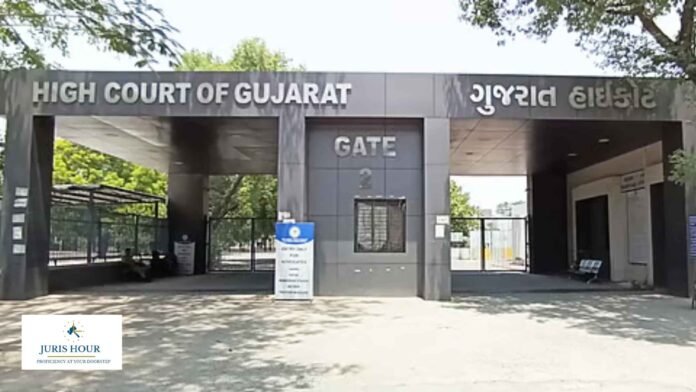
The Gujarat High Court has granted regular bail to a man accused of using a former business associate’s credentials and forging E-Way Bills valued at more than Rs. 1.60 crore, allegedly creating a GST liability of Rs.24.42 lakh along with a three-times penalty.
The bench of Justice Hasmukh D. Suthar allowed the bail application after noting that a substantial part of the investigation had been completed, the prosecution case was primarily based on documentary evidence and nothing remained to be recovered or discovered from the applicant.
Buy Now: E-Way Bill Judgements From 2020–2026 [Includes Orders of GSTAT]
The Court, however, directed the applicant to deposit ₹29.30 lakh before the trial court within one month of his actual release.
The case arose from an FIR registered at Krushnanagar Police Station, Ahmedabad City, for offences under Sections 316(2), 318(4), 336(2), 338 and 340(2) of the Bharatiya Nyaya Sanhita, as well as Sections 66-C and 66-D of the Information Technology Act, 2000.
According to the allegations recorded in the order, the complainant and the applicant initially worked in the same company and later entered business.
The applicant allegedly used the complainant’s name and password relating to Crown Corporation without the complainant’s knowledge or consent between September 2018 and June 2025.
He was accused of generating forged E-Way Bills amounting to ₹1,60,11,837 and forging signatures on those documents. The allegedly forged documents were subsequently stated to have been used for filing returns with the GST Department.
The alleged transactions reportedly resulted in a GST liability of ₹24,42,484, together with a three-times penalty.
The allegations remain subject to investigation and trial. The High Court expressly refrained from examining the evidence in detail while deciding the bail application.
Senior Advocate N.D. Nanavaty, appearing with Advocate Ekant G. Ahuja for the applicant, argued that the applicant was innocent and had been falsely implicated.
The defence submitted that a substantial part of the investigation had already been completed, nothing remained to be recovered or discovered from the applicant and he had no previous criminal antecedents.
The State opposed the application, arguing that the accusations involved forgery and that the manner in which the alleged offence was committed did not justify the grant of regular bail.
While considering the application, the High Court identified several circumstances supporting the applicant’s release:
- A substantial part of the investigation was over.
- None of the alleged offences was punishable with death or imprisonment for life.
- The applicant had remained in custody since August 20, 2026.
- Nothing remained to be recovered or discovered from him.
- The applicant had no previous criminal antecedents.
- The alleged offences were triable by a Judicial Magistrate First Class.
- The prosecution case was primarily based on documentary evidence.
- Commencement and conclusion of the trial were likely to take time.
The Court also considered an undertaking filed by the applicant’s brother on September 16, 2026.
Under the undertaking, the applicant would file a similar undertaking within one week of his release and deposit ₹29.30 lakh before the Additional Chief Judicial Magistrate, Ahmedabad City, within one month.
Any additional amount found during the investigation to have been received by the applicant from, or in connection with, Crown Incorporation would also be deposited.
The High Court relied upon the Supreme Court’s decisions in Sanjay Chandra v. Central Bureau of Investigation and Gudikanti Narasimhulu v. Public Prosecutor, High Court of Andhra Pradesh.
It reiterated the established principle that “bail is the rule and jail is the exception.”
The Court observed that the trial would take time and that keeping the applicant behind bars in the circumstances would amount to pre-trial conviction. It also referred to the protection of personal liberty under Article 21 of the Constitution.
Without expressing any opinion on the merits of the allegations, the Court concluded that the case was fit for exercising discretion in favour of regular bail.
The applicant was ordered to be released upon executing a personal bond of ₹25,000 with one surety of the same amount.
The Court directed him to deposit ₹29.30 lakh before the trial court within one month of his actual release. Deposit any additional amount found to have been received from or in connection with Crown Incorporation. File an undertaking similar to that submitted by his brother. Surrender his passport, if any, within one week. Not leave Gujarat without the trial court’s permission. Report to the concerned police station weekly until the chargesheet is filed. Report once a month for six months after the chargesheet is filed. Provide his Aadhaar card, email address and current residential address. Not tamper with evidence, obstruct the investigation or misuse the liberty granted to him.
The deposited amount must be invested in a fixed deposit and will remain subject to the final outcome of the trial.
The Court clarified that the applicant would be released only if he was not required in connection with another offence. Violation of any bail condition could result in the issuance of a warrant or cancellation of bail.
It further directed the trial court not to be influenced by the preliminary observations made in the bail order while deciding the case on its merits.
Membership Required to Access Case Details & Order Copy
To view the complete Case Details and Download Order Copy, you must have an active membership. Please subscribe to continue.
Read More: Centre Lacks Authority to Levy GST on Mining Royalty Until MMDR Amendment Takes Effect

