
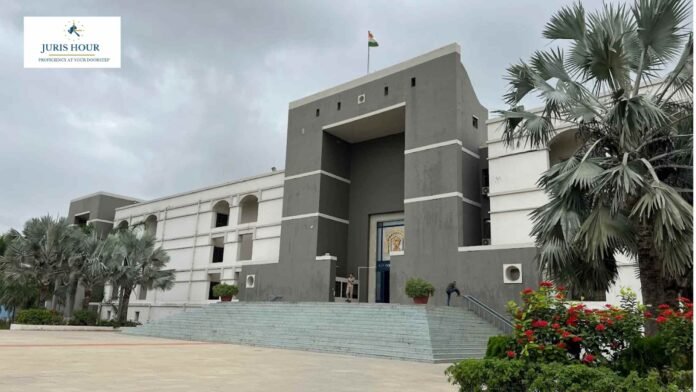
The Gujarat High Court has held that the assignment of leasehold rights in an industrial plot allotted by the Gujarat Industrial Development Corporation (GIDC) is not subject to Goods and Services Tax (GST), and consequently directed the tax department to refund ₹29.25 lakh reversed by a taxpayer as input tax credit (ITC), together with ₹4.44 lakh paid as interest.
The Bench of Justice A.S. Supehia and Justice Vaibhavi D. Nanavati ruled that once the underlying transaction was not a taxable supply, the department could neither treat the credit as blocked under Section 17(5)(d) of the Central Goods and Services Tax Act, 2017 nor retain the amounts recovered through ITC reversal and interest.
The Court quashed the adjudication and appellate orders passed against M/s KOR Chems and directed the respondents to refund ₹29,25,000 paid through Form GST DRC-03 on January 21, 2023, as well as interest of ₹4,44,280 paid through DRC-03 on December 22, 2023. The refund must be made within three weeks from the date of receipt of the High Court’s order.
The petitioner/assessee is a partnership firm engaged in trading industrial chemicals such as hydrogen peroxide, caustic flakes and phosphoric acid, acquired leasehold rights in an industrial plot at Ankleshwar from M/s Myspace Infracon in February 2022.
The total consideration for the transaction was ₹1,91,75,000, which included GST of ₹29,25,000—comprising Central GST of ₹14,62,500 and State GST of ₹14,62,500. The supplier issued a tax invoice dated February 17, 2022, charging GST on the transaction.
Believing that the GST paid on the acquisition was eligible for input tax credit, the firm claimed the credit in its GSTR-3B return for February 2022. The credit was also recorded in its books and reflected in the GST returns.
During an inspection under Section 67(1) of the CGST Act on January 16, 2023, the department recorded the statement of a partner of the firm. The taxpayer explained that the credit had been claimed under a bona fide belief and without knowledge that the department might consider it blocked under Section 17(5)(d).
Another partner, Sanjay Soni, confirmed that the credit was properly reflected in the returns and books. After consulting the firm’s chartered accountant, the taxpayer reversed the entire ITC of ₹29.25 lakh through DRC-03 on January 21, 2023, and subsequently paid interest of ₹4.44 lakh on December 22, 2023, to avoid further litigation.
Despite the reversal of credit and payment of interest, the department issued a pre-show-cause intimation on March 5, 2024, calling upon the taxpayer to pay a penalty. KOR Chems responded that the tax and interest had already been paid during the investigation and that there was no fraud, wilful misstatement, suppression of facts or intent to evade tax.
The department nevertheless issued a show-cause notice dated March 31, 2024, proposing the disallowance and recovery of ₹29.25 lakh as ITC, interest and an equivalent penalty under Section 74(1), on the allegation that the credit was blocked under Section 17(5)(d).
By an order dated June 12, 2025, the adjudicating authority confirmed ITC demand of ₹29.25 lakh, interest of ₹4.44 lakh and a penalty of ₹29.25 lakh. The amounts already paid through DRC-03 were appropriated against the demand. The appellate authority later upheld the demand through an order dated February 27, 2026.
The taxpayer then approached the Gujarat High Court, seeking the quashing of the adjudication and appellate orders and a refund of the amounts paid.
The petitioner relied on the Gujarat High Court’s earlier ruling in Gujarat Chamber of Commerce and Industry & Ors., which held that the assignment, sale or transfer of leasehold rights in a plot allotted by GIDC represents the transfer of benefits arising from immovable property.
In that ruling, the Court had held that Section 7(1)(a), which defines the scope of supply, read with the relevant entries in Schedules II and III of the CGST Act, would not apply to such an assignment. The transaction, therefore, would not attract GST under Section 9 of the Act.
Applying that principle to KOR Chems, the Bench observed that the taxpayer had acquired leasehold rights in a GIDC industrial plot from Myspace Infracon. The GST charged by the supplier and paid by the petitioner was therefore contrary to law.
The Court held that when the charging provision itself did not apply, any amount collected or retained by the department—whether directly as tax or indirectly through reversal of ITC and payment of interest—lacked legal authority.
Accordingly, the reversal of ITC and the payment of interest, both of which proceeded on the assumption that GST was payable on the transaction, could not survive.
The High Court also rejected the department’s reliance on Section 17(5)(d), which blocks ITC on goods or services received by a taxable person for construction of immovable property on the person’s own account, subject to statutory exceptions.
The Bench said that Section 17(5)(d) presupposes a taxable inward supply on which tax is lawfully leviable and paid. In the present case, the assignment of leasehold rights did not qualify as a supply under Section 7 and was not chargeable to tax under Section 9. Therefore, the question of applying the blocked-credit provision did not arise.
The Court further relied on its February 10, 2026 decision in Special Civil Application No. 18068 of 2025, in which it had held that the bar under Section 17(5)(d) applies exclusively to construction-related expenditure.
In KOR Chems’ case, the department had not established that the petitioner undertook any construction activity. The transaction involved only the acquisition of leasehold rights in the GIDC plot. The Court therefore held that Section 17(5)(d) had been erroneously invoked and that the allegation of availing blocked credit was misconceived.
The High Court also found no basis for invoking the extended and penal provisions of Section 74(1) of the CGST Act.
The credit had been disclosed in the taxpayer’s GSTR-3B returns and books of account, and the tax charged by the supplier was reflected in GSTR-2A. In view of the settled legal position that GST itself was not leviable on the assignment of the leasehold rights, the Court held that no question of fraud, suppression of facts or wilful misstatement arose.
The department’s action under Section 74 was therefore contrary to the statutory provisions and the settled legal position, warranting interference by the High Court.
The Court quashed the June 12, 2025 order-in-original, the DRC-07 summary order dated July 1, 2025, the rectification order dated July 2, 2025, the February 27, 2026 appellate order and the corresponding APL-04 order dated March 5, 2026.
Membership Required to Access Case Details & Order Copy
To view the complete Case Details and Download Order Copy, you must have an active membership. Please subscribe to continue.

