
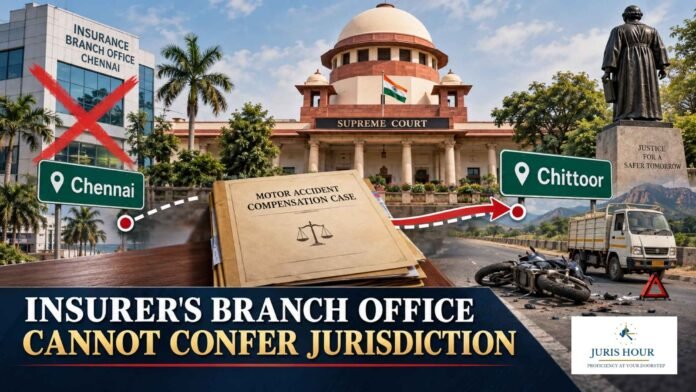
The Supreme Court has ruled that a motor accident compensation claim cannot be filed at a place merely because the insurance company has a branch or business office there.
The bench of Justice Ujjal Bhuyan and Justice Atul S. Chandurkar clarified that the expression “defendant resides” under Section 166(2) of the Motor Vehicles Act, 1988, principally refers to defendants such as the owner or driver of the offending vehicle and does not include the insurer for determining the territorial jurisdiction of a Motor Accidents Claims Tribunal.
Buy Now: Supreme Court Judgments E-Magazine – 5 Month Combo (2026) (1st February – 30th June 2026)
The Court observed that while Section 166(2) allows a claimant to institute proceedings at the place where the claimant resides or carries on business, the corresponding expression used for a defendant is confined to the place where the defendant “resides”. The provision does not confer jurisdiction based on the place where the defendant carries on business.
“The place where the defendant carries on business has been specifically omitted while specifying territorial jurisdiction of a Tribunal,” the Court observed.
The appellant was riding a two-wheeler with his brother on October 25, 2022, when a mini truck allegedly hit the vehicle. The accident occurred at Thatimaakulapalli Cross Road on the Nerabaillu-Yerravaripalem road in Tirupati district, Andhra Pradesh.
The claimant received treatment as an inpatient at a hospital in Tirupati. His brother subsequently lodged a First Information Report at Yerravaripalem Police Station.
The claimant filed a compensation application under Section 166 of the Motor Vehicles Act before the Motor Accidents Claims Tribunal in Chennai. National Insurance Company Limited, which was impleaded as a respondent, objected to the Tribunal’s territorial jurisdiction.
The insurer contended that the accident occurred in Andhra Pradesh, the claimant’s address was in Chittoor district, and no part of the cause of action had arisen in Chennai.
The Chennai Tribunal rejected the insurer’s objection through an order dated July 11, 2025. It held that the Tribunal possessed territorial jurisdiction because the insurance company also carried on business in Chennai.
National Insurance Company challenged the order before the Madras High Court by filing a civil revision petition under Article 227 of the Constitution.
On March 16, 2026, the High Court held that the Chennai Tribunal lacked territorial jurisdiction since the accident occurred in Andhra Pradesh. It set aside the Tribunal’s order and directed that the compensation proceedings be transferred to the Tribunal at Chittoor.
The claimant subsequently approached the Supreme Court.
Before the Supreme Court, the claimant argued that he was residing and working in Chennai and had, therefore, correctly instituted the claim there. It was also argued that National Insurance Company maintained an office in Chennai and would suffer no prejudice if the claim were decided by the Chennai Tribunal.
The claimant emphasised that the Motor Vehicles Act is a beneficial legislation and should be interpreted in a manner protecting accident victims rather than permitting insurers to raise technical objections.
The insurer, however, pointed out that the address provided by the claimant in the compensation application was located in Chittoor district, Andhra Pradesh. It argued that the pleadings contained no statement showing that the claimant resided or carried on business within the territorial limits of Chennai.
The Supreme Court first rejected the claimant’s argument that the insurer could not raise an objection concerning territorial jurisdiction.
Relying on its three-judge Bench ruling in United India Insurance Co. Ltd. v. Shila Datta, the Court explained that impleading an insurer as a respondent in a motor accident compensation claim is not mandatory.
However, where the claimant voluntarily impleads the insurer as a party-respondent, the insurer becomes entitled to raise all grounds available for contesting the claim. Its defence is not restricted to the limited grounds available under Section 149(2) of the Motor Vehicles Act.
The Court held that since the claimant himself had impleaded National Insurance Company as a defendant, the insurer was entitled to challenge the territorial jurisdiction of the Chennai Tribunal.
The Supreme Court explained that Section 166(2) gives a motor accident claimant the option of filing a compensation application before the Tribunal having jurisdiction over:
- The area where the accident occurred;
- The area where the claimant resides;
- The area where the claimant carries on business; or
- The area where the defendant resides.
The Court, however, emphasised that the statutory language deliberately distinguishes between a claimant and a defendant.
In the case of a claimant, jurisdiction may be determined either by residence or by the place where the claimant carries on business. For a defendant, the provision refers only to the place where the defendant resides. It does not include the place where the defendant carries on business.
The Bench noted that the provision is materially different from Section 20 of the Code of Civil Procedure, 1908, which permits a civil suit to be filed where the defendant resides or carries on business.
The Supreme Court further held that the expression “defendant” in Section 166(2), in the context of determining territorial jurisdiction, does not intend to refer to the insurance company.
The Court reasoned that an insurer need not necessarily be impleaded as a party to the compensation application. The principal contesting defendants in such proceedings are ordinarily the owner and driver of the offending vehicle.
It also referred to Section 168(1) of the Motor Vehicles Act, under which the Tribunal must issue notice of the compensation application to the insurer. Thus, even where the insurer has not been impleaded, it receives notice of the proceedings from the Tribunal.
This statutory scheme, according to the Court, further supports the conclusion that the insurer’s place of business cannot independently determine the territorial jurisdiction of the Tribunal.
The Supreme Court also explained the distinction between an objection raised at the initial stage of the claim proceedings and an objection raised after the Tribunal has already passed its award.
Where an objection is raised before the Tribunal at the commencement of the proceedings, the jurisdictional conditions prescribed under Section 166(2) must be strictly satisfied.
However, where such an objection is raised at the appellate stage after the compensation award has already been passed, Section 21(1) of the Code of Civil Procedure becomes relevant. At that stage, the party raising the objection must show not only that the Tribunal lacked territorial jurisdiction but also that the exercise of jurisdiction resulted in a failure of justice.
The Court discussed its earlier rulings in Mantoo Sarkar v. Oriental Insurance Co. Ltd., Malati Sardar v. National Insurance Company Limited and Balveer Batra v. New India Assurance Company. It noted that those cases involved jurisdictional objections considered after the Tribunal had adjudicated the compensation claims.
In the present case, the insurer had raised the objection before the Chennai Tribunal at the initial stage, and the claimant’s application was still awaiting adjudication on merits. Consequently, Section 21(1) of the Code was not attracted, and the jurisdictional requirements under Section 166(2) had to be fulfilled.
Examining the pleadings, the Supreme Court found that the claimant had provided a residential address in Chittoor district, Andhra Pradesh. The accident occurred in Tirupati district, while the driver of the offending vehicle was also stated to reside in Chittoor district.
There was also no assertion in the claim application that the claimant carried on business in Chennai.
The Court concluded that no part of the cause of action arose within Chennai and none of the jurisdictional requirements under Section 166(2) connected the compensation proceedings with the Chennai Tribunal.
The mere presence of an office of National Insurance Company in Chennai was insufficient to confer jurisdiction on the Tribunal.
The Supreme Court acknowledged that the Motor Vehicles Act is a beneficial legislation intended to address the hardship suffered by victims of motor accidents.
However, it held that the beneficial nature of the statute cannot justify an interpretation unsupported by its language.
“An interpretation which does not flow from the plain reading of the statutory provisions despite a purposive interpretation cannot be commended,” the Court stated.
Accordingly, the Supreme Court upheld the Madras High Court’s order and directed that the entire compensation proceedings be transmitted from the Chennai Tribunal to the Tribunal at Chittoor.
The Court asked the Chittoor Tribunal to decide the claimant’s compensation application expeditiously in accordance with law. The civil appeal was dismissed without any order as to costs.
Membership Required to Access Case Details & Order Copy
To view the complete Case Details and Download Order Copy, you must have an active membership. Please subscribe to continue.
Read More: Vitamin and Enzyme Premixes Used Exclusively in Animal Feed Classifiable Under CTH 2309: CESTAT

