
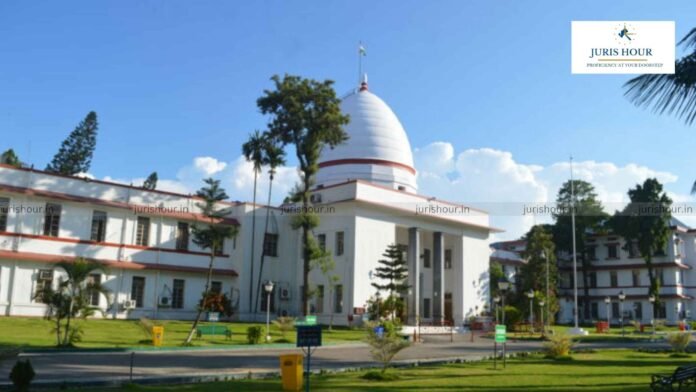
The Gauhati High Court has ruled that tax authorities cannot appropriate a sanctioned refund against an alleged interest liability merely on the basis of their own calculations without first issuing a detailed demand notice and granting the taxpayer an opportunity to respond.
The bench of Justice Arun Dev Choudhury held that an undertaking or surety bond furnished by a taxpayer may provide the basis for initiating recovery proceedings, but it does not permit the authorities to dispense with the requirements of notice, adjudication and an opportunity of hearing.
The bench partly set aside an order passed by the Assistant Commissioner, GST and Central Excise, Guwahati Division-I, which had sanctioned a refund of ₹88.55 lakh to the petitioner but simultaneously appropriated the entire amount against an alleged recoverable sum of ₹1.13 crore.
The petitioner/assessee had availed the benefit of an area-based exemption under Notification No. 32/99-CE dated July 8, 1999, for the period from May 31, 2001 to December 22, 2002. The exemption operated through refunds of duty paid from the Personal Ledger Account, or PLA.
Following a retrospective amendment introduced through Section 153 of the Finance Act, 2003, the department sought to recover ₹59.17 lakh from the company along with interest of ₹29.38 lakh. The total amount of ₹88.55 lakh was subsequently recovered by appropriating refunds relating to August to October 2006.
The company challenged that recovery before the Customs, Excise and Service Tax Appellate Tribunal. By an order dated September 26, 2023, the Kolkata Bench of the CESTAT held that subsequent refunds could not be denied or appropriated merely because the company had allegedly received an excess refund during an earlier period.
The Tribunal consequently set aside the recovery and granted consequential relief.
Although the department challenged the Tribunal’s decision before the Gauhati High Court, the appeal was withdrawn on August 11, 2025, pursuant to the litigation policy under which proceedings involving amounts below ₹2 crore were not to be pursued before the High Court.
The Tribunal’s order, therefore, attained finality.
While implementing the CESTAT’s order, the Assistant Commissioner passed an order on December 18, 2025, determining that ₹88.55 lakh was refundable to the company.
In the same order, however, the authority referred to a separate 50% PLA refund granted to the company for the period from 2011-12 to June 2017 pursuant to an interim order of the Supreme Court dated December 7, 2015.
The interim refund had been released subject to the beneficiaries furnishing solvent surety or an undertaking to protect the Revenue if the final decision went against them.
After considering the subsequent Supreme Court ruling in Union of India v. V.F.F. Limited, the authority calculated the amount allegedly recoverable from the company at ₹1.13 crore. This consisted of a principal amount of ₹43.66 lakh and interest of ₹69.26 lakh.
The authority appropriated the entire sanctioned refund of ₹88.55 lakh against this alleged liability and directed the company to pay the balance of ₹24.37 lakh.
The company argued that its entitlement to the refund of ₹88.55 lakh had been conclusively determined by the CESTAT and was no longer open to reconsideration.
It contended that the refund could not be adjusted against another alleged liability unless that liability had first been validly adjudicated and crystallised in accordance with law.
In particular, the interest liability of ₹69.26 lakh had not been determined through an independent adjudication after giving the company notice and an opportunity of hearing. According to the company, the authority could not convert its unilateral computation into an enforceable demand through the refund order itself.
The CGST department maintained that the 50% PLA refund was released pursuant to the Supreme Court’s interim order and subsequently became recoverable following the final judgment in V.F.F. Limited.
It argued that no fresh adjudication was required because the recovery arose from the Supreme Court’s orders and the undertaking or bond furnished by the company.
The High Court observed that there was no dispute over the company’s entitlement to the refund of ₹88.55 lakh. The CESTAT had set aside the earlier recovery, and that decision had attained finality.
The department itself had accepted this position by sanctioning the refund. Consequently, the petitioner’s entitlement to the amount could not be reopened in the writ proceedings.
At the same time, the Court noted that the refund released pursuant to the Supreme Court’s interim order was conditional upon the furnishing of an undertaking or bond. The subsequent determination made by the Supreme Court could not be reopened by the High Court.
The defect, however, lay in the manner in which the interest and other charges were calculated and recovered.
The impugned order contained detailed calculations of interest for the period from 2011-12 to June 2017, but the company had not been given an opportunity to verify, dispute or rebut those calculations.
The Court found that the refund order did not disclose any independent adjudication determining the alleged liability. No notice had been issued before the authority fixed the principal amount at ₹43.66 lakh and calculated interest of ₹69.26 lakh.
“A mere computation of interest cannot be treated as a crystallized demand,” the Court observed.
The High Court rejected the department’s contention that the undertaking or bond was sufficient to support the immediate adjustment of the refund.
While such an undertaking could furnish a basis for appropriate recovery, the amount sought to be recovered—particularly the interest component—was still required to be determined in accordance with law.
The Court held that the bond could not be construed as authorising the department to dispense with a notice or an opportunity of hearing.
It accordingly distinguished between the sanction of the refund and its subsequent appropriation. While the sanction of ₹88.55 lakh was valid and had to be maintained, its adjustment against the alleged liability of ₹1.13 crore could not be sustained in the manner adopted by the authority.
The Court clarified that it was not deciding whether the company was liable to pay interest on the 50% PLA refund released under the Supreme Court’s interim order. It also left open the correctness of the department’s interest calculations for determination by the competent adjudicating authority.
The High Court upheld the December 18, 2025 order to the extent it sanctioned the refund of ₹88.55 lakh.
However, it set aside the appropriation of that amount against the alleged recoverable liability of ₹1.13 crore, as well as the direction requiring the company to pay a further ₹24.37 lakh.
The department was directed to determine the amount legally recoverable in relation to the 50% PLA refund, including interest and other charges, after considering the Supreme Court’s judgment, the applicable notification and the undertaking or bond furnished by the company.
For this purpose, the authorities must issue a notice containing a detailed demand, allow the company to file its reply and provide an opportunity for a personal hearing.
On the department’s submission that the proceedings could be completed within four months, the Court permitted it to retain the already sanctioned refund temporarily. The final decision on whether the amount should be refunded or appropriated will be taken after the fresh proceedings are concluded.
The writ petition was disposed of with the parties directed to bear their respective costs.
Membership Required to Access Case Details & Order Copy
To view the complete Case Details and Download Order Copy, you must have an active membership. Please subscribe to continue.

