

The Article “ONE CLOCK. DIFFERENT SUNSETS – THE IMPORTANCE OF TIME AND SEQUENCE IN NDPS INVESTIGATIONS” is authored by SRINIVASAN GOPAL, ASSISTANT DIRECTOR(RETD) NATIONAL ACADEMY OF CUSTOMS INDIRECT TAXES AND NARCOTICS PALASAMUDRAM.
Taking a clue from “One Nation, One Tax”, India now has embarked on “One Nation, One Time” framework. The Legal Metrology (Indian Standard Time) Rules, 2026, notified under Section 52 of the Legal Metrology Act, 2009, establish Indian Standard Time as a common time reference for legal, administrative, commercial and other official purposes, with the Rules coming into force 180 days after their publication in the Official Gazette. This development has an obvious relevance to investigations in which the precise time of an event matters.
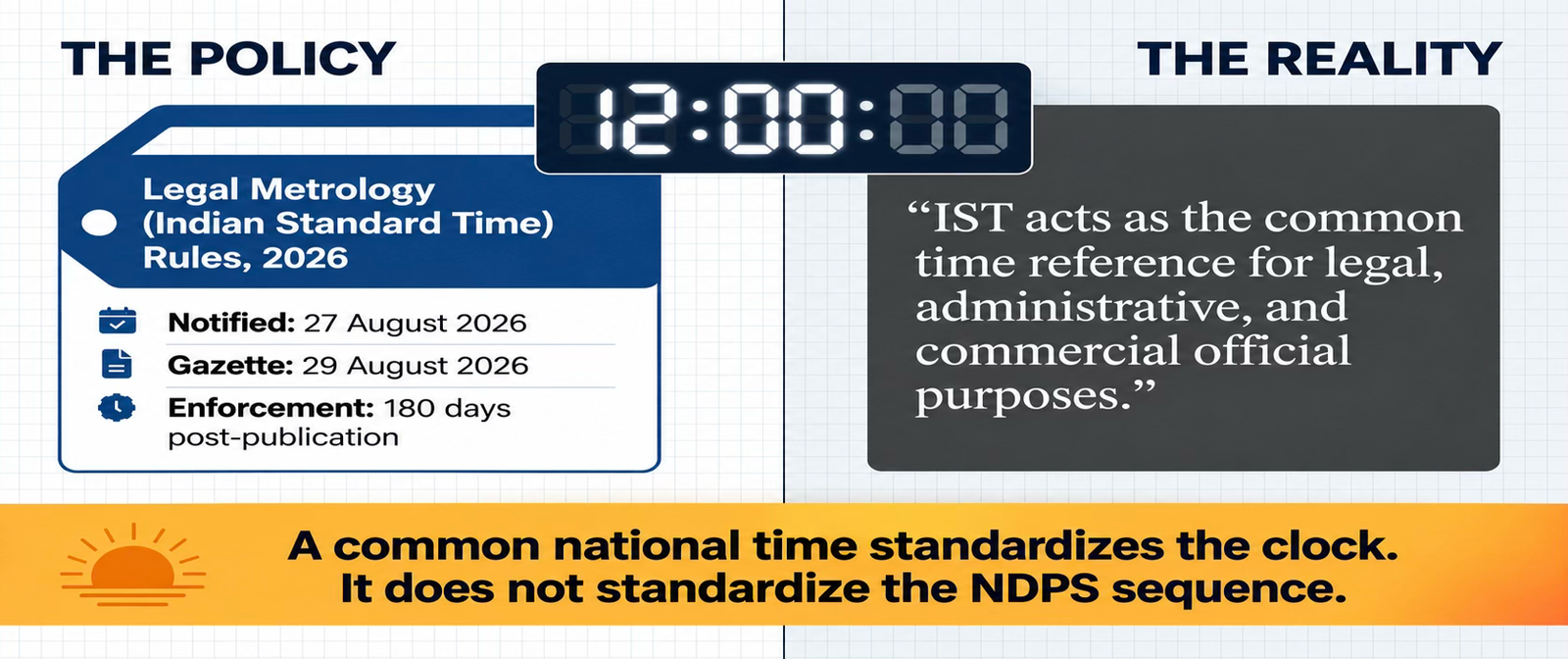
The NDPS Act, presents a particularly interesting problem. The NDPS Act does not merely require officers to record a clock time. In Section 42, legality may turn on whether a search occurred between “sunrise and sunset” or between “sunset and sunrise”. A common national clock does not create a common national sunrise or sunset. Astronomical events remain location-specific.
To understand the nuances of the requirements, it is necessary to draw a fine distinction and develop a practical proposition: in an NDPS investigation, time and sequence should be treated as an integral part of the evidentiary architecture. The proposition is illustrated through Supreme Court and High Court decisions, particularly State of Haryana v. Jarnail Singh, Kallu Khan v. State of Rajasthan, State of Himachal Pradesh v. Sher Singh, and the Delhi High Court’s 2026 decision in Mohan Babu Gupta v. State (NCT of Delhi), where location-specific sunset data supplied by the Positional Astronomy Centre, Kolkata was compared with the investigating agency’s recorded time.
The objective is not to suggest that a timestamp discrepancy automatically vitiates an NDPS case, but to show why the empowered investigating officer should build a clean and legally defensible chronology right from the first information through search and seizure and maintain it throughout the case.
It is emphasized here that the clock cannot be examined in isolation; the first question remains which statutory provision governs the search and it is in this context the decision of the Hon’ble Supreme Court in the case of Kallu Khan is to be seen. So, Kallu Khan does not establish:
“6:05 a.m. search + sunrise issue = Section 42 violation.”
However, this decision has been aptly distinguished by the Hon’ble High Court of Himachal Pradesh in Sher Singh v. State of Himachal Pradesh, discussed below.
Similarly, Jarnail Singh is useful principally for the Section 42/Section 43 distinction involving a public utility/public conveyance. Private conveyance on a public road attracts Section 43 of the NDPS Act.
The conclusion that can be effectively drawn is the classification of the offence under Section 42 or Section 43 and it is only when the provisions of Section 42 are made applicable, it should be followed in the strictest sense.
One Nation, One Time and the NDPS Act
Taking a clue from “One Nation, One Tax,” we now see the emergence of “One Nation, One Time.” The former sought to bring uniformity to the taxation system across the country while the latter aims to bring uniformity to something far more fundamental—the measurement and recording of time. At first glance, one may wonder:
“What has “One Nation, One Time” got to do with the NDPS Act?”
Quite a lot.
In an NDPS investigation, time is not always merely a timestamp. Sometimes, time is a legal requirement. It determines the legality of an action. And sometimes, the credibility of the entire prosecution case may depend upon the accuracy of the timeline.
At this juncture, it would be extremely useful to pose some pertinent questions to link the issue and understand the significance of the Notification in its proper perspective.
- Was the information under Section 42 received before the search and seizure?
- Was it reduced into writing and submitted to the officer superior before proceeding to search and seizure operation?
- Were the grounds of belief recorded in a search operations conducted between sunset and sunrise?
- Was the information communicated to the officer superior within the statutory framework?
These are not merely questions about the time. They are questions about the time integrity of a search and seizure operation. And that is where One Nation, One Time acquires an unexpected significance for narcotics law enforcement.
One National Clock One National Sunrise and Sunset
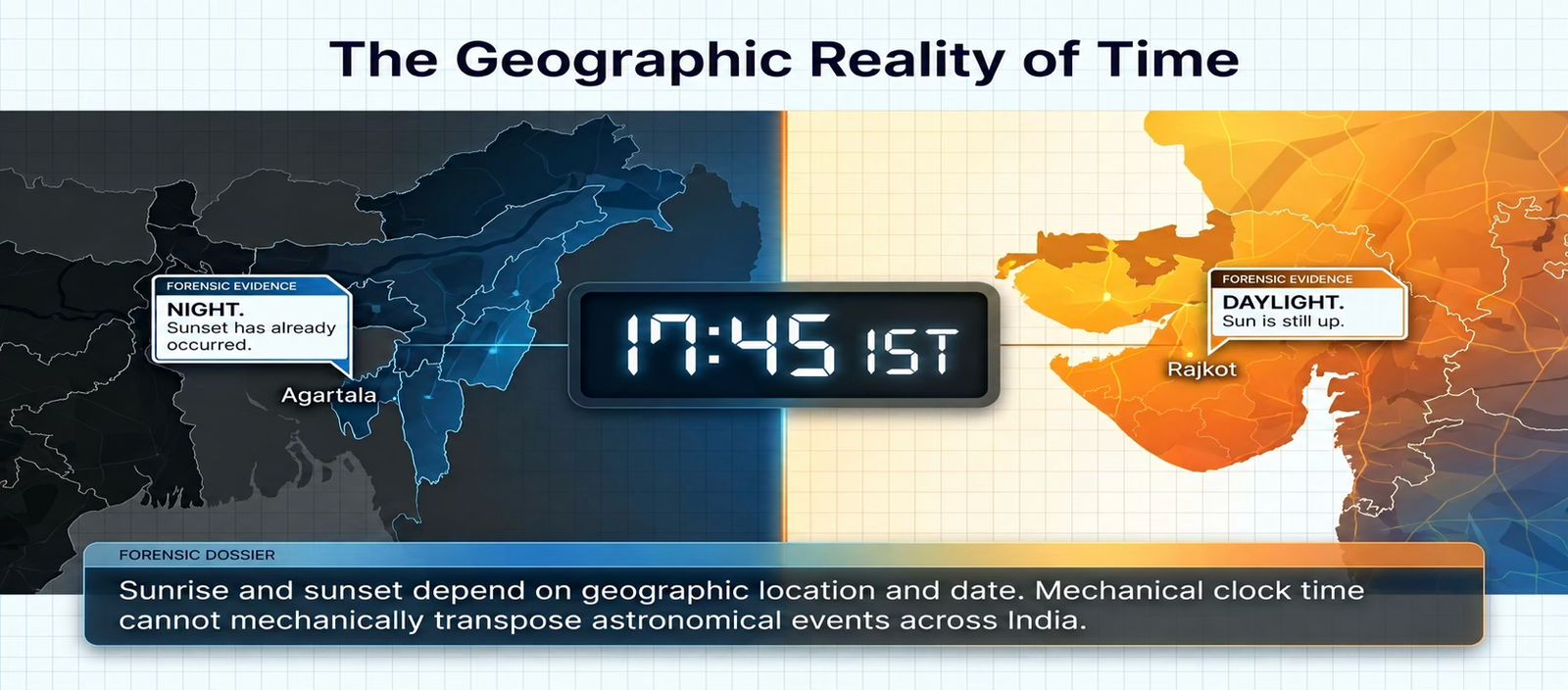
Sunrise and sunset are astronomical phenomena. They are determined by geographical location, date and astronomical calculations. Consequently, the fact that the entire country follows Indian Standard Time does not mean that the Sun rises or sets at the same clock time at every location in India.
The sunrise at Agartala in Tripura cannot, for example, be equated with the sunrise at Rajkot in Gujarat, merely because both places follow the same Indian Standard Time. The distinction may be expressed rather simply:
“One Nation, One Time does not mean One Nation, One Sunrise or One Nation, One Sunset.”
This distinction becomes particularly significant when one examines the proviso to Section 42(1) of the NDPS Act.
Section 42 and the significance of sunset and sunrise
Section 42 deals with the power of entry, search, seizure and arrest in specified circumstances on the basis of information or belief concerning narcotic drugs and psychotropic substances.
The proviso to Section 42(1) assumes particular significance where the empowered officer proposes to conduct a search between sunset and sunrise without obtaining the requisite warrant or authorisation. In such a situation, the officer is required to record the grounds of his belief that obtaining a warrant or authorisation would afford an opportunity for the concealment of evidence or facility for the escape of an offender. The NDPS Act makes the time of the search legally relevant. But how is that time to be determined?
Suppose the prosecution records a simultaneous search in Agartala, Tripura in the East and Rajkot, Gujarat in the West say on 9 September 2026 at 0600 hours. The sunrise and sunset timings are as under:
| Place | Sunrise | Sunset |
| Agartala, Tripura | 5- 9 | 17-36 |
| Rajkot, Gujarat | 6-32 | 18-56 |
| Reference: https://www.packolkata.gov.in | ||
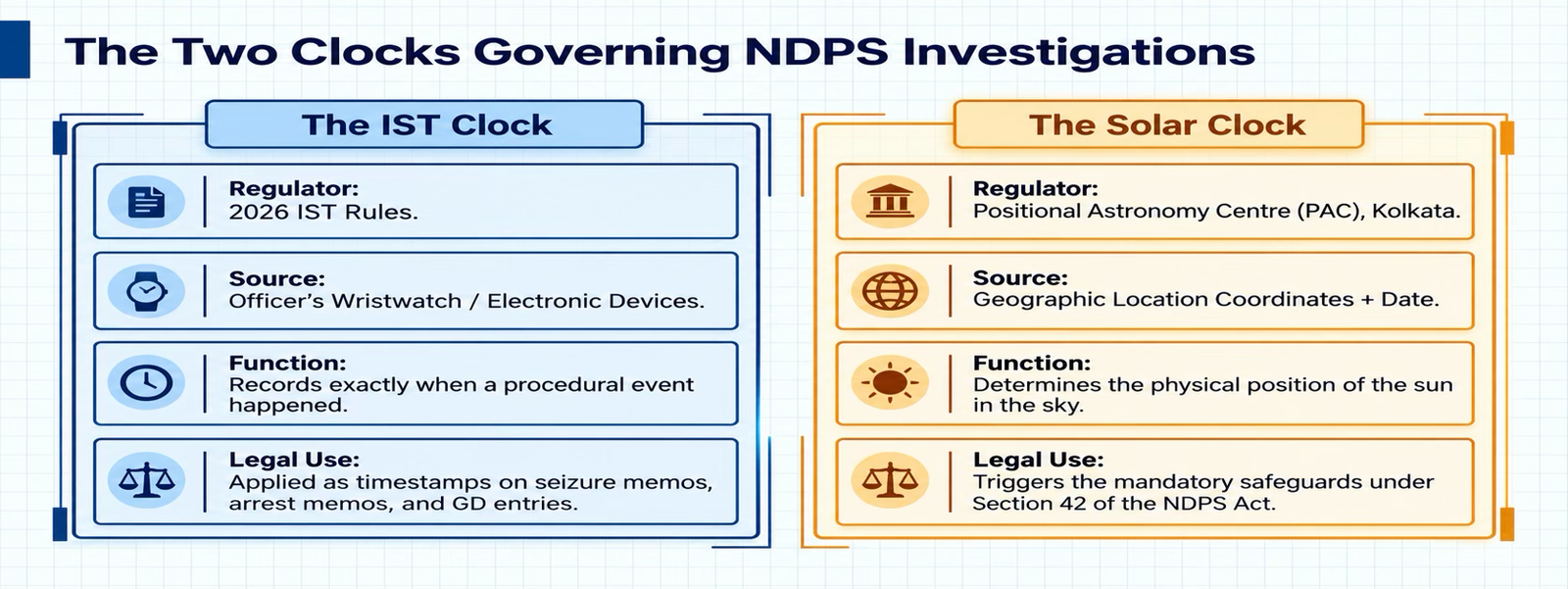
In case of the search at 0600 hours on 9 September 2026, the empowered officer at Rajkot is required to record the grounds of belief as required under the second proviso to Section 42(1) of the NDPS Act, failure to do so would constitute non-compliance with Section 42. While there is no denying the fact that the time is uniform but the sunrise is different for these two cities and hence the legal requirements are to be met strictly.
When the private conveyance changes the analysis
The position can be materially different when the search is of a private conveyance or an enclosed place in circumstances falling within Section 42. In that situation, the second proviso to Section 42(1) permits a search between sunset and sunrise only after the officer records the grounds of belief that obtaining a warrant or authorisation would afford an opportunity for concealment of evidence or escape of the offender. Section 42(2) then requires the relevant writing or grounds to be sent to the immediate superior within seventy-two hours.
The significance of the clock, therefore, becomes immediate. If the recorded search time is 1740 hours, the next question is not whether 1740 hours is generally considered “evening”. The question is whether, at the particular place and on the particular date, sunset had already occurred. It would be extremely useful to refer to the decision of the Hon’ble High Court of Delhi in Mohan Babu Gupta v. State (NCT of Delhi).
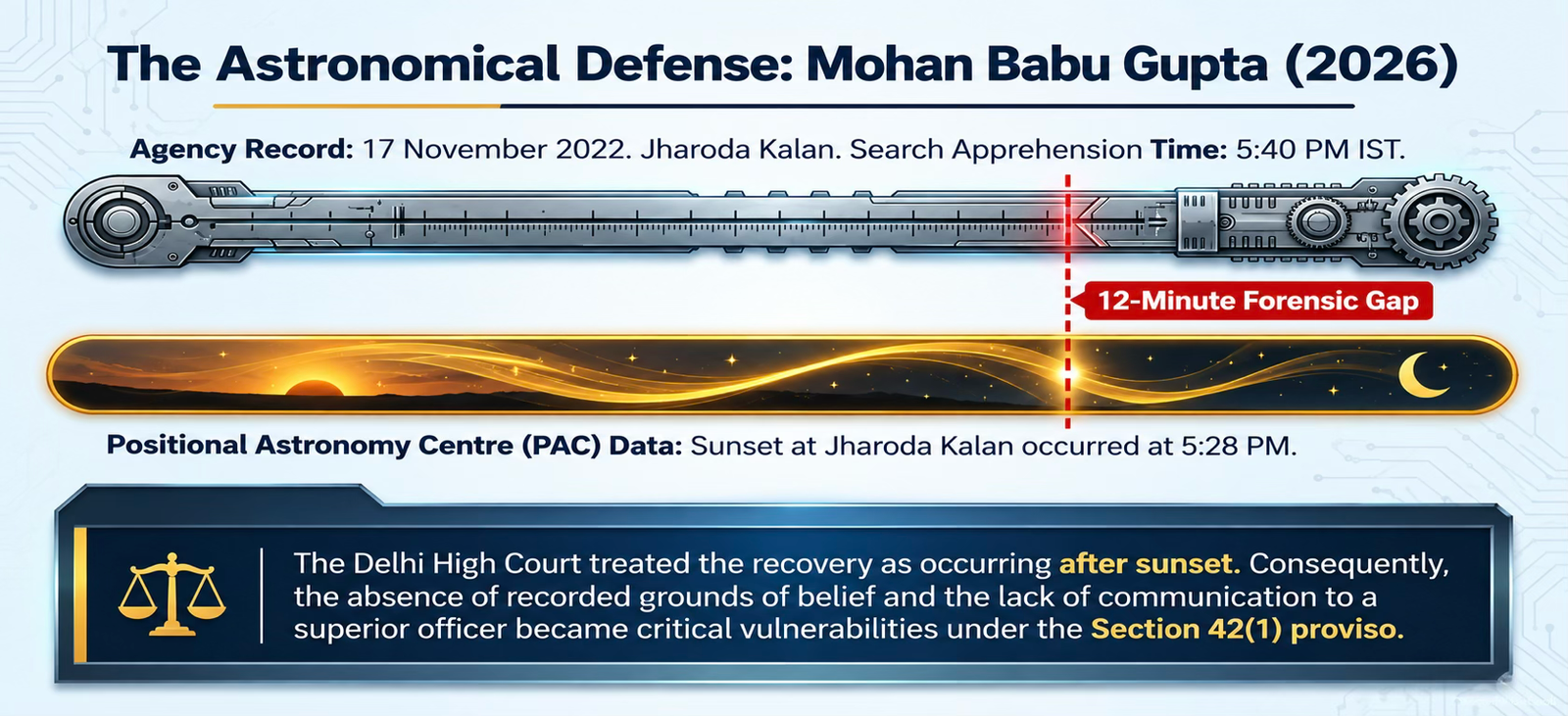
In Mohan Babu Gupta v. State of NCT of Delhi, decided by the Hon’ble High Court of Delhi on 28 March 2026 –2026:DHC:2604, the Court considered a bail application arising from an NDPS prosecution. The record showed the petitioner was apprehended at Jharoda Kalan at about 1740 hours on 17 November 2022. The defence relied upon a communication from the Positional Astronomy Centre, Kolkata stating that sunset at the relevant area on that date was 1728 hours
The Hon’ble High Court, therefore, treated the recovery as having occurred after sunset and examined the consequences under the second proviso to Section 42(1). The Hon’ble Court, inter alia, noted the absence of recorded grounds of belief and the absence of the corresponding communication to the officer superior.
It is to be noted here that the Hon’ble High Court did not treat “sunset” as a fixed national clock-time. It looked at the actual place, the actual date, the recorded time and the astronomical source i.e., Positional Astronomy Centre, Kolkata, an office under the Indian Metrological Department, New Delhi.
The Order demonstrates that a demonstrable post-sunset search, coupled with failure to comply with the statutory safeguards applicable to such a search, can materially affect the prosecution case even at the stage of consideration of bail.
It is necessary to place on record here that the website, inter alia, gives the following information as under:
“Sun rise, Sun set and Moon rise, Moon set data of important stations of India
Data will be available from 15/12/2025 to 31/12/2026”
The cities that are covered for the above database are as follows:
The case of Sher Singh
The case of Sher Singh v. State of Himachal Pradesh decided on 24 August 2026 by the Hon’ble High Court of Himachal Pradesh – 2026:HHC:35784 – is a significant decision to further buttress the argument on compliance with the second proviso to Section 42(1) of the NDPS Act, as it deals with the other judgments on the non-compliance of Section 42 of the NDPS Act.
“19. By referring judgment of the Apex Court in case titled Kallu Khan vs. State of Rajasthan, reported in (2021) 19 SCC 197, learned Additional Advocate General has submitted that in this case also, vehicle 11 2026:HHC:35784 was checked at 6:05 A.M., without complying the provisions of proviso to Section 42(2) of NDPS Act and conviction of Kallu Khan was upheld by the Apex Court.
20. In Kallu Khan‘s case, though vehicle was searched at 6:05 A.M., but it was on 24.04.2011, i.e., in the month of April, when sunrise is of too early. Even otherwise, in this case, applicability of Section 42(2) NDPS Act was not in issue.
21.In Jarnail Singh‘s case referred supra, recovery was from tanker, which is a public utility vehicle and, therefore, in this case, it was held by the Apex Court that Section 42 of NDPS Act was not applicable, but Section 43 of NDPS Act was applicable, which empowers the competent officer to search a public place and seize the contraband. The public place has been explained under Section 43 of NDPS Act as a public place, which includes any public conveyance, hotel, shop, or other places intended for use by, or accessible to, the public.
22. In present case, vehicle is a private vehicle and search is during night, i.e., between sunset and sunrise, and, therefore, Section 42 of NDPS Act was applicable.
23. Perusal of the record, especially ruqua, seizure memo, as well as statement of Investigating Officer, PW-11-HC Ramesh Chand, 12 2026:HHC:35784 shows that no reason to believe was ever recorded by the Investigating Officer, much less sent to the superior officers before entering and searching the private Car, in which applicant-appellant was travelling.
24. It is not a case where there is some defect in compliance of provisions of Section 42 of NDPS Act, but it is a case of total non-of compliance of Section 42 of NDPS Act, which has been held impermissible by the Apex Court in Karnail Singh‘s case, Boota Singh’s rt case and Jagraj Singh’s case. There must be compliance of Section 42 of NDPS Act, at least substantial compliance, which is missing in present case and, therefore, there is a fair chance of acquittal of the applicant-appellant, as per exposition of law existing on date.
25. Therefore, substantive sentence awarded to the applicant-appellant Sher Singh is ordered to be suspended during pendency of the appeal, subject to furnishing personal bond in the sum of Rs. 1,00,000/- with one surety in the like amount to the satisfaction of Trial Court, with undertaking therein to appear before this Court as and when directed and in the event of the dismissal of the appeal, to surrender before the Court, to serve the remaining sentence.
Section 42 and the “One Clock, Different Sunsets” Problem
For empowered officers, the operational implications are straightforward. In a Section 42 case where the search is close to sunset or sunrise, the case file should not leave the astronomical fact to assumption.
- Record the exact time of entry, search, seizure and arrest, preferably in the 24-hour format.
- Record the precise place of search
- Where the timing is close to sunrise or sunset, obtain and preserve reliable location-specific astronomical data.
- If the search occurs between sunset and sunrise, record the grounds of belief contemplated by the second proviso to Section 42(1).
- Ensure the Section 42(2) communication is made within the statutory period and preserve proof of transmission/receipt to the officer superior.
- Ensure the chronology in the case diary, seizure memo, arrest memo, station diary/GD entry and other contemporaneous records is internally consistent.
Time and Sequence Beyond Section 42
The importance of time does not end with sunrise and sunset. The more useful insight is that an NDPS investigation has a sequence. Certain statutory acts must occur before or after other acts. A later document cannot automatically cure a missing earlier step merely because both documents carry authentic timestamps.
Applicability
Sunset becomes legally determinative only where the statutory scheme applicable to the particular search makes the sunset/sunrise distinction relevant—most importantly, a search governed by Section 42 involving a building, conveyance or enclosed place
Section 50 – The Order of Events Matters
Section 50 is a classic example. The Supreme Court in Vijaysinh Chandubha Jadeja emphasised that the empowered officer must inform the person of the existence of the statutory right before the personal search is conducted. The legal question is therefore sequential: information of the right → response/choice → search. A notice prepared after the search cannot simply be treated as equivalent to communication before the search.
Thus, “time” is not merely the timestamp written on a notice. The critical issue is the relationship between the timestamps of the notice, the response, the search and the recovery.
A reference to the Order dated 3 December 2014 in the case of Ambrose v. Directorate of Revenue Intelligence would fortify the requirement to do the work sequentially and that too in the context of Section 50. It would be profitable to extract the relevant paras from the Order ibid
“16. This Court has heard the submissions of Mr. Ajit Sharma, learned amicus curiae for the Appellant and Mr. Satish Aggarwala, learned Standing Counsel for the DRI.
Notices under Section 50 NDPS Act
17. At the outset it requires to be noticed that one remarkable feature of the present case is in regard to the notices purportedly issued to each of the accused, including the Appellant, under Section 50 NDPS Act. From the evidence placed on record it appears that soon after their apprehension outside the Gurudwara the accused were taken to the DRI office. There the DRI officers served notices on the accused under Section 50 NDPS Act. Both the Section 50 NDPS Act notices were typed. They were typed on a computer and printed out. On both notices, the addresses of two accused including their parentage, residential addresses have been set out. In the case of Appellant, his father’s name and residential address in Zimbabwe have been typed out.
18. Mr. Aggarwala drew the attention of the Court to the panchnama (Ex.PW-9/C) which records that when they were apprehended each of the accused introduced themselves giving their parentage and full residential addresses.
19. Even if the above is accepted as a credible explanation of how these typed details figured in the notices, what is a total give away is that typed notices refer to the fact that the DRI officers had “reason to believe” that two accused were carrying “heroin packets”. The typed notice under Section 50 NDPS Act reads thus:
“On the basis of specific information, the officers of Directorate of Revenue Intelligence (Hqrs.), New Delhi intercepted you along with 2 baggage on 7th February 2009 at the parking area of Majnu Ka Tilla Gurdwara, Delhi and have reasons to believe that narcotics drugs i.e., Heroin packets are being carried by you in your person or in two baggage. For retrieval of the same, your person and two baggage are required to be searched. You are hereby informed that under Section 50 NDPS Act, 1985, you have a legal right to get your personal search and search of your bag conducted in the presence of a Magistrate or a Gazetted Officer for which you have to give your option in writing.”
20. It was impossible for the DRI officers to know in advance, even before the search of the bags, that the accused were in possession of heroin packets. It must be recollected that the secret information reduced to writing (Ex.PW-1/A) only referred to the information that a person of Indian origin would be handing over “some narcotic substance” to a medium built African person. The trial Court appears to have completely overlooked the above glaring lacuna. This shows that the notice under Section 50 NDPS Act could not have possibly been issued prior to commencing the search of the bags as contended by the DRI but much later.”
Section 63 BSA — Electronic Time Becomes Evidentiary Material
The Bharatiya Sakshya Adhiniyam, 2023 gives a further dimension. Section 63 provides the statutory framework for admissibility of electronic records, subject to its conditions. The Schedule to Section 63(4)(c) includes device/source particulars and hash-value information in the certificate.
In an NDPS investigation, electronic records may include CCTV footage, call records, mobile-device extractions, GPS or location records, digital photographs, system logs, messaging records and other electronic material. Their evidentiary value may depend not only on content but also on the reliability of the associated date/time information.
In a standard proceeding under the NDPS Act, a recovery and seizure panchnama is drawn up, commencing at 10:00 a.m. and concluding at 5:15 p.m. on 9 September 2026. The seizure included physical contrabands, namely hydroponic weed, alongside digital devices specifically the mobile phones and laptops of the accused. The panchnama formally records that at 5:15 p.m., all seized items—including the electronic devices—were packed, securely sealed with official impressions, and signed by independent panch witnesses, thereby supposedly freezing the chain of custody. However, a forensic examination and subsequent cloning of the seized mobile phone and laptop reveal a serious procedural anomaly: the system metadata and active logs conclusively document that these electronic devices were actively operated until 6:15 p.m. on the exact same day. This establishes an unmonitored, unexplained one-hour window of post-seizure activity. In such a critical scenario, where electronic devices are handled, turned on, or operated outside the protective umbrella of panchnama safeguards thereby raising a serious and potentially consequential challenge to the integrity of the chain of custody.
This is where the concept of a coherent timeline becomes particularly valuable. The empowered investigating officer should identify the time source, and preserve the material needed to establish reliability.
When Authentic Evidence Meets a Statutory Time Limit
An empowered investigating officer arrests a mastermind on 9 September 2026 and from the mastermind, electronic devices, property documents were seized. Scrutiny of the electronic devices reveals that the mastermind had immovable and movable property in his own name and his spouse’s name. Investigation reveals that all the immovable properties identified and verified in his and his spouse’s name are located in Delhi-NCR and were purchased between 1 January 2019 to 31 July 2020 and cumulatively valued at Rs.65,89,09,430/-
Despite the fact that the retrieved electronic documents are genuine and authentic, they are not admissible. An electronic document should not only be genuine, authentic, reliable but also admissible. In the instant case, it is inadmissible on account of the proviso to Section 68C(2), which caps the period to 6 years backwards from the date of arrest/seizure. Though the identified and verified immovable properties arise out of illicit drug trafficking, the same cannot be seized on account of the statutory embargo.
Applicability of the timeline to Sections 52A and 57
Similarly, the timelines operate with reference to Sections 52A and 57 of the NDPS Act. This is coupled with compliance with the requirements relating to arrest, including the associated task of producing the accused within the 24-hour timeline and also communicating the arrest of the accused to his relatives/best friend, as the case may be.
What One Nation, One Time Does
The 2026 Rules should not be overstated. They do not amend the NDPS Act. They do not rewrite Section 42. They do not convert sunrise and sunset into nationally uniform clock-times. They also do not make every historical timestamp in an NDPS case invalid merely because the investigation occurred before the Rules come into force.
Their significance is prospective and infrastructural. The Rules establish IST as a common time reference for the purposes specified in the framework and provide time for departments and institutions to adapt their systems. For investigators and agencies, this creates an opportunity to improve the reliability, traceability and auditability of official records.
A Practical “Time and Sequence” Checklist for NDPS Officers
| Stage | Question | Empowered Investigating Officer’s safeguard |
| Information | When was information received? | Record exact date/time and source; reduce to writing where required. |
| Section 42 | Is the search under Section 42? | Identify building/conveyance/enclosed place and statutory source of power. |
| Sunset/Sunrise | Was the search between sunset and sunrise? | Verify location-specific astronomical data when timing is material. |
| Grounds of belief | Was night search justified? | Record grounds required by the second proviso to Section 42(1). |
| Superior officer | Was the writing/grounds sent in time? | Preserve transmission and receipt under Section 42(2). |
| Section 50 | Was the right communicated before personal search? | Maintain a clear pre-search sequence and contemporaneous record. |
| Seizure | What happened when and where? | Synchronise seizure memo, station diary, arrest memo and custody entries. |
| Section 52A | When were inventory/photos/samples certified? | Maintain a complete seizure-to-Magistrate-to-FSL chronology. |
| Section 57 | When did the 48-hour period run? | Record preparation, dispatch and receipt of the report. |
| Electronic evidence | Which clock generated the electronic record? | Preserve source, device details, hash and certificate; explain offsets. |
| FSL | When did the sample leave custody and arrive? | Maintain an auditable chain of custody. |
The Investigator’s Check
When an NDPS case turns upon time, do not rely upon memory, approximation or a generic assumption. Record the exact time; identify the source of that time; identify the place; identify the statutory provision; and establish the sequence.
A useful internal test is the following:
- What happened?
- Where did it happen?
- When exactly did it happen?
- Which statutory power was being exercised?
- What had to happen before that event?
- What had to happen immediately afterwards?
- Which contemporaneous record proves each step?
- Can all the clocks and records be reconciled?
Conclusion — One Clock, Different Sunsets
The arrival of a legally recognised uniform Indian time reference is a welcome development. Accurate and traceable time is essential to modern administration, digital governance and increasingly to the criminal justice system.
But the NDPS Act constantly tells and reminds us that time is not always merely a number on a clock. Section 42 speaks in the language of sunrise and sunset. Those are astronomical events, not nationally fixed clock readings. One Nation, One Time therefore does not mean One Nation, One Sunrise or One Nation, One Sunset. The recent decision in Mohan Babu Gupta, para supra, demonstrates why this distinction matters.
About the Author
Srinivasan Gopal is a retired Assistant Director from NACIN Palasamudram, with over 36 years of experience under CBIC. He specializes in enforcement, legal interpretation, and capacity building, and is coauthor of Lawmann’s Decoding the NDPS Act, 1985 and Taxmann’s Law Relating to NDPS. His work has been published by the Centre of Excellence, NACIN, Delhi (An Overview of the NDPS Act, 1985), and he has contributed as input provider for the Handbook on Investigation of NDPS Act Cases brought out by the Sadar Patel National Police Academy, Hyderabad. He is regularly invited as expert faculty for national and international programmes by judicial institutions, enforcement agencies, and training bodies.

