
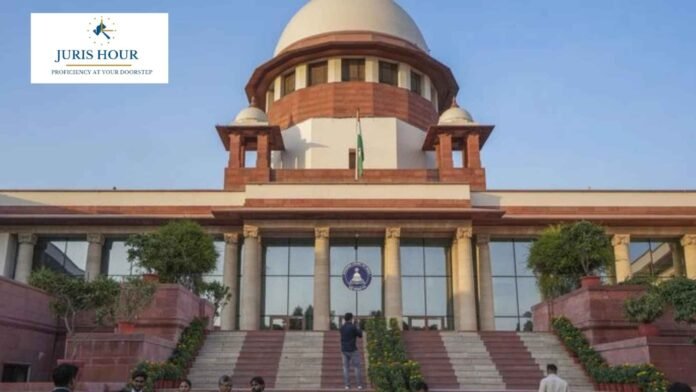
The Supreme Court has stayed further proceedings concerning a penalty of ₹1.17 crore imposed on a two-wheeler spare-parts dealer for allegedly failing to disclose an order that clarified the applicable entry tax rate.
The Bench of Justice Aravind Kumar and Justice Vipul M. Pancholi issued notice to the Commissioner of Commercial Tax and made it returnable within four weeks.
“There shall be stay of further proceedings insofar as levy of penalty is concerned,” the Supreme Court ordered.
Buy Now: Excise Duty E-Magazine – August 2026
The protection was granted in a special leave petition filed by M/s AVS Sales Corporations against the Madhya Pradesh High Court’s judgment dated August 8, 2025. The High Court had dismissed the dealer’s value-added tax appeal, holding that no question of law arose for consideration.
The dispute relates to the entry tax payable on two-wheeler vehicle parts during the financial year 2012-13. The petitioner, an HUF engaged in trading spare parts, nuts, bolts and bearings for two-wheelers, had initially paid tax at 1%.
The entry tax rate on two-wheeler parts was 1% until March 31, 2012. It was increased to 2% with effect from April 1, 2012.
According to the petitioner, there was uncertainty regarding the applicable rate. It consequently filed an application before the Commissioner of Commercial Tax under Section 70 of the Madhya Pradesh VAT Act, 2002, on January 22, 2013, seeking determination of the correct rate.
The Commissioner decided the application on December 9, 2013 and clarified that the applicable entry tax rate was 2%. The dealer, however, maintained that an order passed under Section 70 operated prospectively and that it was consequently liable to pay tax at 2% only from the financial year 2013-14.
During the original assessment for 2012-13, the Assistant Commissioner of Commercial Tax passed an order dated December 16, 2014, computing entry tax at 1%.
The assessment was subsequently reopened. Through a reassessment order dated December 30, 2015, the tax authority applied the enhanced rate of 2% and raised a differential tax demand of ₹39,28,642.
In addition to the tax demand, the authority imposed a penalty of ₹1,17,85,926 under Section 21(2) of the Madhya Pradesh VAT Act. The penalty was equivalent to three times the differential tax. The combined tax and penalty exposure was approximately ₹1.57 crore.
The dealer’s first appeal was dismissed by the Deputy Commissioner of Commercial Tax on February 23, 2017. Its second appeal before the Madhya Pradesh Commercial Tax Appellate Board was also unsuccessful.
Before the High Court, the dealer did not dispute its liability to pay tax at 2% for the financial year 2012-13. Its principal challenge was confined to the three-times penalty.
Tarun Jain, the counsel on behalf of the dealer argued that payment at the lower rate was attributable to genuine confusion regarding the applicability of the enhanced rate and was not a deliberate attempt to evade tax. It pointed out that it had approached the Commissioner for clarification even before the relevant financial year ended.
It was contended that such conduct demonstrated the dealer’s bona fides and that the stringent penalty could not be sustained in the absence of deliberate defiance, dishonest conduct or conscious disregard of a statutory obligation.
Reliance was placed on the Madhya Pradesh High Court’s earlier ruling in Vikash Rexine House v. State of Madhya Pradesh, in which it was held that a penalty could be imposed where the person concerned had deliberately acted in defiance of law, engaged in contumacious or dishonest conduct, or consciously disregarded a statutory obligation.
The dealer also relied upon Ind Exports Limited v. Assistant Commissioner of Commercial Tax, where the High Court had dealt with a bona fide mistake regarding an increase in the tax rate. In that case, there was no allegation that the taxpayer had concealed turnover or furnished false particulars of sales or purchases.
The High Court, however, found that the Commissioner’s clarification fixing the tax rate at 2% had been issued on December 9, 2013, nearly one year before the original assessment order dated December 16, 2014.
According to the High Court, the dealer was under an obligation to bring the Commissioner’s clarification to the attention of the assessing authority during the original assessment proceedings. Had the clarification been disclosed, the assessing officer could have levied tax at 2% at the outset without the need for reassessment or imposition of a penalty, it observed.
The High Court rejected the argument that the assessing officer should be presumed to have known about the Commissioner’s published determination. It held that the statutory inquiry under Section 21(1) concerned an omission attributable to the taxpayer and not an omission on the part of the department.
Holding that it was the dealer’s duty to disclose the determination made in its own case, the High Court dismissed the appeal.
The dealer subsequently approached the Supreme Court. While the proceedings remain pending, the apex court’s interim order protects it against further action relating to the ₹1.17 crore penalty. The order does not expressly stay the differential entry tax demand of ₹39.28 lakh.
Membership Required to Access Case Details & Order Copy
To view the complete Case Details and Download Order Copy, you must have an active membership. Please subscribe to continue.

