
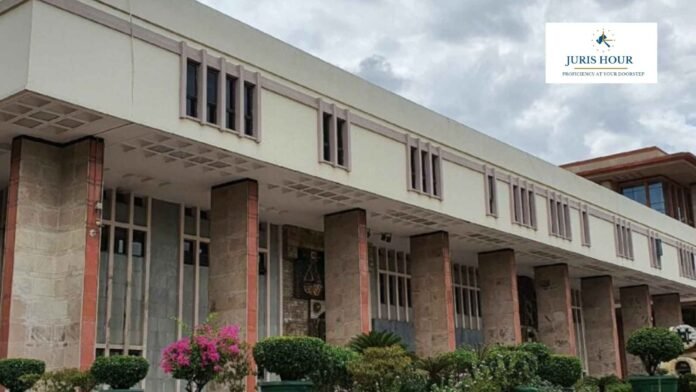
The Delhi High Court granted protection concerning the pre-deposit requirement. It held that appeals arising from show-cause notices issued before October 1, 2025, would be governed by Section 107(6) as it stood on the dates on which the notices were issued. The appeals cannot be rejected by applying the substituted pre-deposit proviso merely because the adjudication orders were passed after October 1, 2025.
The Bench of Justice Anil Kshetrapal and Justice Shail Jain declined to interfere with a batch of GST penalty orders arising from an investigation involving 629 firms and entities, holding that the disputed questions concerning jurisdiction, evidence, natural justice and quantification of penalties must first be examined by the statutory Appellate Authority under Section 107 of the Central Goods and Services Tax Act, 2017.
The petitions raised overlapping questions concerning penalties under Section 122, the competence of the officers who initiated the proceedings, reliance on third-party statements and electronic records, denial of cross-examination and the availability of the appellate remedy.
Buy Now: GSTAT E-Compilation For August 2026
The principal batch arose from an investigation conducted by the Directorate General of GST Intelligence and the concerned anti-evasion authorities into allegations of invoices being issued without an actual supply of goods and the wrongful availment or passing on of input tax credit.
The Department relied on statements recorded during the investigation, electronic material and handwritten records allegedly recovered during searches. According to the petitioners, however, the material did not independently establish their involvement in the disputed transactions.
M/s Siwon Enterprises Pvt. Ltd., which was treated as the lead petitioner, was engaged in trading TMT bars and allied iron and steel products. Its GST registration had been cancelled at its own request with effect from February 25, 2023.
The DGGI conducted searches at residential premises associated with the company’s directors on October 10, 2024. Thereafter, an Additional Director of the DGGI’s Ghaziabad Regional Unit issued a show-cause notice dated June 30, 2025, covering financial years 2018-19 to 2024-25.
The notice alleged that the concerned entities and individuals were involved in issuing invoices without supplying goods and proposed penalties under Sections 122(1), 122(1A) and 122(3)(a) of the CGST Act.
In the case of the lead petitioner, the notice and Form GST DRC-01 proposed a liability of approximately ₹45.55 crore. The petitioner submitted invoices, e-way bills, transportation records and other documents while seeking cross-examination of the persons whose statements had been relied upon.
An Order-in-Original was subsequently passed on December 26, 2025. After penalties were imposed under multiple clauses of Section 122(1), the consequential DRC-07 reflected an aggregate liability of approximately ₹227.72 crore against the lead petitioner.
The High Court noted that the overall investigation involved 629 firms and entities and that the aggregate tax and penalty exposure across the proceedings ran into hundreds of crores of rupees.
The petitioners’ primary jurisdictional challenge was that the officers issuing the notices had not been specifically assigned functions under Section 122 when the notices were issued.
They relied on the definition of “proper officer” under Section 2(91), the powers prescribed under Section 5 and CBIC Circular No. 254/11/2025-GST dated October 27, 2025. The circular specifically assigned officers as proper officers for functions under Section 122 and prescribed monetary limits.
According to the petitioners, the circular itself recorded that no proper officer had earlier been assigned for Section 122. They argued that an assignment made subsequently could not retrospectively validate a show-cause notice that was without jurisdiction when issued.
The Department, on the other hand, relied on Notification No. 14/2017-Central Tax dated July 1, 2017. Under this notification, officers of the DGGI were appointed as central tax officers and invested with powers exercisable by officers of corresponding ranks throughout India.
An Additional Director of the DGGI was placed on par with an Additional Commissioner for exercising powers under the CGST and IGST enactments.
The High Court observed that the CGST Act makes a distinction between the designation or rank of an officer and the assignment of a particular statutory function. The term “proper officer” under Section 2(91) is function-specific, and merely being an officer of central tax does not automatically make that officer the proper officer for every statutory function.
At the same time, the Court found that assignment of functions could be made through statutory and administrative instruments issued by the Board under Sections 3 and 5 of the CGST Act.
On a combined reading of Notification Nos. 2/2017 and 14/2017, the Court held that it could not conclude that an otherwise empowered central tax officer was necessarily deprived of authority to initiate proceedings merely because there was no specific assignment under Section 2(91).
The Court said the issue could not be determined solely on the basis of the October 27, 2025 circular. The effect of the circular had to be considered in the context of the statutory framework and the notifications already in force.
The Bench observed that the jurisdictional objection was not based on a “patent or self-evident” absence of authority that would justify direct interference under Article 226.
The question required interpretation of the CGST Act, the earlier notifications, the subsequent circular and, where applicable, the relationship between adjudication under Sections 73 or 74 and consequential penalties under Section 122. These questions could be raised before the Appellate Authority.
The petitioners also contended that Section 122(1) applies only to a “taxable person”. Consequently, a person who was neither registered nor liable to obtain registration could not be penalised merely because that person was allegedly associated with the transactions of a taxable person.
The High Court acknowledged that Section 122(1) predicates liability on a “taxable person”, whereas Section 122(1A) separately refers to “any person”. It observed that the difference in statutory language could not be ignored.
However, whether a particular petitioner satisfied the statutory description of a taxable person, was liable for registration or played the alleged role in the transactions involved factual questions connected with the evidence gathered during the investigation.
The Court noted that the question concerning the applicability of Section 122(1) to a person who is not a taxable person was already pending before the Supreme Court in Mukesh Kumar Garg v. Union of India.
Accordingly, the High Court left the question of law open, stating that it would be governed by the Supreme Court’s eventual decision.
One of the connected petitions was filed by Krishan Kumar, who claimed to be an individual, a non-taxable entity and an unregistered person under the GST enactments.
A show-cause notice dated September 24, 2025, proposed a penalty of approximately ₹68.62 crore concerning ITC allegedly availed and another penalty of approximately ₹94.84 crore concerning ITC allegedly passed on through five firms said to have been created by him.
The Order-in-Original dated March 24, 2026, imposed penalties aggregating approximately ₹163.46 crore. It also directed initiation of prosecution under Section 132(1), subject to approval by the competent authority.
The petitioner challenged the retrospective application of Section 122(1A) to transactions preceding its introduction on January 1, 2021. He also argued that the two alternatives under Section 122(1A) could not simultaneously be used to impose separate penalties for ITC allegedly availed and ITC allegedly passed on.
The High Court did not adjudicate these factual and legal objections on merits and permitted them to be raised in the statutory appeal.
The petitioners alleged that their replies and supporting documents were not properly considered, relied-upon documents were not supplied and effective opportunities for personal hearings were denied.
They also questioned reliance on statements of third parties, electronic data and handwritten records without allowing cross-examination. Some petitioners claimed that statements had been obtained under coercion and that the electronic evidence was not supported by the required certifications.
Another major grievance concerned the imposition of penalties under several clauses of Section 122(1) for the same alleged conduct. The petitioners alleged that this resulted in multiplication of penalties and, in some cases, created liabilities substantially exceeding the amounts proposed in the original notices.
They further alleged that several financial years, transactions and entities had been mechanically clubbed into composite proceedings and that different adjudicating authorities had reached contradictory conclusions about transactions arising from the same investigation.
The High Court held that these objections could not be effectively decided without examining the extensive documentary and electronic record, the individual role of each petitioner, the genuineness of the transactions and the evidence supporting each alleged contravention.
Since the Appellate Authority under Section 107 can examine both facts and law, the Court found no justification for bypassing the appellate mechanism.
The Court provided relief to the petitioners on the question of pre-deposit.
Notification No. 16/2025-Central Tax dated September 17, 2025, brought an amended pre-deposit requirement under Section 107(6) into effect from October 1, 2025, for cases involving penalty alone.
Relying on its earlier decision in Gaurav Jain v. Joint Commissioner (Appeals-II), CGST Delhi Zone, the Bench held that the substituted proviso does not apply to an appeal arising from proceedings initiated through a show-cause notice issued before October 1, 2025.
The Court explained that the appellate remedy, including the conditions governing its exercise, is determined by the law applicable on the date on which adjudicatory proceedings commenced.
All notices involved in the present batch had been issued before October 1, 2025. The principal notices were dated June 30, 2025, another notice was dated September 24, 2025, and notices in two connected petitions dated back to July 17, 2020.
The Court therefore directed that appeals against these orders must be governed by the earlier version of Section 107(6). The Appellate Authority cannot reject the appeals by applying the substituted proviso merely because the Orders-in-Original were passed after October 1, 2025.
While disposing of the petitions, the High Court granted the petitioners liberty to file statutory appeals under Section 107.
It directed the Appellate Authority to independently examine all grounds raised by the petitioners, including the questions left open in the judgment, without being influenced by the High Court’s observations.
The petitioners were also permitted to seek exclusion of the period during which their writ petitions remained pending before the High Court while computing limitation for filing the appeals. The Appellate Authority was directed to consider any such request in accordance with law.
Membership Required to Access Case Details & Order Copy
To view the complete Case Details and Download Order Copy, you must have an active membership. Please subscribe to continue.
Read More: Madras High Court Stays GST Revision Order Against Nissan Motor

