
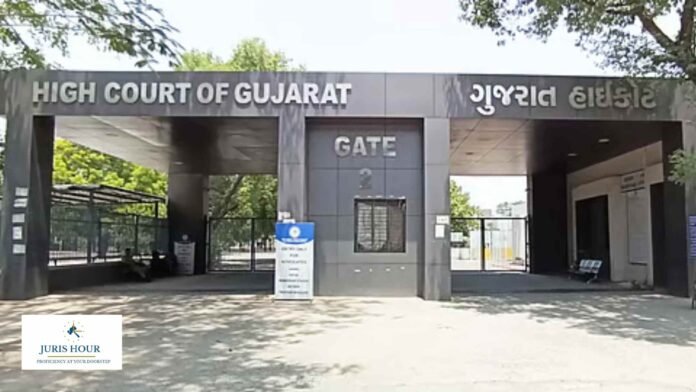
The Gujarat High Court has quashed an Income Tax Department reference made to the Departmental Valuation Officer merely one day before the limitation period for completing an assessment was due to expire and held that the Assessing Officer had artificially created grounds for obtaining a valuation report to extend the assessment deadline under Section 153 of the Income Tax Act, 1961.
The bench of Justice A.S. Supehia and Justice Vaibhavi D. Nanavati observed that the Assessing Officer had “very ingeniously” raised two valuation-related issues to cover up his failure to complete the assessment within the prescribed time.
The taxpayer had originally challenged show-cause notices as well as the reference made by the Assessing Officer to the District Valuation Officer.
Buy Now: Income tax E-Compilation – August 2026
At the beginning of the hearing, however, the company informed the High Court that it was not pressing its challenge to the show-cause notices. It confined the petition to the validity of the valuation reference made under Section 142A of the Income Tax Act.
The company had filed its income tax return for Assessment Year 2021-22 on March 14, 2022, declaring a total income of approximately Rs.8.17 crore. Its return was selected for scrutiny, and a notice under Section 143(2) was issued on June 29, 2022.
Several notices under Section 142(1) were subsequently issued, in response to which the company furnished the information and documents sought by the Income Tax Department.
The dispute also involved material obtained during search and survey proceedings conducted in connection with Ratnakala Exports Private Limited and associated entities. According to the judgment, the relevant search material was forwarded to the jurisdictional Income Tax authority on December 28, 2022.
The Assessing Officer subsequently issued show-cause notices on June 17 and June 20, 2023, concerning alleged unaccounted payments. The order records allegations involving payments of approximately Rs.1.01 crore and Rs.19.75 crore.
The taxpayer submitted a detailed reply on June 22, 2023, contesting the allegations on merits and arguing that the assessment proceedings were barred by limitation.
The company also pointed out that a communication issued by the Assessing Officer through email was not reflected on the Income Tax Business Application portal. The Department, however, maintained that the assessment deadline stood extended in view of the relevant Explanation to Section 153 of the Income Tax Act.
The Assessing Officer referred the matter to the District Valuation Officer for determining the fair market value of the company’s tangible assets. The reference itself acknowledged that the assessment proceedings would become time-barred on June 25, 2023.
The taxpayer argued that the valuation reference was not made to meet any genuine requirement arising from the assessment. Instead, it was issued at the last moment to trigger the exclusion of time available under Explanation 1(v) to Section 153.
Under this provision, while calculating the limitation period for completing an assessment, the period beginning with the date on which a reference is made to the Valuation Officer under Section 142A and ending with the date on which the valuation report is received is excluded.
The company contended that the Assessing Officer attempted to use this provision as a device to keep an otherwise expiring assessment alive.
The reference was reportedly made on two grounds. First, the Department claimed that material found during the search indicated that substantial unaccounted cash had been paid to a group company for share purchases and other properties. The taxpayer had also recorded an increase of approximately Rs.64 crore in fixed assets, including land and buildings, plant and machinery, vehicles and computers.
Second, the Assessing Officer alleged that certain assets had been purchased in the names of individual owners even though depreciation on those assets was claimed in the company’s books.
The taxpayer argued that even if the depreciation claim was considered inadmissible, the Assessing Officer could examine and disallow it under the relevant provisions of the Income Tax Act. Determining the fair market value of the assets had no connection with the question of whether the company was entitled to depreciation.
During the hearing, the Income Tax Department’s counsel fairly accepted that a valuation reference was not required merely to examine the depreciation claim. The Assessing Officer could independently disallow depreciation if it was found to be bogus or otherwise inadmissible.
The Revenue nevertheless defended the reference concerning the alleged use of unaccounted cash for investment in tangible assets. It submitted that the search material revealed cash transactions within the group and that the company’s financial statements disclosed significant additions to tangible assets.
According to the Department, it was necessary to determine the assets’ correct market value and compare it with the investment disclosed by the taxpayer. The reference was therefore claimed to fall within the scope of Section 142A.
The Revenue also argued that the assessment proceedings remained pending when the reference was made on June 24, 2023. Consequently, the exclusion of time contemplated under Explanation 1(v) to Section 153 was said to be legally available.
The High Court rejected the Revenue’s justification after examining the chronology of the assessment proceedings.
The bench noted that the search material had been supplied to the Income Tax authority on December 28, 2022. Despite having that material, the Assessing Officer did not issue the relevant show-cause notices until June 17 and June 20, 2023.
The Court found that no satisfactory explanation had been offered for this delay of nearly six months. It described the Department’s contention that the Assessing Officer was examining and correlating the material during this period as a “lame explanation.”
The show-cause notices issued in June 2023 asked the taxpayer to explain why the amounts mentioned in them should not be treated as unaccounted payments. Significantly, the notices did not raise any question concerning the valuation of assets.
The High Court also noted that the taxpayer had already provided details relating to its assets in December 2022. In response to an earlier notice, the company had explained payments made for computers, machinery, a factory shed, vehicles, furniture and office equipment and had furnished supporting banking details.
After receiving this reply, the Assessing Officer did not further question the asset payments for several months. The valuation issue appeared again only through the reference dated June 24, 2023, immediately before the assessment was to become time-barred.
The Court held that the Assessing Officer had acted illegally by creating an additional ground relating to the alleged bogus depreciation claim. The officer was expected to know that the depreciation issue could be examined and decided without referring the assets for valuation.
The bench concluded that the first ground relating to the valuation of assets also appeared to have been introduced intentionally to extend the limitation period.
All the relevant material obtained from the search proceedings, as well as the information supplied by the taxpayer, was already available with the Assessing Officer. Despite this, the officer failed to complete the assessment before the deadline.
According to the Court, the Assessing Officer attempted to overcome this failure by creating an artificial cause of action for referring the assets to the Valuation Officer and thereby invoking the exclusion of time under Explanation 1(v) to Section 153.
The Court remarked that the Assessing Officer was fully conscious that the limitation period would expire on June 25, 2023, because this fact was expressly recorded in the reference itself.
It found that the two issues raised for obtaining the valuation report were designed to cover up the officer’s inaction in completing the assessment within the statutory period.
The High Court quashed the reference to the Departmental Valuation Officer. The Court emphasised that a valuation reference made merely one day before the assessment became time-barred could not be sustained when the surrounding circumstances established that it was used as a device to artificially extend limitation.
Membership Required to Access Case Details & Order Copy
To view the complete Case Details and Download Order Copy, you must have an active membership. Please subscribe to continue.

