
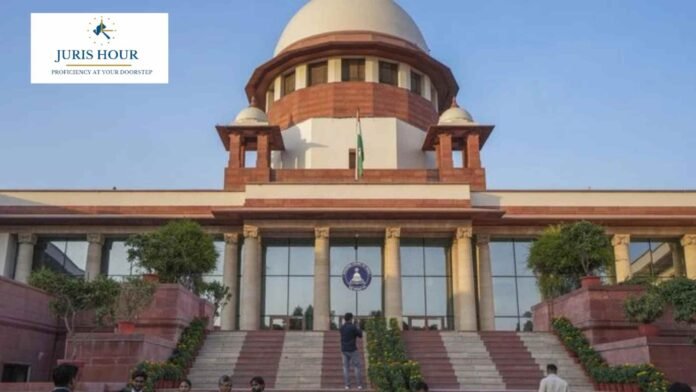
The Supreme Court has protected the retiral and pensionary benefits of a former municipal employee who served for more than three decades on the strength of a Scheduled Tribe certificate that was subsequently invalidated.
While refusing to interfere with the cancellation of the employee’s “Tokre Koli” Scheduled Tribe certificate, the Court exercised its extraordinary power under Article 142 of the Constitution to protect his service exclusively for calculating and releasing his retirement benefits.
A Bench comprising Justice Aravind Kumar and Justice Vipul M. Pancholi observed that invalidation of a caste or tribe claim ordinarily carries consequences under the law. However, the Court said that relief may be granted in exceptional circumstances where the equities of the case warrant the exercise of Article 142 to ensure complete justice.
Buy Now: Supreme Court Judgments E-Compilation – August 2026
“Generally, invalidation of a caste or tribe claim upon verification would have consequences in law. However, this Court has consistently recognized that, in exceptional circumstances where equities of the case so warrant, the power under Article 142 of the Constitution of India may be exercised to do complete justice,” the Bench observed.
The appellant was issued a caste certificate in 1984 certifying that he belonged to the “Tokre Koli” Scheduled Tribe. Relying on that certificate, he was appointed as a Junior Engineer (Civil) with the Municipal Corporation of Greater Mumbai on October 21, 1994. He was subsequently promoted in 1999.
After the original certificate was misplaced, the appellant obtained another certificate on October 21, 2000, from the Sub-Divisional Magistrate, Bhusawal Division. The fresh certificate described him as belonging to the “Tokare Koli” Scheduled Tribe.
In 2008, the municipal corporation referred his caste claim for verification. The Police Vigilance Cell submitted a report on September 16, 2008, relying upon several historical records relating to the appellant’s paternal ancestors.
Those records described their caste as “Koli”, “Hindu Koli” and “Hindu Suryawanshi Koli”, rather than “Tokre Koli”. A show-cause notice was consequently issued to the appellant in July 2009, following which he submitted replies and representations in support of his claim.
After several rounds of proceedings and reconstitution of the Scheduled Tribe Certificate Scrutiny Committee, the matter was listed for hearing on January 2, 2020.
The appellant did not personally appear on that date but submitted a written representation seeking an adjournment because his advocate and elderly family members were unavailable. The Committee rejected the request and reserved the matter for orders.
By an order dated July 27, 2020, the Scrutiny Committee invalidated the caste certificate issued in October 2000 and directed its cancellation and confiscation.
The appellant challenged that decision before the Bombay High Court, primarily alleging a violation of the principles of natural justice. He contended that the Committee had improperly rejected his request for an adjournment and had failed to adequately consider the documents produced by him.
He relied, among other things, on a 7/12 extract relating to the family’s agricultural land, in which the property was described as “tribal land”. He also relied upon a caste validity certificate granted to his cousin, Vinod G. Sonavane.
The appellant further argued that references to “Koli” and “Suryavanshi Koli” in historical family records could not, by themselves, invalidate his claim of belonging to the “Tokre Koli” Scheduled Tribe.
The Bombay High Court dismissed the writ petition on September 15, 2020. It held that sufficient opportunities had been granted to the appellant during the prolonged verification proceedings.
According to the High Court, rejection of the adjournment request on January 2, 2020, neither caused prejudice to the appellant nor resulted in a violation of natural justice.
On the merits, the High Court relied upon pre-Constitution records relating to the appellant’s father and grandfather, in which their caste was recorded as “Koli”. It found that these old records possessed substantial probative value and did not support the claim that the appellant belonged to the “Tokre Koli” Scheduled Tribe.
The High Court also accepted the Scrutiny Committee’s finding that the caste validity certificate granted to the appellant’s cousin had been obtained through misrepresentation.
The Supreme Court examined the Scrutiny Committee’s order as well as the judgment of the Bombay High Court and found no error in their conclusions.
The Bench, therefore, refused to disturb the finding that the appellant did not belong to the “Tokre Koli” Scheduled Tribe. The cancellation and confiscation of the caste certificate consequently remained valid.
During the Supreme Court proceedings, however, the appellant sought alternative relief protecting his pension and other retirement benefits. He informed the Court that he had retired on June 30, 2025, and that neither his children nor any other family member had obtained a benefit based on the invalidated certificate.
In an affidavit dated August 18, 2026, the appellant stated that he had no children and that none of his family members had derived any benefit from the caste certificate.
The Court also noted that the appellant had entered municipal service in 1994 and continued working until his retirement in 2025. He had remained in service during the pendency of the appeal because of an interim order passed by the Supreme Court on November 18, 2021.
The Supreme Court considered it appropriate to protect the appellant from losing his retirement benefits after more than 30 years of service.
The Bench referred to its decision in Chairman and Managing Director, Food Corporation of India v. Jagdish Balaram Bahira, in which a three-judge Bench recognised that an appointment secured on the basis of an invalid caste or tribe certificate would ordinarily not survive. Nevertheless, the Court could exercise Article 142 in an appropriate case to render complete justice.
The Court also relied upon R. Sundaram v. Tamil Nadu State Level Scrutiny Committee and Surekha Baljorsingh Thakur v. Caste Scrutiny Committee, where protection concerning post-retirement benefits was granted despite the annulment of caste certificates.
Accordingly, the Supreme Court protected the appellant’s service from October 21, 1994, to June 30, 2025, for the limited purpose of calculating and releasing his retiral and pensionary benefits under the applicable service rules.
The Court expressly clarified that the protection would not validate or recognise the appellant’s claim of belonging to the “Tokre Koli” Scheduled Tribe.
Neither the appellant nor any member of his family would be entitled to claim any future benefit based on the invalidated caste certificate, the Bench directed.
Membership Required to Access Case Details & Order Copy
To view the complete Case Details and Download Order Copy, you must have an active membership. Please subscribe to continue.

