
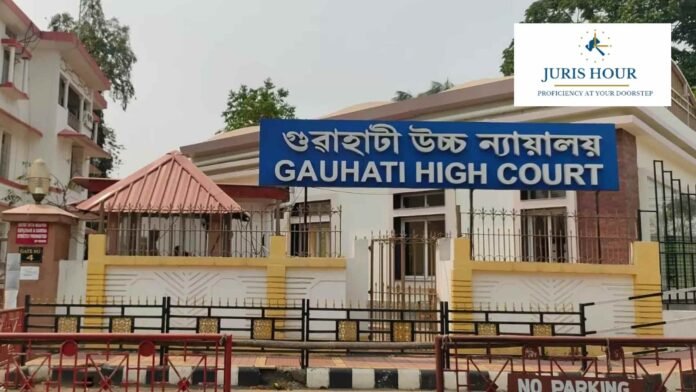
The Gauhati High Court has held that the one-year limitation prescribed under Section 11B of the Central Excise Act, 1944, cannot be invoked to deny the refund of Education Cess (EC) and Secondary and Higher Education Cess (SHEC) mistakenly paid without any legal liability.
The Bench of Justice Michael Zothankhuma and Justice Anjan Moni Kalita observed that Section 11B governs claims for the refund of excise duty and does not apply to amounts collected or accepted by the tax department without authority of law.
Buy Now: 70+ Judgements Indirect Tax – July 2026 | E-Magazine
The Court accordingly dismissed two appeals filed by the Commissioner of CGST and Central Excise against Oil India Limited and the Commissioner of Central Excise and Service Tax against Oil and Natural Gas Commission Limited. Since both appeals involved the same issue, they were disposed of through a common order.
The principal issue before the Court was whether Section 11B barred the refund of EC and SHEC mistakenly paid by the companies when their refund applications covered payments made more than one year before the relevant date.
The companies were engaged in the exploration and production of petroleum crude falling under Customs Tariff Heading 2709. Although crude oil attracted a nil rate of excise duty, the companies were required to pay Natural Calamity Contingent Duty under the Finance Act, 2001.
They were also liable to pay Oil Industry Development Cess under Section 15(1) of the Oil Industry (Development) Act, 1974. However, EC and SHEC were not payable on the OID Cess deposited with the Ministry of Petroleum and Natural Gas. Due to a mistaken understanding of the applicable law, the companies nevertheless paid EC and SHEC to the tax department.
After discovering the mistake, the companies applied for refunds. The Adjudicating Authority rejected the claims, following which the companies approached the Commissioner (Appeals), Customs, Central Excise and Service Tax, Guwahati.
The Commissioner (Appeals), by an order dated March 31, 2015, held that the companies were entitled to a refund of the EC and SHEC paid by mistake. However, the authority restricted the refund to payments covered by applications filed within one year of the relevant date under Section 11B.
The appellate authority also found that the burden of EC and SHEC paid on OID Cess had not been passed on to consumers. The companies subsequently challenged only that portion of the decision which denied refunds for claims beyond the one-year period.
The Customs, Excise and Service Tax Appellate Tribunal, Kolkata, allowed the appeal on April 16, 2025. It held that the statutory limitation under Section 11B did not apply because the EC and SHEC had been paid under a mistake of law. Consequently, the refund claims could not be rejected merely because they related to payments made more than one year earlier.
Challenging the Tribunal’s decision, the tax department approached the Gauhati High Court. The appeals were admitted on questions concerning the applicability of the limitation under Section 11B and the doctrine of unjust enrichment.
The department questioned whether the Tribunal was justified in granting the refund on the basis of a chartered accountant’s certificate without recording a categorical finding, supported by substantive evidence, that the burden of the cess had not been passed on to another person.
Addressing this contention, the High Court noted that in one appeal, the Commissioner (Appeals)’ finding that EC and SHEC had not been passed on to consumers had already attained finality. In the other appeal, unjust enrichment had not been raised by the department before any of the earlier forums.
Therefore, the only surviving question was whether Section 11B could prevent the refund of EC and SHEC paid by mistake when the claims were filed beyond the prescribed one-year period.
The Court noted that it was an admitted position in both cases that the companies had paid the cess due to a mistake. Referring to the Supreme Court’s decision in Union of India v. S.R. Dhingra, the Bench observed that a mistake does not confer a right upon any person and may be corrected.
Examining Section 11B, the Court explained that the provision applies when a person claims a refund of excise duty and interest paid on such duty. It requires the application to be made within one year of the relevant date, unless the duty was paid under protest.
However, the Bench held that an amount paid under a mistaken belief, despite there being no legal liability to pay it, does not assume the character of excise duty merely because it was deposited with the tax department.
The Court relied upon the Karnataka High Court’s ruling in Commissioner of Central Excise (Appeals), Bangalore v. K.V.R. Construction, which held that Section 11B refers only to refunds of excise duty and not to other amounts collected without authority of law.
Once an amount that was not legally payable had been deposited, the department had no authority to retain it, the Court observed. Such an amount remained outside the scope of Section 11B and was required to be returned.
The Bench also referred to the Gujarat High Court’s ruling in Oil and Natural Gas Corporation Limited v. Union of India. In that case, the Gujarat High Court held that OID Cess was not a duty of excise and, therefore, the EC and SHEC mistakenly calculated and paid on such cess could not be regarded as excise duty.
Consequently, the Gujarat High Court had ruled that Section 11B and its limitation period did not apply. Instead, the general principles of limitation, including Section 17 of the Limitation Act, 1963, would govern a claim arising from a mistake. Under Section 17, limitation ordinarily begins when the applicant discovers the mistake or could have discovered it by exercising reasonable diligence.
The Gauhati High Court further relied upon the Delhi High Court’s decision in Hind Agro Industries Limited v. Commissioner of Customs and the Calcutta High Court’s decision in Commissioner of Service Tax, Kolkata v. Electrosteel Castings Limited.
After considering the precedents, the Bench agreed with the consistent judicial view that the limitation under Section 11B does not apply to an amount mistakenly paid and collected without authority of law.
The Court clarified that the mere fact that the companies referred to Section 11B in their refund applications would not bring the claims within the scope of that provision. The substance and true nature of the payment, rather than the provision mentioned in the application, determined whether Section 11B was attracted.
“Section 11B of the Act cannot be a bar to refund the EC and SHEC that has been paid mistakenly by the respondents to the appellant,” the Court held.
The Bench also invoked Article 265 of the Constitution, which mandates that no tax shall be levied or collected except by authority of law. Since EC and SHEC were paid under a mistaken notion and there was no legal authority for their collection, the department could not retain the amounts.
Holding that the tax authorities were required to refund the mistakenly paid EC and SHEC, the High Court found no merit in the departmental appeals and dismissed both of them.
Membership Required to Access Case Details & Order Copy
To view the complete Case Details and Download Order Copy, you must have an active membership. Please subscribe to continue.

