
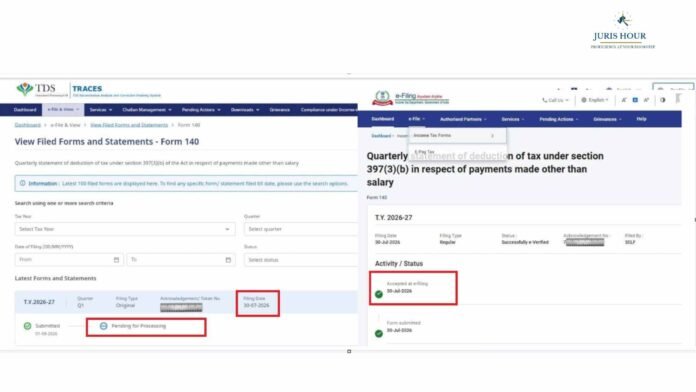
A serious concern has emerged over the functioning of the new TDS filing and processing system for FY/Tax Year 2026-27, after a taxpayer reportedly found a quarterly TDS return—filed within the prescribed due date—remaining “Pending for Processing” for several weeks before ultimately being rejected.
According to the issue highlighted, the Q1 FY 2026-27 TDS return was successfully filed on the Income Tax Department’s e-Filing Portal on 30 July 2026, before the applicable deadline. However, the statement allegedly continued to show “Pending for Processing” on the TRACES portal until 17 August 2026 and was subsequently shown as “Rejected” on 18 August 2026.
The development has raised an important question for deductors and tax professionals: Can a taxpayer who filed the original TDS statement within time be exposed to late-filing consequences merely because the system rejected the statement several weeks after accepting it for processing?
Buy Now: 80+ Income Tax Judgments | E-Magazine July 2026
Return Filed on 30 July, Rejected on 18 August
For quarterly TDS statements for Q1, covering April to June, the prescribed filing deadline is 31 July. The official TRACES FAQ continues to specify 31 July as the due date for Q1 quarterly TDS statements.
Therefore, a Q1 statement filed on 30 July would ordinarily constitute a filing made within the prescribed timeline.
The grievance, however, arises from what reportedly happened thereafter. Despite the filing being accepted through the Income Tax e-Filing system, its status remained pending on TRACES for approximately 18 days before the statement was ultimately rejected.
The deductor may consequently have to submit the statement afresh after the statutory due date, creating apprehension that the fresh filing could attract late-filing fee even though the original filing attempt was completed before the deadline.
“Why Should Filer Be Penalised for Portal Delay?”
The concern raised by the affected stakeholder is straightforward: where a statement is uploaded within the statutory deadline and accepted by the filing portal, any subsequent delay attributable to processing or inter-system validation should not convert an otherwise timely compliance into a taxpayer default.
The stakeholder has questioned why a deductor should bear a late fee for nearly 20 days when the return was already filed before the deadline and remained pending at the system’s end.
The grievance also raises a broader design issue concerning the new TDS compliance infrastructure. If a return contains a structural or validation defect that makes it incapable of being accepted, stakeholders argue that such an error should ideally be detected either by the validation utility or at the upload/initial validation stage.
Once the portal accepts a statement and generates the relevant filing acknowledgement or token, the deductor would reasonably expect the statement to proceed to CPC-TDS/TRACES for processing, where it could eventually be processed with or without defaults, rather than being rejected weeks later for an issue that could potentially have been detected earlier.
Helpdesk Response Raises Further Concern
Adding to the concern, the stakeholder stated that the Helpdesk reportedly described rejection after acceptance as a “normal scenario.”
This response has drawn criticism because acceptance of a statutory filing followed by rejection several weeks later can have significant compliance consequences, particularly when the intervening period extends beyond the original filing deadline.
The stakeholder has therefore urged the Income Tax Department to urgently examine the matter, maintaining that system delays should not be converted into taxpayer defaults.
Official TRACES Material Shows “Pending for Processing” as Recognised Status
Official TRACES guidance identifies “Pending for Processing” as one of the processing statuses for TDS/TCS statements. For regular statements, TRACES lists statuses including “Pending for Processing”, “Processed for 26AS”, “Processed with default” and “Processed without default.”
The official FAQ also explains that a statement is considered successfully processed when its status becomes “Processed with/without default.”
Significantly, the same FAQ sets out several circumstances in which correction statements may be rejected, including invalid TAN information, incorrect previous token numbers and mismatches in verification keys.
However, the present concern is more fundamental because it reportedly relates to an original Q1 filing made within the statutory deadline under the new FY 2026-27 compliance framework, which allegedly remained pending for weeks before rejection.
Similar Q1 Processing Difficulties Reported by Other Users
The concern does not appear entirely isolated insofar as prolonged “Pending for Processing” statuses are concerned.
In another publicly reported case this month, a deductor stated that its Q1 Tax Year 2026-27 Form 140 had been filed on 23 July 2026 and that an email received on 25 July informed it that the statement had been processed without default. Despite this, the new TRACES portal reportedly continued showing the statement as “Pending for Processing,” preventing the deductor from downloading TDS certificates.
The same issue was reportedly still unresolved on 17 August despite repeated contacts with the CPC-TDS Helpdesk and registration of a service request.
While these reports do not establish a system-wide defect, they indicate that at least some deductors have encountered discrepancies or delays between processing communications and the status displayed on the new TRACES system during the first quarter of FY 2026-27.
FY 2026-27 Marks Transition to New TDS Framework
The issue assumes additional significance because FY 2026-27 represents the first year of TDS compliance under the Income-tax Act, 2025, which took effect from 1 April 2026.
The Income Tax Department’s own guidance acknowledges the technological transition involved. It states that ERP and payroll systems need to be updated to reflect the new section numbering, terminology and reporting requirements.
The Department has also cautioned that quoting an old Act section number for a payment governed by the new Act may result in processing errors at the time of filing the TDS return, potentially requiring a correction statement.
The guidance further states that return preparation utilities and the TRACES portal would support both the old-format returns for periods up to March 2026 and new-format returns for periods beginning April 2026.
Against this transitional background, delayed processing or rejection of statements filed within time could create significant uncertainty for deductors.
Section 234E Late Fee Concern
The financial implication is particularly important because late filing of quarterly TDS statements attracts a statutory fee.
According to the official TRACES FAQ, Section 234E provides for a fee of ₹200 for every day during which the failure to furnish the TDS/TCS statement continues, subject to the fee not exceeding the amount of tax deducted or collected.
TRACES separately states that failure to furnish a quarterly TDS statement by the prescribed due date attracts ₹200 per day from the due date until the statement is filed.
This creates the central concern in cases of delayed system rejection: what should be treated as the filing date where a deductor successfully uploaded a statement within time, but the system rejected it only after the statutory deadline had passed?
If a fresh filing is treated as the operative filing without recognising the timely original submission, the deductor could potentially face a late-filing consequence for a period during which the statement was already sitting within the Department’s processing infrastructure.
Need for Protection Against System-Generated Delay
The episode highlights the need for clarity from the Income Tax Department and CPC-TDS regarding the treatment of statements that are timely uploaded and initially accepted but subsequently rejected after prolonged processing.
A taxpayer-facing compliance system should ideally distinguish between delay attributable to the deductor and delay attributable to departmental processing or portal infrastructure.
Where a statement contains a fatal structural or validation error, early identification at the validation or upload stage could allow the deductor to correct and refile the statement before the deadline.
Conversely, where the system accepts a return within the due date and takes days or weeks to determine that it cannot be processed, stakeholders are seeking safeguards to ensure that the intervening processing period does not automatically result in late-filing consequences for the deductor.
Tax Professionals Seek Urgent Intervention
The issue has been brought to the attention of the Income Tax Department through social media, with a request for urgent examination and comments from other deductors and tax professionals who may have faced similar difficulties.
The concern is especially relevant during the first year of the new TDS filing framework, when deductors, software providers, tax professionals and departmental systems are transitioning to revised forms, section references and processing architecture.
The immediate question requiring clarification is whether a deductor who can establish that the original Q1 TDS statement was successfully filed and accepted on 30 July 2026 will be protected from late-filing consequences where that statement remained pending at TRACES and was rejected only on 18 August.
Until the Department clarifies the treatment of such cases, taxpayers and professionals may preserve the original filing acknowledgement, token number, screenshots showing “Pending for Processing”, subsequent rejection communication and Helpdesk/service-request records to establish the chronology of timely compliance.
The larger concern raised by the episode can be summed up simply: a processing delay occurring within the tax administration’s own systems should not, by itself, transform a filing made within the statutory deadline into a taxpayer default.
The Income Tax Department and CPC-TDS may therefore need to examine whether the new system requires faster upfront validation, clearer rejection reasons and a mechanism for protecting the original filing date where a statement accepted within time is subsequently rejected because of processing or system-related issues.

