
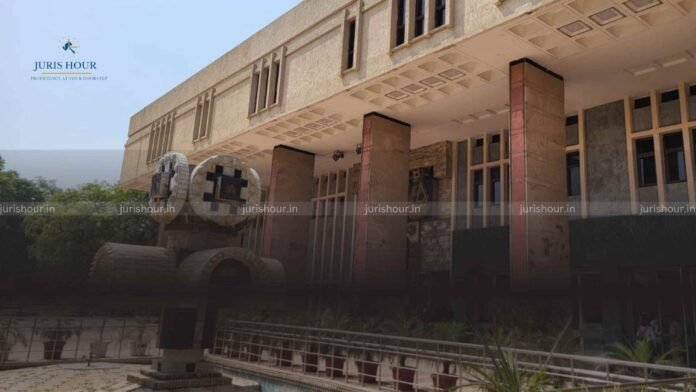
The Delhi High Court has directed the Income Tax Department to release more than ₹53.09 crore along with applicable statutory interest, holding that authorities cannot compel an assessee to furnish Form 26B once a refund has crystallized pursuant to an assessment order or appellate proceedings.
The Bench of Justice Dinesh Mehta and Justice Rajneesh Kumar Gupta criticized the Department’s refusal to issue the refund despite favorable orders passed by the Income Tax Appellate Tribunal (ITAT) and subsequent appeal-effect orders issued by the Assessing Officer.
The petitioner approached the High Court seeking directions for release of refunds along with interest under Sections 244A and 244A(1A) of the Income-tax Act, 1961. The company contended that refunds relating to Assessment Years 2003-04 and 2008-09 to 2013-14 had remained unpaid for nearly two years despite favorable orders from the ITAT and appeal-effect orders passed by the Assessing Officer.
Buy Now: 80+ Income Tax Judgments | E-Magazine July 2026
According to the case records, the ITAT had allowed the assessee’s appeals through orders passed between April 2024 and February 2025. Thereafter, the Assessing Officer passed orders giving effect to those appellate decisions and quantified refunds aggregating to approximately ₹53.09 crore.
However, despite determining that the amount was refundable, the Department insisted that the taxpayer submit Form 26B before the refund could be processed.
The controversy arose after the taxpayer submitted Form 26B, even though it maintained that such a requirement was legally unnecessary. The Department subsequently rejected the forms, citing outstanding tax demands associated with the company’s PAN and related TANs amounting to approximately ₹924.57 crore.
During the proceedings, however, the Revenue acknowledged that demands aggregating ₹913.66 crore had already been stayed by various authorities and courts, leaving only about ₹10.91 crore as allegedly outstanding.
The taxpayer disputed even this figure and argued that the actual outstanding amount was only around ₹27.63 lakh. The Court declined to enter into that factual dispute and left the issue for determination by the authorities.
A central issue before the Court was whether the Department could insist upon submission of Form 26B for releasing refunds that arose after completion of assessment proceedings and appellate orders.
The taxpayer argued that Form 26B, Rule 31A of the Income-tax Rules, and Section 200A of the Income-tax Act operate in a limited sphere dealing with correction and processing of TDS statements, and not with refunds that become payable after assessments under Section 201 or pursuant to appellate decisions.
The Revenue defended its stand by relying upon departmental practice and a Standard Operating Procedure (SOP) issued by the Centralized Processing Cell (TDS), contending that Form 26B was routinely required whenever TDS refunds were claimed.
The Court held that Sections 200A and 201 operate in entirely different fields. According to the Bench, Section 201 deals with assessment of TDS liabilities, whereas Section 200A concerns processing and adjustment of TDS statements at the CPC level. Rule 31A and Form 26B are procedural mechanisms intended for adjustments under Section 200A.
The Court observed that once an assessment has been completed under Section 201, or an appellate authority has passed an order resulting in a refund, the taxpayer acquires a vested and crystallized right to receive that refund along with applicable interest. Such entitlement cannot be made dependent on furnishing Form 26B.
In one of the most significant findings of the judgment, the Court ruled that after an assessment under Section 201, neither Rule 31A nor Form 26B can be invoked to delay or deny payment of a refund.
The Bench further clarified that the Department can withhold or adjust refunds only through a legally valid order passed under Section 245 of the Income-tax Act. Absent such an order, neither the Assessing Officer nor the CPC is empowered to retain a refund that has become payable after assessment or appellate proceedings.
Notably, the Revenue failed to produce any order under Section 245 authorizing adjustment or withholding of the refund. Consequently, the Court held that the Department’s reliance on alleged outstanding demands relating to the taxpayer’s PAN and associated TANs was legally unsustainable.
The Court remarked that the case reflected a “grim picture” of the prevailing state of affairs in refund administration. It noted that the taxpayer had been engaged in litigation for nearly a decade and had succeeded before the Tribunal in 2024, yet the quantified refund continued to remain unpaid.
The Bench also observed that the Assessing Officer had taken shelter behind Form 26B requirements and alleged outstanding demands despite the existence of orders recognizing the refund entitlement.
The Delhi High Court directed the Income Tax Department to release ₹53,09,56,470 together with applicable interest under Sections 244A and 244A(1A) of the Income-tax Act on or before September 30, 2026.
The Court further warned that if the refund amount is not credited within the stipulated period, it would carry additional interest at the rate of 1% per month over and above the statutory interest.
While observing that the matter was fit for imposition of exemplary costs, the Bench ultimately refrained from doing so.
Membership Required to Access Case Details & Order Copy
To view the complete Case Details and Download Order Copy, you must have an active membership. Please subscribe to continue.
Read More: GST Orders Passed on Unscheduled Dates Under Allahabad HC Scanner; GSTN Asked to Respond

