
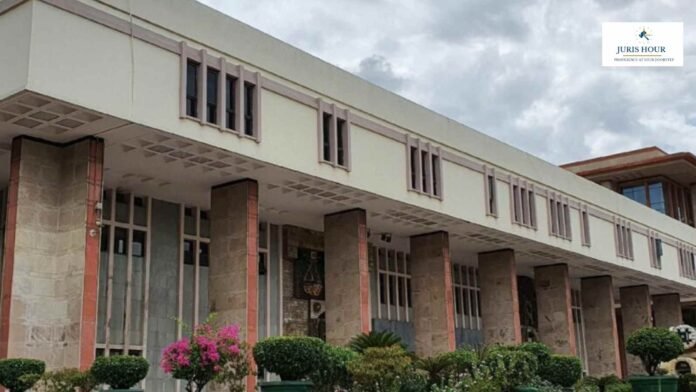
The Delhi High Court has set aside reassessment proceedings and the consequential demand raised against a Singapore-based company after finding that the assessee was not afforded an effective opportunity to defend itself.
The bench of Justice Dinesh Mehta and Justice Rajneesh Kumar Gupta quashed the order passed under Section 148A(d) of the Income Tax Act, 1961, the subsequent ex-parte assessment order and the penalty order, restoring the matter to the stage of issuance of notice under Section 148A.
The company had challenged the initiation of proceedings under Section 148 of the Income Tax Act as well as their culmination in an assessment order dated May 27, 2025. The challenge was mounted both on jurisdictional grounds and on the allegation that the proceedings violated the principles of natural justice.
Buy Now: 80+ Income Tax Judgments | E-Magazine July 2026
Aedas Interiors is a Singapore-based company which had obtained a Permanent Account Number (PAN) in India in 2010. At the time of obtaining the PAN, the company had applied through an employee, Paulianna Ow, who subsequently left the organisation. According to the company, because of inadvertence or lack of knowledge, the authorised representative’s email address was not subsequently updated.
The company told the High Court that it discovered an outstanding tax demand only when it accessed the Income Tax Department’s portal on January 29, 2026. The demand had been raised pursuant to the assessment order dated May 27, 2025. The company contended that merely reflecting a demand on the portal could not, in the circumstances, establish that the relevant proceedings had effectively been served upon it.
The core grievance was that the notice under Section 148A(b), stated to have been issued on February 21, 2024, was never served on the company. Likewise, the company claimed that the order under Section 148A(d), dated March 31, 2024, was not served, nor was the subsequent order passed under Sections 147 read with 144 on May 27, 2025.
The assessment for Assessment Year 2020-21 was ultimately completed ex-parte. The company argued that it had consequently been denied an opportunity to respond to the reassessment proceedings and defend its position before the Assessing Officer.
The petitioner further submitted that its address was available in the PAN records maintained by the Income Tax Department. It therefore argued that the Assessing Officer ought to have issued a physical notice or intimation at the available address, particularly when the company had not responded to the electronic communication.
According to the company, such communication was necessary to enable it to participate in the proceedings and avail itself of the remedies available under law. The failure to provide such an opportunity, it argued, rendered the reassessment proceedings and the assessment order contrary to the principles of natural justice.
Revenue Admitted Possibility of Non-Receipt
Representing the Revenue, Senior Standing Counsel Siddhartha Sinha submitted that the notice would ordinarily have been automatically sent to the email address furnished at the time of obtaining the PAN, in accordance with the system-generated process.
However, the Revenue also acknowledged that since the employee through whom the PAN application had been made had subsequently left the company, it was possible that the company did not receive the communication and consequently could not defend the proceedings. The Revenue therefore submitted that the company could be granted an opportunity to contest the matter and that the proceedings could be restored to the stage at which notice was issued.
At the same time, the Revenue maintained that the proceedings should not be treated as time-barred merely because the company did not receive or act upon the electronic communication. It argued that the responsibility to keep the email address and other particulars updated with the Income Tax Department rested with the assessee. The Revenue also submitted that the company was expected to access the Income Tax portal whenever required.
Delhi High Court Focuses on Denial of Effective Opportunity
The High Court declined to enter into the question of whether the relevant notice was actually sent to the former employee’s email address, observing that deciding that issue was unnecessary for disposal of the writ petition.
The Bench noted that ordinarily an assessee would not deliberately risk non-appearance and failure to file a reply, particularly when such inaction could result in an adverse assessment. The Court further observed that even after a demand is raised, an assessee would ordinarily be expected to pursue the appellate or other remedies available under law.
In the present case, however, the Court found that the Singapore-based company had been subjected to a demand without being afforded a hearing. The Bench concluded that the circumstances justified judicial intervention in the interest of justice.
The High Court accordingly set aside the demand raised through the assessment order dated May 27, 2025, as well as the Section 148A(d) order dated March 31, 2024. The Court also quashed the consequential penalty order dated December 16, 2025.
Rather than terminating the reassessment proceedings altogether, the Court restored the matter to the Assessing Officer from the stage of issuance of notice under Section 148A. This means that the Revenue has been permitted to proceed afresh while giving the assessee the opportunity that was missing from the earlier proceedings.
The Court directed the petitioner to file its reply to the notice on or before September 15, 2026. The jurisdictional Assessing Officer has been directed to pass an order under Section 148A(d) by October 31, 2026, after obtaining the requisite approval from the prescribed authority competent to grant such approval at the relevant time.
The Bench also clarified that if any exigency arises, either the petitioner or the Assessing Officer would be at liberty to seek an extension of time.
Membership Required to Access Case Details & Order Copy
To view the complete Case Details and Download Order Copy, you must have an active membership. Please subscribe to continue.
Read More: CIT(A) Can’t Direct Reopening of Another AY: ITAT

