
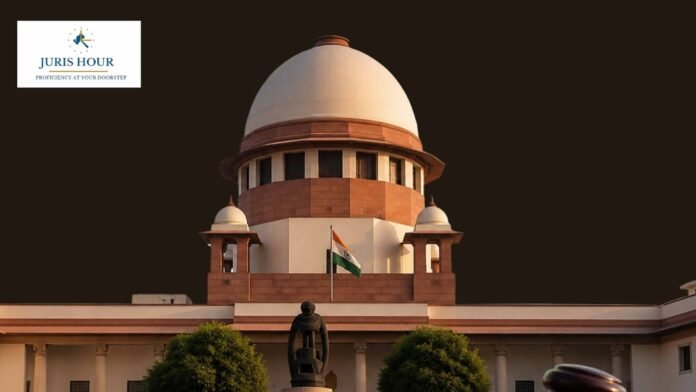
The Supreme Court has dismissed the Special Leave Petitions filed by the Commissioner of State GST and VAT, Department of Trade and Taxes, Delhi, against proceedings concerning a refund claim of ₹70.09 lakh, refusing to condone a delay of 394 days in approaching the Court.
The bench of Justice Pamidighantam Sri Narasimha and Justice Alok Aradhe expressly kept open the important question of law concerning the interpretation of Rule 90(2) of the Central Goods and Services Tax Rules, 2017, for consideration in an appropriate case.
The bench recorded that it did not find any plausible and bona fide explanation for the “inordinate delay” of 394 days in filing the Special Leave Petitions and consequently dismissed them on the ground of limitation. Importantly, however, the Court clarified that the legal issue raised by the GST authorities regarding Rule 90(2) of the GST Rules had not been decided on merits and would remain open for examination in a suitable future case.
Buy Now: 130 GST Judgments – E-Magazine July 2026
The dispute arose from a refund application under Section 54(3) of the CGST Act, 2017. The company had filed Form GST RFD-01 on November 30, 2023, seeking refund for the financial period April 2020 to March 2022. The amount involved was ₹70,09,455.
According to the Delhi High Court proceedings, the refund application was not decided within the prescribed statutory framework, prompting the taxpayer to approach the High Court through W.P.(C) No. 14121 of 2024/2025 proceedings. By an order dated March 28, 2025, the High Court directed the GST authorities to sanction the refund along with applicable statutory interest. The Court specifically directed that the refund be given within four weeks from the date of the order.
The subsequent proceedings before the Delhi High Court reveal that the refund order became the subject of repeated compliance proceedings.
When the taxpayer complained that the March 28, 2025 order had not been complied with, the Division Bench, on July 16, 2025, recorded that the refund had not been disbursed. The Department stated that the taxpayer’s application had inadvertently been sent to the wrong ward officer, which had resulted in the delay. The Court consequently permitted the taxpayer to file a fresh application and directed that the refund be processed expeditiously.
The matter did not end there. On December 12, 2025, the Department placed a status report before the High Court stating that there was a discrepancy in the taxpayer’s returns. The Court noted that the issue concerning the procedure to be followed in the event of a mistake in the return had apparently not been brought to the notice of the Bench when the original refund order was passed. The taxpayer, meanwhile, expressed willingness to file an amended manual return.
The underlying legal controversy relates to the statutory mechanism governing acknowledgement and processing of refund applications under the GST Rules.
The Delhi High Court proceedings refer to the earlier judgment in M/s Jian International versus Commissioner of Delhi Goods and Services Tax, reported as 2020 SCC OnLine Del 2606. The Court relied upon the framework under Rules 89, 90 and 91 of the CGST/DGST Rules concerning acknowledgement of refund applications and the issuance of deficiency memos.
The material reproduced in the High Court record notes that Rule 90 provides for an acknowledgement in Form GST RFD-02 where a refund application is complete in all respects. It further records the statutory timeline for issuing acknowledgement and dealing with deficiencies. Where deficiencies are noticed, the proper officer is required to communicate them electronically in Form GST RFD-03, following which a fresh refund application is required after rectification of the deficiencies.
The Delhi High Court had earlier observed that permitting the Department to issue a deficiency memo beyond the prescribed timeline could have the effect of allowing the authorities to defeat the original filing date of the refund application. The Court also observed that such a course could delay the taxpayer’s right to seek refund and impair the benefit of the original filing date contemplated under the Rules.
It was against this backdrop that the GST authorities raised a question concerning the interpretation of Rule 90(2) before the Supreme Court.
The taxpayer continued to pursue implementation of the March 28, 2025 refund order. On February 13, 2026, the Delhi High Court observed that the earlier order did not require clarification and that the taxpayer could take necessary steps in accordance with law for compliance.
Thereafter, the taxpayer approached the High Court alleging continued non-compliance. The refund still remained unpaid, according to the proceedings recorded in the case.
The record further shows that the Department subsequently passed an order dated March 24, 2026 rejecting the taxpayer’s refund request. The taxpayer challenged this development, contending that the earlier directions of the High Court had already required the refund to be granted and that the issue of alleged shortfalls had been dealt with in the earlier proceedings.
The Delhi High Court took a serious view of the Department’s subsequent rejection of the refund claim.
The Bench comprising Justice Nitin Wasudeo Sambre and Justice Ajay Digpaul recorded that, on a plain reading of the earlier orders, it was prima facie of the view that the respondents were in contempt of the March 28, 2025 order. However, since counsel appearing for the Department sought time to file a response, the Court granted four weeks for filing the response, with two weeks thereafter for rejoinder. The matter was directed to be listed on July 30, 2026.
The May 18 order therefore formed part of a continuing dispute over whether the Department had complied with the original judicial direction to release the refund along with statutory interest.
The Supreme Court proceedings ultimately turned on limitation rather than the substantive GST question.
The GST Department approached the Supreme Court through Special Leave Petitions, but there was a delay of 394 days in filing them. The Supreme Court found that no plausible and bona fide explanation had been furnished for the delay and declined to condone it.
Consequently, the Special Leave Petitions were dismissed without examining the substantive merits of the challenge.
However, the Court made an important clarification. It specifically stated that the question of law raised by the Department concerning the interpretation of Rule 90(2) of the GST Rules was being kept open for consideration in an appropriate case.
Thus, the Supreme Court’s order should not be read as a final pronouncement settling the interpretation of Rule 90(2).
Membership Required to Access Case Details & Order Copy
To view the complete Case Details and Download Order Copy, you must have an active membership. Please subscribe to continue.

