
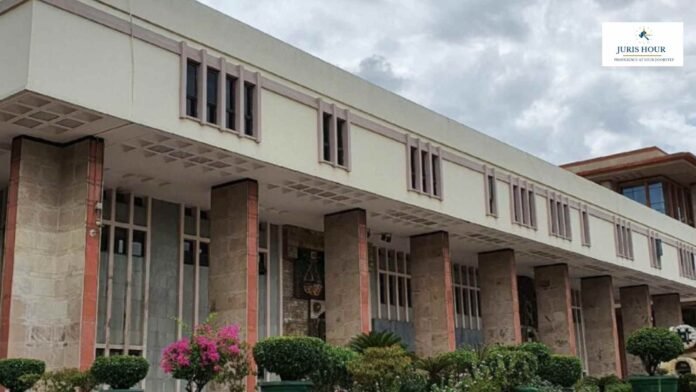
The Delhi High Court has held that pendency of writ petition did not bar Customs adjudication and challenges involving disputed service of hearing notices and limitation to be examined in statutory appeal.
The Bench of Justice Anil Khetarpal and Justice Shail Jain held that challenges involving disputed questions of fact, including alleged denial of effective personal hearing, non-consideration of written submissions, service of hearing notices and limitation, should ordinarily be pursued before the statutory appellate authority under Section 128 of the Customs Act.
The dispute arose from a DRI investigation concerning the import of information technology and networking equipment by the company, which is engaged in providing cloud and edge networking services through infrastructure such as servers, routers, switches and optical modules at data centres across India.
Buy Now: 70+ Judgements Indirect Tax – July 2026 | E-Magazine
According to the Department’s allegations, the imports involved use of third-party Importer Exporter Code (IEC) holders, undervaluation and misdeclaration of imported goods and non-compliance with Bureau of Indian Standards (BIS) requirements. The investigation resulted in three separate Show Cause Notices (SCNs).
The first SCN concerned four live consignments intercepted at the time of import and proposed confiscation under Section 111 of the Customs Act, along with recovery of differential customs duty and penalties under Sections 112 and 114.
The second SCN covered 74 Bills of Entry relating to consignments that had already been cleared and proposed recovery of differential customs duty under Section 28(4), along with consequential penalties.
The third SCN concerned networking equipment found at data centres in different jurisdictions for which the Department alleged that no lawful import documentation or evidence of customs clearance could be produced.
A central issue before the High Court was whether all three SCNs arising from the same DRI investigation should have been adjudicated by a Common Adjudicating Authority (CAA).
The company had submitted a representation on April 2, 2024, seeking appointment of a CAA for all three SCNs. However, CBIC, through Notification No. 58/2024-Customs (N.T.) dated September 4, 2024, appointed the Additional or Joint Commissioner of Customs, Office of the Commissioner of Customs (Preventive), Mumbai, as the CAA only for the third SCN dated November 21, 2023. No CAA was appointed for the first two SCNs.
The company therefore approached the Delhi High Court seeking appointment of a single authority to adjudicate all three SCNs.
The company argued that the notices arose from a single investigation, involved common facts and evidence, and substantially overlapped. It pointed out that 19 relied-upon documents were common to all three SCNs, while all 99 relied-upon documents in the second and third SCNs were common. It also relied upon CBIC Circular No. 30/2015 dated December 4, 2015, concerning appointment of a CAA in cases involving an aggregate customs duty demand of ₹5 crore or more and identical issues.
The High Court noted that the three SCNs did arise from the same DRI investigation and that there was substantial overlap in the material relied upon by the Department. The Court therefore observed that the request for common adjudication was not without basis.
However, the Bench emphasised that the three SCNs also concerned materially different transactions and stages of the alleged violations.
The January 2, 2023 SCN dealt with live consignments intercepted during import. The November 20, 2023 SCN related to 74 Bills of Entry covering consignments that had already been cleared, while the November 21, 2023 SCN concerned equipment found at data centres for which the Department alleged an absence of lawful import documentation.
The Court referred to the principle recognised in Star Delta Exim (P) Ltd. v. Union of India, which was subsequently affirmed by the Supreme Court, that common adjudication may be useful where connected SCNs are founded upon substantially common material and separate adjudication could result in inconsistent findings.
At the same time, the Court clarified that this principle does not mean that every SCN emerging from a common investigation must necessarily be adjudicated by one authority irrespective of differences in allegations, transactions and reliefs.
Pendency of writ petition did not automatically stay adjudication
Another important issue was whether the Customs authorities at New Delhi could proceed with adjudication while the petition seeking appointment of a CAA was pending before the High Court.
On August 19, 2025, the High Court had directed that a personal hearing fixed before the Commissioner of Customs, Mumbai, be adjourned beyond November 10, 2025. The order had also recorded a prima facie view that multiple authorities adjudicating SCNs arising from the same factual situation could result in contradictory findings and outcomes.
The petitioners argued that the subsequent adjudication of the other two SCNs disregarded the Court’s earlier order.
The High Court, however, found that the August 19, 2025 order did not expressly stay the adjudication proceedings before the competent authority at New Delhi. Consequently, the mere pendency of the writ petition did not render the subsequent adjudication without jurisdiction.
The Court held that the communication by which the petitioner had brought the August 19 order to the adjudicating authority’s attention and sought deferment was a circumstance requiring consideration, but it did not amount to a judicial restraint against continuation of the proceedings.
Since two of the three SCNs had already been adjudicated, the Court concluded that directing all three matters to be placed before a CAA at that stage would not serve any useful or effective purpose.
A separate connected petition was filed by Rahi Systems Private Limited, which had been arrayed as a co-noticee in the November 20, 2023 SCN.
The company alleged that its IEC had been used in connection with imports and that it had been wrongly proceeded against under Sections 112(a) and 114AA of the Customs Act.
A significant procedural dispute arose concerning service of hearing notices. The company had entered appearance through counsel and filed its Vakalatnama on December 20, 2023. A hearing notice dated October 4, 2024, was allegedly sent to an email address belonging to a former employee. After learning of the notice, the company communicated with the adjudicating authority on October 15, 2024, sought an adjournment and provided three alternative email addresses for future correspondence.
The company contended that subsequent corrigenda and hearing notices were not served on the email addresses it had furnished and that it remained unaware of the subsequent proceedings until it received the adjudication order by post at its registered Pune address on December 1, 2025.
The adjudication order imposed penalties of ₹2 crore under Section 112(a)(i) and ₹4 crore under Section 114AA of the Customs Act upon Rahi Systems.
The High Court did not reject the legal principle that a noticee must receive a real and effective opportunity of hearing.
Instead, the Bench held that the crucial question was whether such an opportunity had actually been denied in the particular cases. That determination depended upon disputed facts concerning whether notices were served, where they were transmitted and whether the petitioners had sufficient opportunity to place their defence before the adjudicating authority.
The Court observed that allegations of violation of natural justice, when their existence and effect depend upon disputed factual questions, do not automatically justify bypassing the statutory appellate mechanism.
The appellate authority, according to the Court, is better positioned to examine the complete adjudication record and determine whether an effective opportunity of hearing was actually afforded and whether any prejudice resulted.
In the connected petition filed by a former General Manager/Country Head and Director of the company, the petitioner alleged that his detailed reply dated March 27, 2023 to the January 2, 2023 SCN had not been considered.
He argued that the Order-in-Original proceeded on the premise that no written submissions had been made by him, despite his assertion that a detailed reply had been filed. He also alleged denial of an effective opportunity of personal hearing.
The High Court held that questions such as whether the reply was received, whether it formed part of the adjudication record, whether it was actually considered and what opportunities of personal hearing were provided would require examination of the complete record.
Such factual scrutiny, the Court held, could appropriately be undertaken by the statutory appellate authority.
The Respondents had raised a preliminary objection that the writ petitions challenging the November 14, 2025 Orders-in-Original were not maintainable in view of the alternative statutory remedy available under Section 128 of the Customs Act.
The High Court accepted the broader principle that availability of an alternative statutory remedy is not an absolute bar to exercise of writ jurisdiction under Article 226 of the Constitution. However, the Court reiterated that it may decline to exercise that jurisdiction where the impugned order has been passed by a competent authority and the challenge substantially involves examination of the adjudication record, disputed questions of fact and appreciation of evidence.
The Court found that the consolidated adjudication order covered 23 firms and individuals and that the petitioners’ objections principally concerned the manner in which the adjudication was conducted and the treatment of material relating to individual noticees.
In the absence of an inherent lack of jurisdiction or a pure question of law incapable of examination by the statutory appellate forum, the High Court found no sufficient reason to depart from the ordinary rule of relegating the petitioners to the statutory remedy.
The company had also raised a contention concerning the statutory period for determination of duty in respect of the January 2, 2023 SCN.
The High Court declined to decide the limitation issue in writ jurisdiction. It held that the question would require examination of the relevant SCN, underlying transactions, dates relevant to computation of limitation and findings recorded in the adjudication order.
Accordingly, the Court expressly left the limitation objection open for consideration by the competent appellate forum.
The High Court expressly clarified that nothing in its judgment should be construed as an opinion on the merits of the allegations in the SCNs, the valuation adopted by the Department, liability to duty or penalty, limitation, or the individual procedural objections raised by the petitioners. All such questions were left open before the competent appellate forum.
The Delhi High Court dismissed the petition seeking appointment of a CAA for all three SCNs, holding that the prayer could not be granted in the circumstances after two SCNs had already been adjudicated.
The Court also dismissed the challenge to the November 14, 2025 Orders-in-Original in the other connected petitions, but expressly preserved the petitioners’ right to approach the statutory appellate authority.
Membership Required to Access Case Details & Order Copy
To view the complete Case Details and Download Order Copy, you must have an active membership. Please subscribe to continue.

