
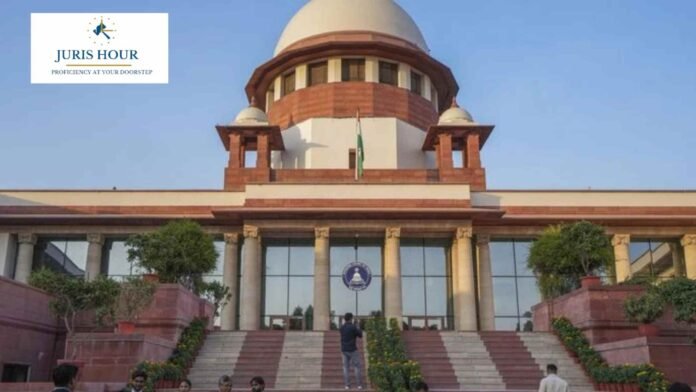
The Supreme Court has delivered a significant judgment on public employment, deputation and service seniority, holding that the absorption of four officers from the Development and Panchayat Department into the Public Works Department (Building & Roads), Haryana, as Assistant Engineers/Sub-Divisional Engineers, was illegal, non est and void.
The bench of Justice Manoj Misra and Justice Ujjal Bhuyan directed that the four officers be repatriated to their parent department, ruling that an appointment made in violation of statutory service rules cannot be validated merely because the employees have continued in service for several years.
The central controversy before the Supreme Court concerned whether four officers who had initially been sent on deputation from the Development and Panchayat Department to the PW(B&R) Department could subsequently be absorbed into the borrowing department by invoking Rule 10 of the Punjab Service of Engineers, Class II, P.W.D. (Buildings and Roads Branch) Rules, 1965, as applicable to Haryana.
Buy Now: 70+ Judgements Indirect Tax – July 2026 | E-Magazine
A connected issue was whether such officers could claim seniority over candidates who had entered the PW(B&R) Department through regular direct recruitment or promotion.
The Supreme Court ultimately found that the absorption itself could not be sustained. Having concluded that the appointments were illegal and void, the Court held that it was unnecessary to undertake a detailed determination of the disputed seniority under Rule 12(5).
The dispute arose from the movement of four officers—Pradeep Atri, Praveen Chaudhary, Pankaj Gaur and Arun Bhatia—from the Development and Panchayat Department to the PW(B&R) Department.
The first two cases, concerning Atri and Chaudhary, involved deputation arrangements initiated substantially through individual requests and subsequent departmental or ministerial interventions. The other two officers, Gaur and Bhatia, were taken on deputation after the PW(B&R) Department itself requisitioned officers from other departments.
The four officers were subsequently absorbed into the PW(B&R) Department. Their absorption and the seniority granted to them were challenged by direct recruits who contended that they had entered the cadre through the prescribed recruitment process and could not lawfully be placed below officers who had entered through deputation and transfer.
The Punjab and Haryana High Court, in its judgment dated 15 March 2023, held that the deputation and absorption were bad in law but nevertheless permitted the four officers to continue because they had been serving in the department since 2005 and no longer had lien in their parent department. The High Court, however, restricted their seniority vis-à-vis direct recruits and promotees.
The Supreme Court disagreed with the High Court’s decision to allow the officers to continue in service despite finding their absorption illegal.
The Court made an important distinction between a genuine deputation undertaken to meet administrative requirements and a situation where an employee seeks entry into another department on his own initiative.
In the case of Pradeep Atri, the Court noted that he had approached the PW(B&R) Department directly while still a probationer in his parent department. There had been no requisition from the borrowing department seeking his services, nor had his parent department initially forwarded his name for deputation.
The Supreme Court held that such an arrangement was inconsistent with the basic concept of deputation. It observed that the process was initiated by the officer himself, after which the borrowing department sought to justify the arrangement by referring to vacancies and shortage of officers.
The Court therefore concluded that the deputation process concerning Atri was fundamentally flawed and could not be sustained in law.
The Court adopted an even stronger view in relation to Praveen Chaudhary.
Chaudhary had been appointed as a Sub-Divisional Officer in the Development and Panchayat Department and was still on probation when the process for his deputation to the PW(B&R) Department was initiated.
The judgment records that the Revenue Minister and Transport Minister wrote recommending his deputation, even though they had no departmental responsibility over either the Panchayat Department or the PWD. The Supreme Court regarded this as evidence of political interference and service indiscipline.
After Chaudhary joined the PW(B&R) Department on deputation, the process for his permanent absorption was initiated almost immediately. His deputation order had expressly stated that he would have no right or claim to absorption.
The Supreme Court concluded that the principles governing deputation had effectively been abandoned in his case and held his deputation to be completely vitiated and manifestly illegal.
An important aspect of the judgment concerns Rule 6(3) of the 1965 Rules.
The Court noted that the service rules contemplated a 50:50 recruitment structure between direct recruitment and promotion. Rule 6(3) also permitted the Government, as a stop-gap arrangement, to fill vacancies through promotion until direct recruits became available, subject to the prescribed limitations.
According to the Supreme Court, this mechanism demonstrated that the alleged shortage of Sub-Divisional Engineers could not, by itself, justify bypassing the statutory recruitment structure through deputation and subsequent absorption.
The Court consequently held that while the deputation of Pankaj Gaur and Arun Bhatia was on a somewhat different footing because the borrowing department had requisitioned officers, their deputation was nevertheless contrary to Rule 6(3), although the Court did not treat the deputation itself as illegal in the same manner as the Atri and Chaudhary cases.
The most important legal interpretation in the judgment concerns Rule 10 of the 1965 Rules, which permits appointment by transfer in “special circumstances” with the approval of the Public Service Commission.
The Supreme Court emphasised that appointment by transfer is not one of the ordinary modes of recruitment contemplated under Rule 6. The regular recruitment structure consisted of direct recruitment and promotion, each accounting for 50 percent of the service.
Rule 10 was therefore treated as an exceptional provision that could be invoked only where genuinely special circumstances existed.
The Court rejected the argument that shortage of officers or the existence of vacancies constituted such special circumstances.
It explained that vacancies arise routinely in government service and therefore cannot ordinarily be described as something exceptional or extraordinary. The expression “special circumstances”, according to the Court, requires something more than normal or routine.
The Court further explained that Rule 10 is intended for exceptional situations, such as an urgent public-service exigency or the requirement of specialised personnel possessing particular qualifications, skills or expertise, where waiting for regular recruitment would not adequately address the situation.
The Court also found a fundamental legal defect in the manner in which Atri was absorbed.
He was appointed by transfer against a vacancy earmarked for direct recruitment. However, the rules defined direct recruitment as appointment through open competition and expressly excluded appointment by promotion or transfer from that category.
Consequently, the Supreme Court held that an officer appointed by transfer could not be accommodated against a vacancy specifically earmarked for direct recruitment.
This finding was significant because it went beyond the question of whether procedural requirements had been followed. The Court found that the very structure of the appointment was incompatible with the statutory recruitment framework.
The Court also considered the fact that Atri had participated in the direct recruitment process for the PW(B&R) post pursuant to the 7 May 2006 advertisement but had not qualified.
The Court noted that he subsequently obtained appointment to the same post through absorption by transfer. In the Court’s assessment, this effectively enabled him to obtain indirectly what he had been unable to obtain through the regular recruitment process.
The Supreme Court consequently held that there were no special circumstances capable of justifying his absorption under Rule 10 and declared the absorption illegal and untenable.
The judgment contains strong observations concerning the role of political recommendations in the absorption process.
In relation to Pankaj Gaur and Arun Bhatia, the Court noted that although their deputation had originated from a departmental requisition, their subsequent requests for absorption were accompanied by recommendations from political figures.
The Court found that departmental authorities themselves had initially expressed concern that such absorption could lead to litigation and demoralisation among regularly recruited staff. Nevertheless, the absorption process ultimately proceeded.
The reasons advanced to constitute “special circumstances” included that the two officers were M.Tech degree holders, had been recruited through a proper process in their parent department and had performed well while working in the PW(B&R) Department.
The Supreme Court rejected these considerations as insufficient. Being highly qualified, performing satisfactorily, or facing the prospect of becoming junior on repatriation could not, by themselves, amount to “special circumstances” under Rule 10.
The Court further held that the political influence apparent in the absorption process rendered the appointments invalid in law.
One of the most consequential parts of the judgment concerns the High Court’s decision to allow the four officers to remain in service despite finding their deputation and absorption legally defective.
The High Court had taken a sympathetic view because the officers had served for approximately 18 years and no longer possessed lien in their parent department. The High Court considered that termination at such a late stage would cause hardship.
The Supreme Court held that this approach was legally impermissible.
The Court stressed that illegality cannot be cured merely by the passage of time. An appointment contrary to statutory rules is illegal from inception and cannot become valid simply because the employee has continued in service for many years.
Relying upon the principle explained by the Constitution Bench in Uma Devi, the Court distinguished illegality from irregularity and held that an illegal appointment cannot be regularised merely on equitable or sympathetic considerations.
The Supreme Court also rejected the reasoning that the absence of lien in the parent department prevented the officers from being repatriated.
The Court explained that when a person is validly appointed substantively to another service, the lien in the previous service may ordinarily disappear. However, where the subsequent appointment itself is found to be illegal and is set aside, the employee’s substantive position in the parent department can revive.
Thus, termination of the illegal absorption and repatriation would result in revival of their lien in the parent department.
Answering the issues before it, the Supreme Court held that the deputation of Pradeep Atri and Praveen Chaudhary was illegal. The deputation of Pankaj Gaur and Arun Bhatia was irregular. The absorption of all four officers as Assistant Engineers/Sub-Divisional Engineers in the PW(B&R) Department was illegal and void. Since the absorption itself was being set aside, it was unnecessary to determine the disputed seniority question under Rule 12(5).
The Supreme Court expressly set aside and quashed the absorption orders of all four officers.
It held that their continued service in the PW(B&R) Department had consequently become untenable and directed their repatriation to the Development and Panchayat Department, Government of Haryana.
The parent department has been directed to determine their cadre and seniority by placing them immediately above those candidates who were junior to them in the seniority position in the cadre of Sub-Divisional Officer (Panchayati Raj).
The Court also set aside the portion of the Punjab and Haryana High Court’s judgment that had permitted the four officers to continue in the PW(B&R) Department, along with the consequential directions flowing from that finding.
Membership Required to Access Case Details & Order Copy
To view the complete Case Details and Download Order Copy, you must have an active membership. Please subscribe to continue.
Read More: 15% Customs Duty Applicable On Laptop LCD Panels: CESTAT

