
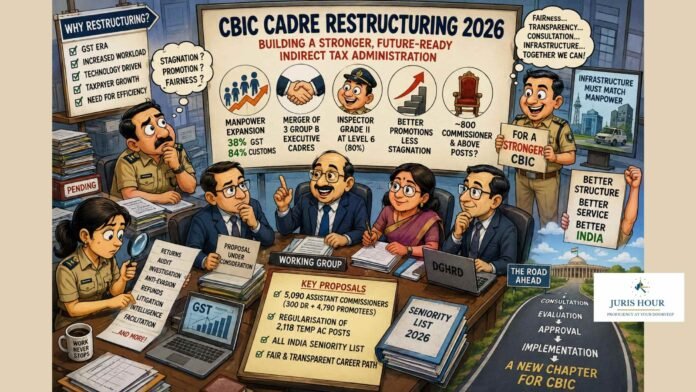
The Central Board of Indirect Taxes and Customs (CBIC) is in the midst of a long-awaited cadre restructuring exercise that could significantly reshape the organisational structure, manpower deployment and promotional architecture of India’s indirect tax administration.
The exercise assumes particular importance because the existing CBIC structure largely flows from the cadre restructuring approved in 2013 and the subsequent reorganisation of Central Excise, GST and Customs formations. The transition to GST from July 1, 2017 fundamentally changed the nature and volume of indirect-tax administration, but a comprehensive restructuring of the cadre has not yet been implemented on the scale contemplated by the current exercise.
As of August 18, 2026, the restructuring proposal is still under consideration and has not been publicly notified as a final Cabinet-approved restructuring order. Several details currently circulating among officers and associations originate from presentations and representations concerning the proposal and should therefore be distinguished from formally notified Government decisions.
Buy Now: Recovery Of Tax Dues And Penalty Against Legal Heirs Of A Deceased Assessee : Case Compilation
Why the 2026 Exercise Matters
CBIC’s Human Resource Development structure itself recognises cadre review and restructuring as a core function. DGHRD is tasked with supporting CBIC in its cadre review and restructuring exercise in response to changing economic conditions and departmental requirements.
The need for a fresh exercise has become particularly pronounced after GST. The introduction of GST resulted in a fundamental shift from the earlier Central Excise and Service Tax administration to a technology-driven system involving registration, return scrutiny, risk-based assessment, audit, investigation, intelligence, refund processing and coordination with State GST authorities.
The existing cadre structure, however, continues to carry significant elements of the pre-GST architecture. Associations representing officers have argued that manpower distribution, promotional avenues and cadre structures must now be aligned with the workload generated by GST and modern Customs administration.
The Department of Personnel and Training has historically treated cadre review as an exercise intended to maintain a balance between organisational requirements and legitimate career aspirations, with an ideal periodicity of five years.
The Historical Background: 2013 Restructuring
The last major CBEC cadre restructuring was approved by the Union Cabinet in December 2013. The Ministry of Finance’s Annual Report records that the Cabinet approved the plan on December 5, 2013, with the reorganised field structure subsequently operationalised from October 15, 2014.
The 2013 restructuring was substantial. The sanctioned strength of the then Central Board of Excise & Customs increased from 66,808 posts to 84,875 posts, representing creation of 18,067 additional posts.
Among the important changes were substantial increases in the strength of Superintendents and Inspectors. The 2013 restructuring increased the sanctioned strength of Superintendents from 13,948 to 19,108 and Inspectors from 20,163 to 25,203.
The restructuring also involved changes at senior Group A levels and provided for 2,118 temporary Assistant Commissioner posts, a feature that subsequently became an important issue in the Department’s human-resource management.
The subsequent implementation of GST in 2017 and the Customs reorganisation in 2018 altered the operational environment considerably. CBIC’s own records continue to list the 2017 cadre restructuring/reorganisation orders and the 2018 allocation of revised cadre strength among the reorganised formations.
Why a Fresh Restructuring Became Necessary
The central argument behind the current exercise is that the CBIC of 2026 is substantially different from the CBEC of 2013.
GST has created an integrated indirect-tax framework covering a much wider taxpayer base and involving extensive digital compliance. At the same time, Customs administration has become increasingly technology-driven and risk-based, with trade facilitation, data analytics, non-intrusive inspection, anti-smuggling activity and international supply-chain management assuming greater importance.
The existing manpower structure therefore has to answer several questions:
- How many officers are required at each level?
- How should manpower be distributed between GST and Customs?
- Should existing Group B executive cadres continue as separate streams?
- How should promotional avenues be structured?
- What should be the relationship between direct recruits and promotee officers?
- How should the cadre deal with long-standing stagnation?
- Should there be an integrated All India seniority structure?
- How should field formations, directorates and headquarters be staffed?
- What number of senior Group A posts is functionally justified?
These questions are at the centre of the 2026 debate.
Working Group and the Current Proposal
The restructuring process has involved examination of the existing manpower architecture and consideration of changes in cadre composition.
The CBIC’s official DGHRD website, however, has not yet published a final 2026 restructuring order. Its dedicated online cadre-restructuring page currently prominently displays the older “Creation of Working Group for CR 2018” entry dated July 9, 2018.
At the same time, officer associations have reported that a new Working Group has examined the restructuring proposal and that its report has been submitted for consideration.
In June 2026, the All India Association of Superintendents of Central Tax said that CBIC had constituted a Working Group to examine different aspects of cadre restructuring and submit recommendations. The association sought disclosure of the Working Group’s report and the proposal being examined by DGHRD before finalisation.
This is significant because it indicates that the process had moved beyond a purely conceptual exercise by mid-2026, but had not yet reached the stage of a publicly available final restructuring notification.
Major Proposed Change: Inspector Grade II
One of the most consequential proposals reportedly placed before officer associations concerns the direct recruitment level of Inspectors.
According to a June 2026 presentation reported by the All India Association of Central Excise Gazetted Executive Officers, the proposal contemplated direct recruitment of Inspector Grade II at Pay Level 6 instead of Level 7, with an indication that 80% of direct recruitment could be at Level 6 and 20% at Level 7.
The proposal has generated opposition from associations that contend that placing the entry-level Inspector cadre at a lower level could adversely affect pay progression and service conditions when compared with comparable Central Government services.
The precise position cannot yet be treated as final because the reported proposal remains subject to consideration and consultation.
Proposed Merger of Three Group B Executive Streams
Another potentially transformative proposal concerns the existing division of the executive Group B structure.
At present, the Inspector-level Customs and GST/Central Excise streams have developed into separate functional cadres, including:
- Central Excise/CGST Inspectors;
- Preventive Officers in Customs; and
- Examiners in Customs.
Officer associations have long argued that this fragmentation creates disparities in career progression despite officers entering through comparable recruitment channels.
The 2026 proposal reportedly contemplates merger of the three Group B executive cadres into a unified structure with an All India Seniority List.
If ultimately implemented, this could be among the most important structural changes in the restructuring exercise.
It could potentially affect recruitment, seniority, transfer, promotion and the feeder structure for Group A posts.
The Stagnation Issue
Career stagnation has emerged as one of the principal arguments advanced by associations supporting an early restructuring.
The All India Association of Superintendents of Central Tax has said that officers in the Superintendent cadre have faced prolonged stagnation despite increasing responsibilities under GST. In July 2026, the association sought intervention for early implementation of cadre restructuring, specifically citing stagnation and inter-cadre disparities.
The association has also highlighted differences in promotional progression between Central Excise/CGST officers and Customs Examiner and Preventive Officer streams.
The issue is not merely administrative. The design of the feeder cadres directly affects the availability of vacancies for promotion to Assistant Commissioner and higher Group A positions.
Inspector-to-Superintendent Promotion
Another reported proposal concerns the qualifying service required for promotion from Inspector to Superintendent.
According to the presentation reported in June 2026, the proposal contemplated increasing the qualifying service from two years to four years.
Officer associations have opposed the proposed increase and argued that it could further delay career progression.
This issue is likely to become one of the most closely watched aspects of the final restructuring because the Superintendent cadre represents a critical operational layer in GST and Central Excise administration.
The Four-Year Time-Scale Issue
The proposal reportedly also examined the existing four-year time-scale progression available after appointment as Superintendent.
One version presented to the associations reportedly contemplated replacing the automatic four-year progression with a vacancy-based promotional structure involving a proposed Senior Superintendent level at Level 9. The association said that this could make progression dependent upon a Departmental Promotion Committee rather than an automatic time-scale mechanism.
However, the association subsequently recorded that assurances had been given that the existing four-year time-scale would continue and that the proposed Senior Superintendent post would not necessarily be created.
This demonstrates why the reported presentation must not be confused with a final Government decision.
Major Expansion in GST and Customs Manpower
Perhaps the most striking feature of the reported proposal is the proposed increase in manpower.
According to the presentation made to an officer association in June 2026, the proposal envisaged:
38% manpower enhancement for GST formations
and
84% manpower enhancement for Customs formations.
If ultimately approved, these increases would represent a significant recognition of the expanded workload of both GST and Customs administration.
However, the exact absolute number of posts, their grade-wise distribution and their formation-wise allocation would have to be established through the final Government-sanctioned proposal.
Associations have nevertheless argued that the proposed GST enhancement may still be inadequate in view of the taxpayer workload and the range of functions now expected to be performed by GST formations.
Proposed Strength of Assistant Commissioners
The reported proposal also contains a significant provision concerning the Assistant Commissioner cadre.
According to the June 2026 presentation, the proposed strength was stated to be 5,090 Assistant Commissioners, comprising approximately 300 direct recruits and 4,790 promotee officers. It also reportedly contemplated regularisation of 2,118 existing temporary Assistant Commissioner posts as part of a separate Branch B service.
The 2,118-post issue has a historical background. CBIC records show that continuation of these temporary Assistant Commissioner posts has been dealt with separately over the years.
Regularisation of these posts, if finally approved, could have substantial implications for promotion from the Superintendent cadre and for the long-term Group A structure.
Proposed Separate Service for Promotee Officers
The proposal reportedly also contemplated a separate service arrangement for officers promoted into Group A from the existing departmental feeder cadres.
According to the association account, promotee Assistant Commissioners would reportedly require five years of qualifying service for promotion to Deputy Commissioner, while direct recruits would have a different progression mechanism. The reported proposal also mentioned a 22% promotional quota for promotee Assistant Commissioners to Deputy Commissioner.
Officer associations have raised concerns about this structure, particularly regarding the difference between the promotional prospects of direct recruits and promotee officers.
This aspect will therefore require careful scrutiny when the final proposal is released.
Around 800 Commissioner-Level and Above Posts Reportedly Proposed
Another controversial aspect is the reported expansion of senior Group A posts.
According to the June 2026 presentation reported by an officer association, the proposal could result in approximately 800 Commissioner and above posts.
Associations have questioned whether such an expansion is functionally justified, particularly in GST formations.
This is one area where the final workload study and Government-approved structure will be critical. A cadre review is expected to be based not merely on promotional aspirations but also on functional workload, organisational requirements, financial implications and administrative efficiency.
The Debate Over GST’s Organisational Structure
One of the larger questions behind the restructuring is how far the hierarchy in GST formations should extend.
Some associations have argued that revenue-related functions under GST do not justify an excessively tall hierarchy beyond the Additional Commissioner level. Others contend that increasing taxpayer numbers, audit requirements, intelligence functions, litigation, investigation, enforcement and specialised compliance functions require adequate senior-level supervision.
The final structure will therefore have to balance two competing objectives:
administrative efficiency and adequate manpower on one side, and avoidance of unnecessary hierarchical expansion on the other.
Infrastructure Must Accompany Manpower
The restructuring debate is not limited to sanctioned posts.
Officer associations have emphasised that additional manpower without corresponding infrastructure would not solve the operational problems faced by field formations.
The CBIC’s own HRD structure recognises the connection between manpower and infrastructure, while associations have specifically argued for additional infrastructure alongside manpower expansion.
The practical implementation of a large-scale restructuring would consequently require:
- office accommodation;
- residential facilities where required;
- vehicles and field infrastructure;
- IT systems;
- additional administrative staff;
- training capacity;
- appropriate supervisory structures; and
- allocation of posts to formations based on workload.
All India Seniority List: A Critical Parallel Issue
The cadre restructuring debate is also closely linked to the continuing work on All India Seniority Lists.
DGHRD’s official records show that 2026 has witnessed several orders and corrections relating to integrated seniority lists for different CBIC cadres, including Administrative Officers, Superintendents of Central Excise, Customs Appraisers and Customs Preventive Superintendents.
In April 2026, CBIC/DGHRD published final integrated All India Seniority Lists for Administrative Officers of Customs and Administrative Officers of CGST & Central Excise, including Directorates, for the relevant 2023–24 period.
The continuing seniority-list exercise is important because promotions to higher grades can depend upon finalisation of seniority.
The All India Association of Superintendents of Central Tax has specifically linked the seniority-list issue with the delayed Departmental Promotion Committee for promotion to Assistant Commissioner. In July 2026, the association referred to 1,588 vacancies in the Assistant Commissioner and Deputy Commissioner grades, most of which it described as promotional posts.
Chairman’s Assurance and Consultation Process
The consultation process gained further significance in June and July 2026.
In June, AIASCT stated that once the Working Committee submitted its report, associations would be invited for consultation.
In a July 15, 2026 update, the association reported that the CBIC Chairman informed its delegation that the Committee’s report was yet to be placed before him. The Chairman reportedly assured the delegation that after examining the report, the Board would consider the demands and hold a detailed discussion.
This provides the clearest indication of the status as of July 2026: the exercise had progressed to the stage of a Working Committee/High-Level Committee report, but the final proposal had not yet been formally issued.
The Transparency Debate
Transparency has become another major issue.
Officer associations have requested access to the Working Group report and the proposal under consideration so that they can examine the consequences for various cadres.
The AIASCT said in June that sharing the Working Group report and DGHRD proposal would enable informed discussion and allow field-level stakeholders to provide constructive inputs.
A separate association representing Central Excise gazetted executive officers has also raised objections to aspects of the proposal, particularly concerning Inspector pay level, promotion conditions, Group A structure and manpower allocation.
The consultation question is therefore likely to remain central until the proposal is finalised.
What Is Officially Confirmed as of August 18, 2026?
The available official material supports the following conclusions:
First, CBIC has an established institutional framework for cadre restructuring through DGHRD and the Department of Revenue.
Second, the previous major cadre restructuring was the 2013 exercise, followed by field reorganisation and allocation of revised cadre strength in subsequent years.
Third, the current restructuring process is active and has involved examination by a Working Group/Committee, according to 2026 representations and discussions reported by recognised officer associations.
Fourth, detailed features such as the proposed 38% GST and 84% Customs manpower increases, 5,090 Assistant Commissioners, 2,118-post regularisation, Inspector Grade II structure and proposed merger of three Group B executive cadres are presently best treated as reported elements of the proposal presented to associations, rather than final Government-approved provisions.
Fifth, as of August 18, 2026, there is no publicly available final CBIC cadre-restructuring notification on the official CBIC/DGHRD pages establishing that the entire reported proposal has received final Government or Cabinet approval. The official CBIC pages continue to maintain the historical cadre-restructuring material, while current 2026 HRD updates are heavily focused on seniority lists, DPC-related matters and personnel administration.
What Happens Next?
The next critical stages are likely to be examination of the Working Group report, consideration by CBIC/DGHRD, consultation with stakeholders, inter-ministerial/financial scrutiny where required, and approval by the competent authority.
If the proposal involves substantial creation of posts and significant changes to the organised Group A structure, the Government will also have to examine the financial and administrative implications before final approval.
Only after the competent authority approves the restructuring and formal orders are issued will the proposed figures and promotional structures acquire legal and administrative effect.
The final notification will therefore be more important than the presentations currently circulating among associations.
Likely Impact on Officers
If the reported proposal is substantially implemented, its effects could be wide-ranging.
For Inspectors, the entry pay level, recruitment pattern, qualifying service and integration of cadres could change.
For Superintendents, the restructuring could directly affect promotional avenues, seniority and the four-year time-scale.
For Assistant Commissioners, regularisation of temporary posts and expansion of sanctioned strength could significantly increase the number of available positions.
For Customs officers, the reported 84% manpower enhancement could lead to a substantial redistribution of posts across Customs formations.
For GST officers, the proposed 38% manpower increase could provide additional capacity, although associations are already arguing for a larger expansion.
For the Department, merger and integration of cadres could simplify cadre management but would also require careful handling of seniority, recruitment rules, promotions and inter-cadre rights.
The Larger Administrative Question
The 2026 CBIC cadre restructuring exercise is ultimately about more than creating posts.
It raises a fundamental question about what India’s indirect tax administration should look like nearly a decade after GST.
The 2013 structure was designed for a substantially different tax environment. The current system is characterised by digital compliance, automated return processing, risk-based scrutiny, analytics, e-invoicing, data matching, GST intelligence, Customs risk management and increasingly complex cross-border trade.
A successful restructuring must therefore accomplish two objectives simultaneously: give CBIC sufficient manpower to perform its expanding functions while creating a fair and sustainable career structure for its officers and staff.
The challenge will be to ensure that additional posts are created where workload actually exists, that field formations receive adequate supporting infrastructure, that promotion avenues are not unnecessarily restricted, and that the organisational hierarchy remains proportionate to functional requirements.
Conclusion
The CBIC cadre restructuring exercise has emerged as one of the most consequential human-resource reforms facing the indirect tax administration in 2026.
More than a decade after the 2013 restructuring and nearly nine years after GST fundamentally transformed indirect tax administration, the Department is examining a new architecture involving manpower expansion, possible cadre integration, changes in promotional structures, treatment of temporary Assistant Commissioner posts and redistribution of manpower between GST and Customs.
The reported proposal contains potentially far-reaching changes — including 38% additional manpower for GST, 84% for Customs, a reported 5,090 Assistant Commissioner structure, regularisation of 2,118 temporary Assistant Commissioner posts and merger of three Group B executive streams.
Yet these figures and structural features should, at this stage, be reported with an important qualification: they reflect the proposal discussed with associations and not a final notified cadre restructuring order.
The next decisive development will therefore be the formal consideration of the Working Group’s report, stakeholder consultation and eventual Government approval. Until that process concludes, the 2026 exercise remains a work in progress — but one that could fundamentally redefine the manpower and promotional architecture of CBIC for the next decade.
Status as of August 18, 2026: Proposal under consideration; no final comprehensive 2026 CBIC cadre-restructuring notification publicly identified on the official CBIC/DGHRD portals.
Read More: Aircraft Hiring Taxable as Supply of Tangible Goods: CESTAT

